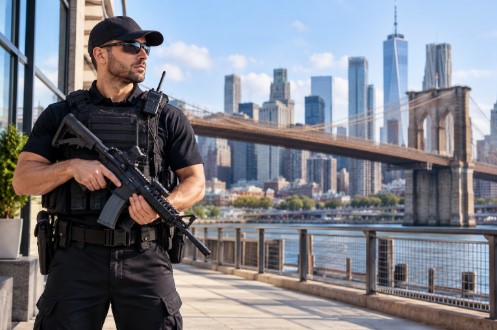
Businesses, residential properties, construction sites, events, and institutions can face security concerns that vary significantly depending on their location, operating hours, valuables on-site, and level of public access. In some environments, standard security measures may be sufficient. In others, a higher level of trained physical security may be considered as part of a broader risk-management plan.
Armed security guards in Brooklyn may be appropriate for locations where a professional security assessment identifies elevated risks that justify armed personnel. Their role can include maintaining a visible security presence, monitoring access points, observing suspicious activity, supporting emergency procedures, and helping protect people and property. Because armed security involves additional responsibility and regulation, businesses should evaluate their needs carefully before choosing this level of protection.
What Do Armed Security Guards Do?
The responsibilities of armed security guards in Brooklyn depend on the assignment, property, and security plan.
Typical duties can include controlling access, monitoring entrances, conducting patrols, observing surveillance systems, documenting incidents, and responding according to established procedures.
Their role is generally preventive and protective rather than simply reactive.
A visible security presence can help discourage certain types of unauthorized activity while providing staff, visitors, or residents with a clearly identifiable person to contact when a concern arises.
When Might Armed Security Be Appropriate?
Not every property requires armed personnel.
The decision should be based on a realistic assessment of potential risks rather than assumptions about a neighborhood or business type.
Armed security may be considered for environments involving:
- High-value inventory or assets
- Sensitive facilities
- Cash-intensive operations
- Restricted-access areas
- Elevated security threats
- High-profile individuals or events
- Locations with documented security incidents
The level of security should remain proportionate to the actual risk.
Why Is a Security Assessment Important?
A professional security assessment can identify vulnerabilities before a security program is developed.
This may involve examining:
- Entrances and exits
- Lighting
- Surveillance coverage
- Visitor procedures
- Existing alarm systems
- Employee access
- Parking areas
- Emergency procedures
A business considering armed security guards in Brooklyn should understand why armed personnel are being proposed and what specific risks they are intended to address.
Adding personnel without a clear security strategy can result in unnecessary cost without solving underlying weaknesses.
What Training Should Armed Guards Have?
Armed security requires additional training and responsibility beyond basic observation duties.
Relevant training may cover areas such as:
- Applicable laws and regulations
- Firearm handling
- De-escalation
- Emergency response
- Communication
- Incident reporting
- Access control
- Situational awareness
- Use-of-force policies
Specific licensing and training requirements vary by jurisdiction.
Organizations should verify that any security provider and assigned personnel meet applicable New York licensing and regulatory requirements.
Why Is De-Escalation Important?
One of the most important security skills is knowing how to prevent a situation from becoming more serious.
Guards may encounter disputes, unauthorized visitors, frustrated customers, or individuals behaving unpredictably.
Strong communication can sometimes resolve these situations without further escalation.
Professional armed security guards in Brooklyn should understand that carrying a firearm does not replace judgment, communication, or conflict-management skills.
In many situations, prevention and de-escalation are the preferred outcomes.
How Does Access Control Improve Security?
Access control determines who can enter specific areas and under what conditions.
A guard may verify:
- Employee credentials
- Visitor identification
- Delivery information
- Vendor access
- Appointment details
- Authorized vehicle entry
Consistent procedures help prevent unauthorized individuals from entering restricted areas.
Access control can also create a record of who entered or left a property, which may be useful when reviewing incidents.
Why Are Patrols Important?
Patrols help security personnel observe parts of a property that cannot be monitored continuously from one location.
Depending on the site, patrol routes might include:
- Parking lots
- Building exteriors
- Loading areas
- Stairwells
- Common areas
- Storage spaces
- Perimeter boundaries
The presence of armed security guards in Brooklyn may be more effective when personnel actively monitor the assigned environment rather than remaining at a single post throughout the shift.
Patrol procedures should be designed around identified risks.
Can Security Guards Monitor Cameras?
Yes, security personnel may be assigned to observe surveillance systems as part of their duties.
Camera monitoring can help guards identify unusual activity before it reaches a staffed entrance or another sensitive area.
However, cameras and personnel serve different purposes.
Cameras provide visibility and recorded evidence, while guards can assess situations and respond according to established procedures.
Combining technology with trained personnel can create a more complete security system.
What Is the Role of Incident Reporting?
Accurate documentation is an important part of professional security.
Incident reports may include:
- Time and location
- Individuals involved
- Observed behavior
- Actions taken
- Witness information
- Relevant camera locations
- Notifications made
Reports help property managers and organizations identify repeated problems and evaluate whether existing security procedures are effective.
Clear documentation can also help create continuity between security shifts.
How Does Security Differ for Residential Properties?
Residential environments require a balance between security and everyday accessibility.
Apartment buildings, gated communities, and residential complexes may need guards to monitor visitors, parking areas, entrances, or common spaces.
Residents generally expect security personnel to remain professional and approachable while consistently enforcing property procedures.
If armed security guards in Brooklyn are used in a residential setting, their responsibilities and authority should be clearly defined so residents and property staff understand the security process.
What About Retail and Commercial Properties?
Retail and commercial environments may experience concerns involving unauthorized access, theft, disturbances, or after-hours property protection.
Security personnel may be positioned near entrances or other high-visibility locations while conducting periodic patrols throughout the property.
Their role should complement other measures such as:
- Surveillance cameras
- Alarm systems
- Employee procedures
- Lighting
- Controlled access
Physical security generally works best as part of a layered system rather than as a standalone solution.
How Can Construction Sites Benefit From Security?
Construction sites can contain expensive machinery, tools, materials, and equipment.
They may also have multiple entry points and limited activity after working hours.
Potential concerns include:
- Theft
- Trespassing
- Vandalism
- Unauthorized vehicle access
- Entry into hazardous areas
Security personnel can monitor site access and conduct patrols during periods when construction crews are absent.
Whether armed personnel are necessary should depend on the site’s specific risk profile.
Are Armed Guards Suitable for Events?
Some events may require enhanced security because of their size, location, attendees, or identified risks.
Event security planning may involve:
- Entrance screening
- Credential verification
- Crowd observation
- Restricted-area monitoring
- Emergency coordination
- Vehicle access management
Armed security guards in Brooklyn may be included in some higher-risk security plans, but the decision should be based on professional risk assessment and applicable event requirements.
A clearly defined chain of command is particularly important when several security teams or agencies are involved.
How Should Businesses Select a Security Provider?
Organizations should evaluate more than hourly pricing.
Important considerations include:
- Licensing
- Insurance
- Guard screening
- Training requirements
- Supervisory procedures
- Incident documentation
- Communication systems
- Experience with similar properties
- Scheduling reliability
Businesses should also ask how guards are matched to assignments.
A security professional working at a corporate building may need a different approach from someone assigned to a construction site or event.
Why Does Communication With Property Management Matter?
Security personnel need clear instructions from property owners and managers.
Important information may include:
- Authorized access lists
- Restricted areas
- Emergency contacts
- Opening and closing procedures
- Delivery schedules
- Known security concerns
- Escalation procedures
Without clear communication, even experienced armed security guards in Brooklyn may have difficulty applying site-specific rules consistently.
Regular reviews can help keep procedures aligned with changing conditions.
Can Technology Replace Security Guards?
Technology can strengthen security but cannot perform every function of trained personnel.
Cameras can record activity, alarms can detect specific events, and access-control systems can restrict entry.
However, technology cannot independently handle every interaction that occurs on a property.
A well-designed security plan may combine:
- Cameras
- Alarms
- Lighting
- Electronic access controls
- Communication systems
- Trained personnel
The appropriate combination depends on the site’s risks and operating environment.
How Often Should a Security Plan Be Reviewed?
Security needs can change over time.
A property may gain new tenants, change operating hours, renovate entrances, experience new incidents, or introduce different access procedures.
Periodic reviews help determine whether staffing and security measures still match current conditions.
For organizations using armed security guards in Brooklyn, reviewing incident patterns and guard reports can also reveal areas where procedures or coverage should be adjusted.
Conclusion
Armed security should be treated as one part of a broader protection strategy rather than as an automatic solution for every property. Effective security begins with understanding actual risks, identifying vulnerable areas, establishing clear procedures, and choosing appropriately trained personnel. Organizations considering armed security guards in Brooklyn should evaluate licensing, training, supervision, communication, site requirements, and the specific risks that justify armed coverage. In some environments, on site security guards can also support a layered approach by maintaining a consistent physical presence, monitoring activity, and helping enforce established access and safety procedures. A security program based on documented needs and regularly reviewed procedures can provide a more practical foundation for protecting people, property, and day-to-day operations.