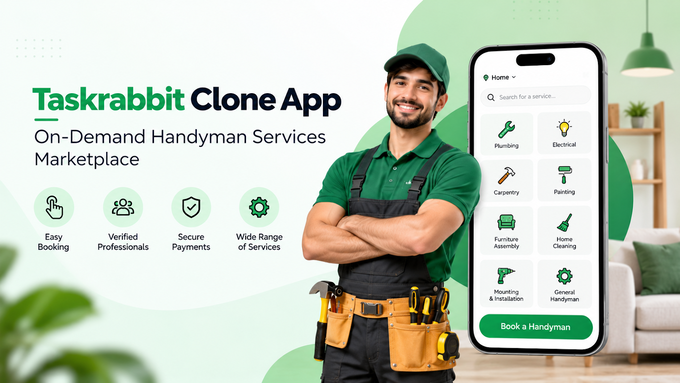
Finding reliable help for home repairs, cleaning, moving, assembly, and everyday tasks has become easier through on-demand service platforms. A Taskrabbit Clone App On-Demand Handyman Services Marketplace connects customers with skilled local professionals through a convenient mobile and web experience. Instead of searching directories, making repeated phone calls, or waiting days for a response, users can describe a task, compare service providers, book a time, and pay through one platform.
For entrepreneurs, this marketplace model creates an opportunity to build a scalable local services business. A well-designed Taskrabbit clone app can serve homeowners, renters, offices, property managers, and independent workers. However, success depends on more than copying a familiar interface. The product must solve trust, availability, pricing, communication, payment, and service quality challenges from the start.
What Is a Taskrabbit Clone App?
A Taskrabbit clone app is a ready-to-customize digital platform inspired by the core marketplace model used by Taskrabbit. It typically includes separate experiences for customers, service providers, and administrators. Customers post or select a task, professionals discover suitable jobs, and administrators manage users, transactions, disputes, categories, and platform policies.
The app can support a broad selection of services, including furniture assembly, appliance installation, home repairs, painting, plumbing support, electrical assistance, moving help, cleaning, yard work, mounting, delivery, and office maintenance. Businesses can launch with a focused category, such as handyman services, and expand as demand increases.
A clone app is not necessarily a basic copy. It is a foundation that can be branded, localized, and adapted to a specific market. The owner can define commission rates, service categories, booking rules, coverage areas, worker verification requirements, and customer support workflows. This approach can reduce development time while allowing the business to create a distinct customer experience.
How the On-Demand Handyman Marketplace Works
The customer journey usually begins with a service search. A user selects a category, enters a task description, uploads photos if necessary, and provides a location and preferred schedule. The app then displays relevant professionals based on skills, distance, availability, ratings, response time, and price.
Depending on the marketplace model, customers may choose a fixed service package, request quotes, or receive offers from multiple providers. For simple tasks, fixed pricing can make booking fast and predictable. For complex repairs, quote-based booking may be more practical because the final cost can depend on materials, labor time, and the condition of the property.
After selecting a professional, the customer confirms the appointment and pays through the platform or authorizes a payment method. Both parties receive booking details and can communicate through in-app messaging. Once the job is complete, the customer confirms delivery, leaves a rating, and receives a digital receipt. The platform can then release payment to the provider after deducting its commission or applicable fees.
Essential Features for Customers
A strong customer app must make service discovery and booking simple. Registration should support email, phone, and social login options, while profiles should allow users to save addresses, payment methods, and frequently used services. Clear categories and search filters help users find the right professional without navigating a confusing interface.
The task request form is one of the most important parts of the product. It should collect the service type, description, location, preferred date, expected duration, and relevant photos or videos. Smart prompts can help customers provide enough detail for providers to estimate the job accurately and avoid misunderstandings after booking.
Customers should also be able to compare provider profiles. Useful information includes skills, certifications, completed jobs, ratings, reviews, pricing model, service radius, and availability. Showing verified identity badges and insurance information can improve confidence, particularly for work inside a customer’s home.
Other important customer features include
– Real-time booking status and appointment reminders
– In-app chat and photo sharing
– Secure online payments and digital invoices
– Rescheduling and cancellation requests
– Service history and repeat booking
– Ratings, reviews, and issue reporting
– Location sharing or arrival tracking where appropriate
The interface should also be accessible for people who are not highly comfortable with technology. Simple language, visible calls to action, readable text, and clear confirmation screens can reduce booking errors and support a wider audience.
Essential Features for Handyman Professionals
The provider side of the marketplace should help skilled workers manage their business, not just receive job alerts. Professionals need to create a detailed profile with their service categories, work history, operating area, rates, availability, certifications, and photos of previous projects. A complete profile can improve customer confidence and increase booking conversions.
Providers should be able to accept, reject, or negotiate requests based on their schedule and expertise. A calendar with blocked time, recurring availability, and travel buffers helps prevent double bookings. Push notifications are useful for new requests, appointment changes, customer messages, and payment updates, but the platform should avoid excessive alerts that lead to notification fatigue.
A provider dashboard can display upcoming jobs, earnings, completed tasks, customer ratings, cancellation history, and tax or payout information. Professionals may also need tools for uploading receipts, adding material charges, documenting completed work, and requesting approval for changes to the original scope.
Flexible payment support is important because many service providers depend on regular cash flow. The app can offer scheduled payouts, instant payout options, transaction histories, and transparent fee explanations. Showing exactly how commissions and processing charges affect earnings helps build trust between the platform and its provider community.
Admin Panel and Marketplace Management
The admin panel is the control center for the marketplace. Administrators should be able to manage customer and provider accounts, approve documents, create service categories, adjust commission settings, monitor bookings, and review reported incidents. Role-based permissions can limit sensitive functions to authorized team members.
Provider verification deserves special attention. Depending on the service category and local regulations, the platform may need identity checks, background screening, licenses, insurance documentation, or proof of experience. Verification rules should be clearly communicated and consistently applied. A badge should represent a meaningful review process rather than a superficial profile label.
The admin team also needs operational tools for dispute resolution. These may include booking records, chat history, uploaded photos, payment details, cancellation timelines, and review activity. A structured support workflow can help staff respond consistently when a customer reports property damage, poor workmanship, lateness, or an incomplete task.
Analytics provide another essential function. Marketplace owners can track booking volume, gross transaction value, average order size, repeat bookings, customer acquisition cost, provider acceptance rate, cancellation rate, and service quality scores. These insights help identify which categories are profitable and where the user experience needs improvement.
Revenue Models for a Handyman Services Marketplace
The most common revenue model is a commission on each completed booking. The platform may charge the provider, the customer, or both parties. A transparent commission structure is usually easier to explain and forecast than a complicated collection of hidden fees.
A service fee can be added to the customer invoice to cover platform operations, payment processing, customer support, and trust and safety measures. Some businesses use a combination of provider commission and customer service fee, but the total price should remain competitive with local alternatives.
Other revenue opportunities include provider subscription plans, promoted listings, lead fees, business accounts, and partnerships with property managers or real estate companies. A subscription could provide lower commissions, advanced analytics, priority support, or increased visibility in search results. Promoted listings should be labeled clearly so customers can distinguish advertising from organic ranking.
A marketplace should avoid prioritizing short-term monetization over service quality. If high fees reduce provider earnings or make prices unattractive to customers, supply and demand may both decline. Pricing experiments should be measured against booking conversion, repeat usage, provider retention, and customer satisfaction.
Trust, Safety, and Service Quality
Trust is the foundation of any handyman services marketplace. Customers invite providers into private spaces, while professionals rely on unfamiliar customers to provide accurate information and safe working conditions. The app should establish expectations for both sides before a booking is confirmed.
Useful trust and safety measures include identity verification, background checks where legally appropriate, secure messaging, payment protection, verified reviews, emergency support, and clear cancellation policies. The platform can also provide guidance for customers on preparing a workspace and for providers on documenting the condition of property before beginning a job.
Ratings should be designed carefully. A simple star score may not explain whether a problem involved punctuality, communication, workmanship, or price. Category-based feedback can produce more useful quality signals. The platform should also monitor unusual review patterns, fraudulent accounts, repeated complaints, and suspicious booking behavior.
Insurance and liability policies should be reviewed with qualified legal and insurance professionals before launch. The marketplace must clearly explain whether it acts as a technology platform, a service provider, or an employer in its operating jurisdiction. Local labor, tax, consumer protection, and licensing requirements can affect the product design and business model.
Technology and User Experience Considerations
A reliable Taskrabbit clone app normally includes mobile applications or responsive web experiences for customers and providers, plus a web-based admin dashboard. A scalable backend should manage authentication, profiles, service listings, bookings, messaging, payments, notifications, reviews, and reporting.
Location technology supports provider discovery, service area validation, travel estimates, and arrival updates. Payment integration should use a reputable gateway that supports marketplace payouts, refunds, authorization, and compliance requirements. Real-time communication may use push notifications and in-app chat, while cloud infrastructure can support growth across cities and categories.
The first version should focus on a clear minimum viable product. Core functionality may include registration, provider profiles, task requests, availability, booking, messaging, payments, reviews, and basic administration. Advanced features such as artificial intelligence estimates, live map tracking, dynamic pricing, and subscription packages can be added after real user behavior reveals a genuine need.
Performance and privacy should be planned from the beginning. The app may process addresses, phone numbers, payment information, identity records, and photos of private property. Strong access controls, encryption, secure data storage, audit logs, and a clear privacy policy are essential for protecting users and maintaining credibility.
Launch Strategy and Growth Opportunities
Launching in one city or service area is often more effective than attempting national coverage immediately. A focused launch allows the business to build sufficient provider density, test pricing, improve support procedures, and gather local reviews. A marketplace with a smaller service radius can usually provide faster arrivals and better matching than a widely dispersed network.
Early growth can come from partnerships with apartment communities, real estate agencies, offices, relocation companies, hardware retailers, and property management firms. Referral programs can encourage existing customers and providers to invite new users. Local search optimization, neighborhood campaigns, useful repair content, and targeted advertising can also increase awareness.
The most important growth metrics include completed bookings, repeat customer rate, provider utilization, average response time, fill rate, cancellation rate, contribution margin, and complaint resolution time. Tracking these measures helps the owner understand whether growth is creating a healthy marketplace or simply increasing operational complexity.
Conclusion
A Taskrabbit Clone App On-Demand Handyman Services Marketplace can bring convenience to customers while creating a flexible source of work for local professionals. Its value depends on smooth booking, accurate matching, secure payments, strong provider tools, and credible trust and safety processes.
Businesses planning this type of platform should treat the clone app as a customizable foundation rather than a finished strategy. Start with a focused market, validate demand, build a dependable minimum viable product, and use marketplace data to guide expansion. With thoughtful operations and a customer-centered experience, an on-demand handyman marketplace can develop into a reliable digital services brand.
Frequently Asked Questions (FAQs)
1. What Is a Taskrabbit Clone App for On-Demand Handyman Services?
A Taskrabbit clone app is a ready-made solution for launching an on-demand handyman services marketplace where customers can book professionals for home repairs, plumbing, electrical work, furniture assembly, and other household tasks.
2. How Does an On-Demand Handyman Services Marketplace App Work?
An on-demand handyman marketplace connects customers with local service providers, enabling them to browse services, compare profiles, schedule bookings, make payments, and review professionals through a single platform.
3. How Much Does It Cost to Develop a Taskrabbit Clone App?
The cost of developing a Taskrabbit clone app depends on its features, customization, platform, and integrations. A ready-made solution can help reduce development time and initial investment.
4. What Features Should a Taskrabbit Clone App Include?
A Taskrabbit clone app should include service listings, location-based search, provider profiles, online booking, secure payments, ratings and reviews, notifications, in-app chat, and an admin dashboard for efficient marketplace management.
5. Why Should Entrepreneurs Invest in a Taskrabbit Clone App?
Investing in a Taskrabbit clone app enables entrepreneurs to tap into the growing on-demand home services market with a scalable digital platform. It simplifies service bookings, connects customers with local professionals, and supports business growth through flexible features, streamlined operations, and multiple revenue opportunities.