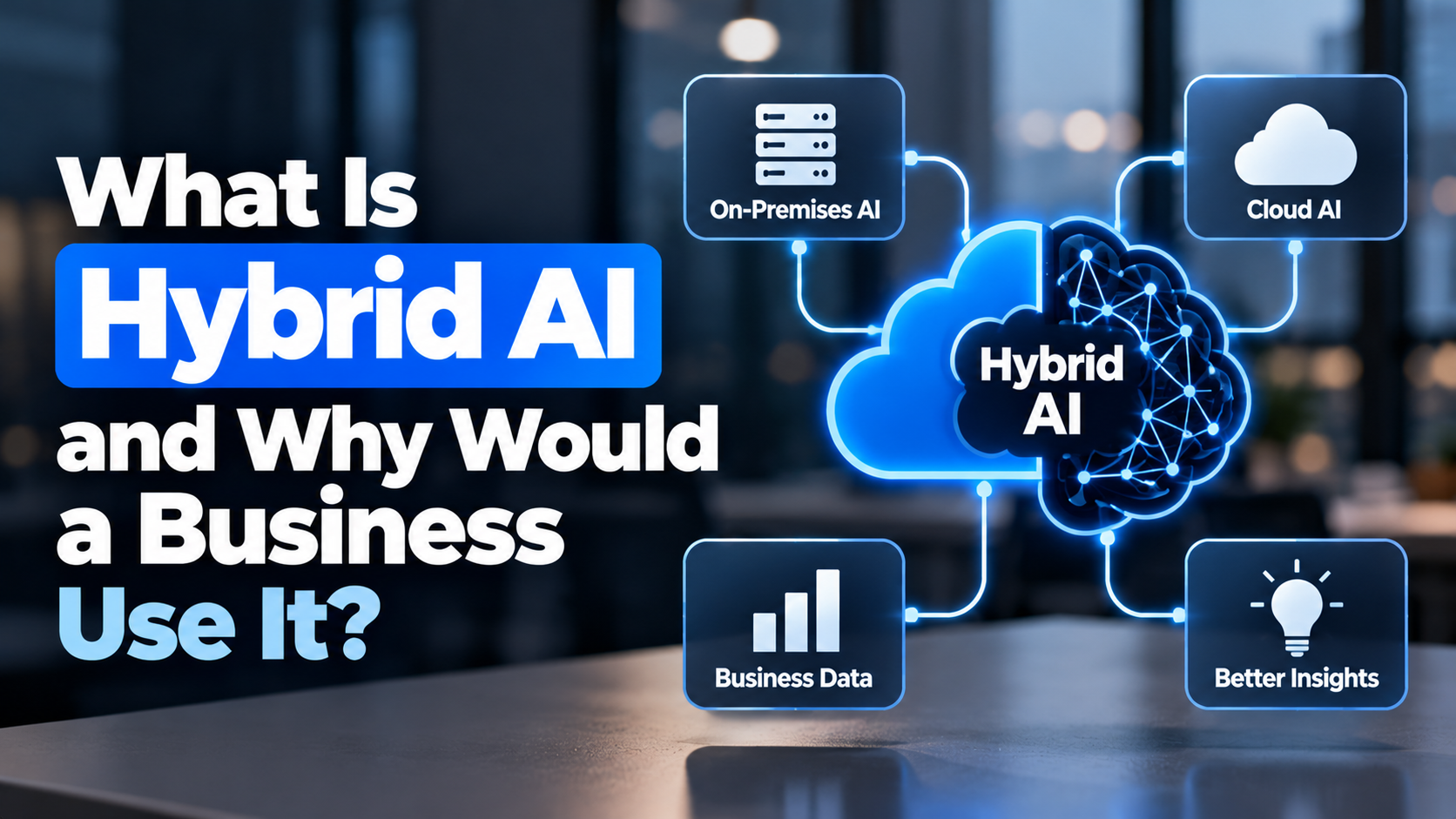
Hybrid AI combines different types of artificial intelligence (AI) to help businesses solve problems more effectively. It can bring together AI that learns from data, systems that follow set rules, and computing resources that work in the cloud or on local servers. This mix helps companies balance speed, cost, privacy, and accuracy.
AI is already changing how companies work. According to Gartner, worldwide AI spending is forecast to total $2.7 trillion in 2026, a 49.5% increase year-over-year. It shows how much businesses are investing in this technology.
However, not every AI system works best on its own. Some tasks need fast answers, while others need careful checks or strong data protection. Hybrid AI helps businesses handle these different needs. It gives teams more ways to use AI in daily work without depending on a single method.
Read on to understand what hybrid AI is and how it helps businesses.
How Does Hybrid AI Work in Real Business Settings?
Hybrid AI works by giving each task to the right system. One system may study past sales, while another checks company rules before approving a result. A business can also combine local servers with cloud services to run AI where it works best.
For example, a retailer could use AI to predict product demand. It could then apply set rules to check stock levels and send alerts when supplies run low.
Hybrid AI can combine three main elements:
- Machine learning: Finds patterns in data and makes predictions.
- Rule-based systems: Follow clear instructions and business policies.
- Hybrid infrastructure: Combines local computing resources with cloud services.
These elements help businesses build AI systems that fit their needs instead of relying on one tool for every task.
Why Are Businesses Turning to Hybrid AI?
Businesses need AI that delivers useful results without adding too much cost or risk. Hybrid AI offers several ways to meet these needs.
1. Keep Sensitive Data More Secure
Some businesses handle private customer records, payment details, or company secrets. They may prefer to process this information on their own systems instead of sending everything to the cloud.
Hybrid AI lets companies keep selected data on local servers while using cloud resources for other tasks. However, businesses must still apply access controls, encryption, and security checks.
2. Get Faster Results When Time Matters
Some AI tasks need quick answers. For example, a factory may need to detect a faulty product while it moves along a production line. Processing data near the machine can reduce delays. The company can then send selected information to the cloud for deeper analysis.
3. Manage Costs as AI Needs Grow
Running large AI models can require powerful processors, storage, and energy. Hybrid AI helps businesses choose where each task should run.
They can use local servers for regular workloads and cloud resources when demand rises. This approach may reduce waste, although the actual savings depend on usage, hardware, and cloud fees.
Where Can Hybrid AI Make a Difference?
Hybrid AI can support many everyday business activities. Its value depends on choosing the right use case.
- Healthcare: Help analyze medical images while keeping sensitive records under strict controls.
- Retail: Predict demand, track stock, and improve product recommendations.
- Manufacturing: Spot equipment problems and identify product defects.
- Banking: Flag unusual transactions and apply rules to review possible fraud.
- Customer service: Answer common questions while sending complex cases to human staff.
According to McKinsey’s 2025 State of AI survey, 88% of respondents said their organizations used AI in at least one business function. Yet many companies were still testing or piloting AI rather than scaling it across the business. This shows why firms need practical systems that fit real work.
What Technology Does Hybrid AI Need?
Hybrid AI needs more than a smart model. Businesses also need reliable systems to store data, run AI tasks, and protect information.
Choose Servers That Match the Workload
AI servers handle demanding tasks such as training models and running AI predictions. Systems with suitable processors, graphics processing units (GPUs), memory, and storage can support these workloads.
For example, Lenovo offers ThinkSystem and ThinkEdge server families for different computing needs. Businesses can review its AI server solutions to understand how AI infrastructure can support work across data centers and edge locations.
The right choice depends on model size, response speed, data needs, power limits, and future growth.
Connect Local Systems With Cloud Resources
Local servers can process data close to where it is created. Cloud services can provide extra computing power when demand increases.
To make this setup work, businesses should plan for:
- Reliable network connections between systems.
- Clear rules for moving and storing data.
- Tools to monitor performance and spending.
- Security checks across all connected environments.
Good planning helps teams avoid slowdowns, unexpected costs, and data risks.
What Should a Business Check Before Adopting Hybrid AI?
Hybrid AI is not the right answer for every company. Before investing, leaders should define the problem they want AI to solve.
Start with these steps:
- Set a clear goal: Choose a task that needs faster work, better predictions, or less manual effort.
- Review your data: Check its quality, location, privacy needs, and access rules.
- Compare costs: Include hardware, cloud use, maintenance, and staff training.
- Run a small test: Measure accuracy, speed, security, and business value before expanding.
- Keep people involved: Let employees review important decisions and correct mistakes.
A small, well-planned project can teach a business what works before it commits to a larger system.
Conclusion
Hybrid AI helps businesses combine different AI methods and computing environments to solve problems in practical ways. It can support faster decisions, better data control, and flexible computing when companies match each task to the right resources.
However, success depends on more than technology. Businesses need clear goals, good data, strong security, and regular checks. By starting with one useful task and measuring the results, companies can build a hybrid AI strategy that grows with their needs.