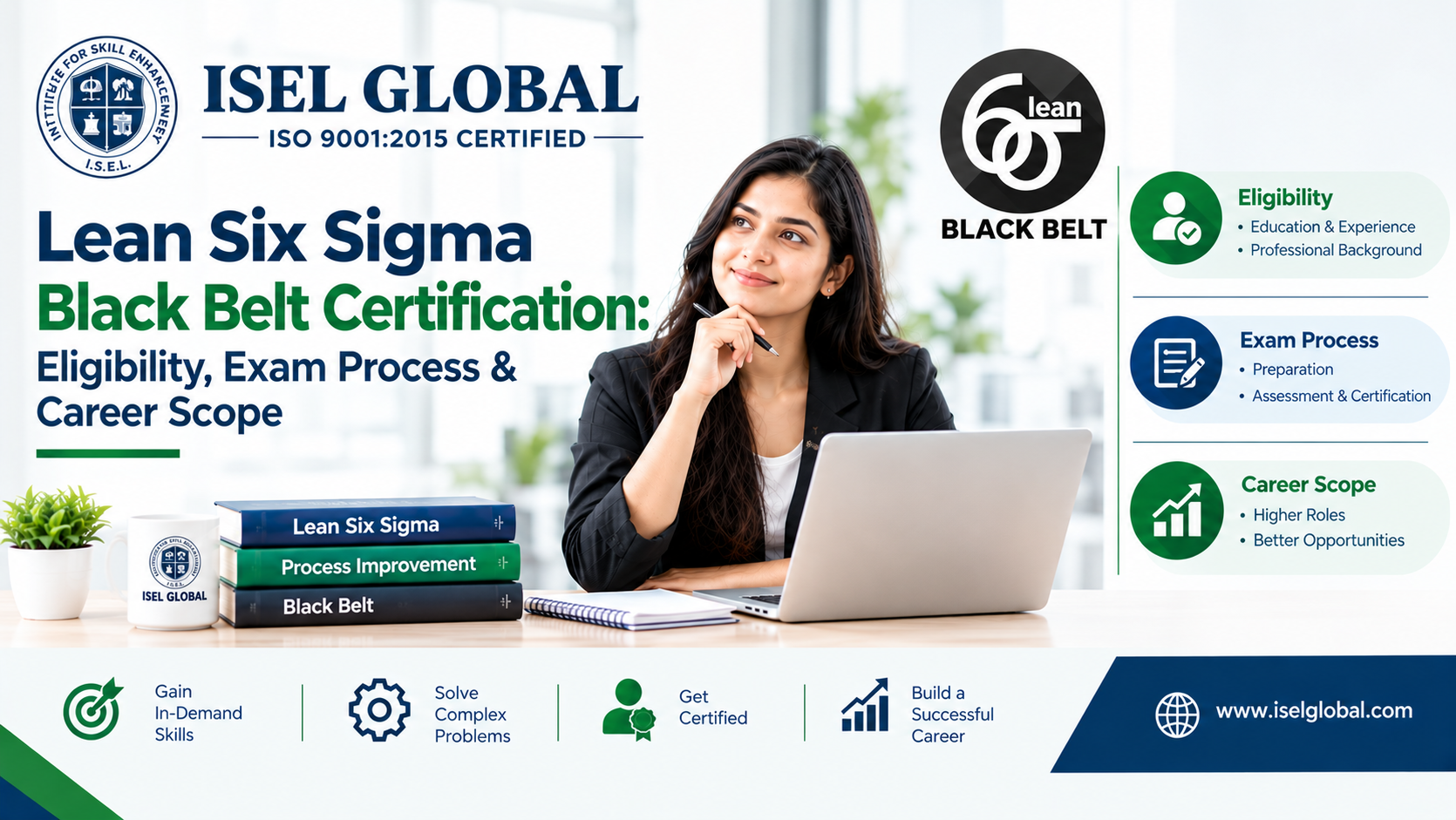
In a competitive job market, professionals need more than technical knowledge to advance their careers. They must also understand how to improve processes, reduce operational waste and deliver measurable business results. Lean Six Sigma Black Belt Certification helps professionals develop advanced process improvement, analytical and project management skills that can be applied across multiple industries.
Whether you work in manufacturing, IT, healthcare, quality management or project management, a Six Sigma Black Belt can strengthen your ability to lead improvement initiatives. This guide explains the eligibility requirements, exam process, course curriculum, career opportunities and factors to consider when choosing a certification program in India.
What Is Lean Six Sigma Black Belt Certification?
Lean Six Sigma Black Belt Certification validates advanced knowledge of Lean Six Sigma methodologies, statistical analysis, process improvement and project leadership. It prepares professionals to identify operational problems, analyse their root causes and implement solutions that improve quality, efficiency and customer satisfaction.
The qualification generally builds on foundational Six Sigma knowledge and may include practical projects, depending on the training provider and certification requirements.
Why Is Six Sigma Black Belt Important for Professionals?
A Six Sigma Black Belt is valuable for professionals who want to move beyond identifying problems and take responsibility for solving them. It develops the skills needed to lead cross-functional teams, use data to make decisions and manage improvement projects.
For example, a manufacturing professional might use root cause analysis to investigate recurring defects, while an IT professional could apply process mapping to reduce software delivery delays. In both cases, the objective is to improve performance using a structured, evidence-based approach.
What Are the Key Benefits of Lean Six Sigma Black Belt Certification?
The major benefits include:
- Advanced problem-solving: Learn to investigate root causes instead of relying on assumptions.
- Data-driven decisions: Apply statistical tools to understand process performance.
- Project leadership: Manage improvement projects and coordinate cross-functional teams.
- Operational efficiency: Identify waste, reduce variation and improve workflows.
- Career development: Strengthen your professional profile for suitable quality, operations and process improvement roles.
- Industry flexibility: Apply Lean Six Sigma methods in manufacturing, IT, logistics, healthcare and service operations.
The actual benefits depend on your experience, practical skills and how effectively you apply the methodology at work.
Who Is Eligible for Lean Six Sigma Black Belt Certification?
Eligibility varies by certification provider. Many programs are designed for working professionals with experience in quality, operations, engineering or process improvement. Some providers recommend completing a Green Belt program or gaining equivalent foundational knowledge before progressing to Black Belt.
Professionals considering the course should check the provider’s specific education, experience, prerequisite, examination and project requirements before enrolling.
A background in statistics can be helpful, but the required level of mathematical knowledge depends on the curriculum.
How Does the Six Sigma Black Belt Exam Process Work?
The examination process depends on the certifying organisation. A typical learning and assessment pathway may include the following steps:
- Review the prerequisites: Confirm eligibility and any recommended Green Belt knowledge.
- Complete the training: Study process improvement, statistical methods and project management.
- Prepare for the exam: Use practice questions, revision notes and a reliable Six Sigma book or six sigma ebook.
- Take the assessment: Complete the examination according to the provider’s rules.
- Meet additional requirements: Submit a project or demonstrate practical experience if required.
- Receive certification: Obtain the credential after meeting all applicable requirements.
Before enrolling, verify the exam format, passing criteria, retake policy and certificate validity directly with the provider.
What Skills Will You Learn in a Lean Six Sigma Black Belt Course?
A comprehensive Six Sigma Black Belt course commonly covers:
- DMAIC: Define, Measure, Analyse, Improve and Control.
- Advanced root cause analysis and process mapping.
- Statistical process control and hypothesis testing.
- Process capability and variation analysis.
- Failure Mode and Effects Analysis (FMEA).
- Design of Experiments (DOE), where included in the syllabus.
- Risk assessment, project planning and change management.
- Team leadership and performance measurement.
These skills help professionals connect technical analysis with practical business objectives.
What Does the Course Curriculum Include?
The curriculum generally progresses from understanding business problems to implementing and sustaining solutions. It may include project selection, data collection, measurement system analysis, statistical analysis, solution validation and control planning.
Lean methods focus on reducing waste and improving flow, while Six Sigma techniques focus on reducing process variation and defects. Together, they provide a structured approach to continuous improvement.
Professionals who have completed Lean Six Sigma Green Belt Training may already understand DMAIC fundamentals and can build on that foundation when progressing to advanced topics. However, prerequisites depend on the certification provider.
What Career Opportunities Are Available After Certification?
Lean Six Sigma Black Belt professionals may pursue roles such as:
- Six Sigma Black Belt or Continuous Improvement Specialist
- Quality Manager or Quality Engineer
- Process Improvement Manager
- Operational Excellence Consultant
- Business Process Analyst
- Manufacturing Excellence Professional
- Project Manager
- Process Excellence or Transformation Lead
Employers may value the certification alongside relevant experience, leadership ability and evidence of successful improvement projects. Experienced professionals can also explore advanced development pathways, including a Master Black Belt, where offered by the relevant provider.
What Are the Salary Trends for Six Sigma Black Belt Professionals in India?
There is no single salary for Six Sigma Black Belt professionals in India. Compensation varies by industry, location, job responsibilities, years of experience and demonstrated project results. A certification alone does not guarantee a salary increase or promotion.
Professionals evaluating career opportunities should compare current job listings for their target roles and locations, including Bengaluru and Mumbai. Reviewing the experience requirements, technical skills and expected responsibilities in these listings can provide a more realistic picture of earning potential.
Which Industries Hire Six Sigma Black Belt Professionals?
Lean Six Sigma skills can be useful in industries where organisations need consistent quality, efficient operations and measurable performance improvements.
Common application areas include manufacturing, automotive, healthcare, information technology, banking, logistics, supply chain management, consulting and business services. The specific demand for certified professionals varies by employer and role.
What Common Mistakes Should You Avoid?
Avoid choosing a certification based only on price, overlooking the syllabus or assuming that every Black Belt credential follows identical standards. Other common mistakes include memorising exam answers without understanding the tools, neglecting practical projects and expecting certification alone to secure a senior position.
Instead, compare the curriculum, assessment method, trainer expertise and practical learning opportunities before making a decision.
How Can You Get More Value From Your Certification?
Choose a program aligned with your career goals and practise the tools using realistic business problems. Learn to explain how you identified a problem, analysed its causes, measured the results and maintained the improvement.
Keep records of project outcomes where your employer permits it, and develop your communication and leadership skills alongside technical knowledge. These habits can help you demonstrate the practical value of your learning to employers.
Conclusion
Lean Six Sigma Black Belt Certification can help professionals develop advanced process improvement, analytical and leadership capabilities. By understanding eligibility requirements, exam procedures, course content and career opportunities, you can make a more informed decision about your professional development.
If you are comparing the best Six Sigma Black Belt certification in India, evaluate the syllabus, assessment requirements, practical learning and relevance to your career goals. Explore the certification programs available through ISEL Global to identify a learning pathway that suits your experience and ambitions.
Frequently Asked Questions (FAQs)
1. What is Lean Six Sigma Black Belt Certification?
Lean Six Sigma Black Belt Certification demonstrates advanced knowledge of process improvement, statistical analysis, root cause identification and project leadership. It helps professionals apply structured methods to reduce defects, improve efficiency and support business performance. The exact syllabus, assessment requirements and certification criteria depend on the organisation providing the training and credential.
2. Who can apply for Six Sigma Black Belt Certification?
Working professionals in engineering, manufacturing, quality management, IT, operations and project management may benefit from a Black Belt program. Some providers recommend prior Green Belt knowledge or relevant work experience, while others have different entry requirements. Check the specific provider’s eligibility rules before enrolling to ensure that the program matches your background.
3. Is Green Belt required before Black Belt certification?
Not always. Some certification providers require or recommend Green Belt knowledge, while others allow candidates to enter directly if they meet the applicable prerequisites. Green Belt training can provide a useful foundation in DMAIC, process mapping and basic statistical tools. Review the chosen program’s requirements before deciding which level is appropriate for you.
4. How long does it take to complete Six Sigma Black Belt certification?
The completion time varies according to the training format, course syllabus, examination schedule and any project requirements. Self-paced online learning may offer greater flexibility, while instructor-led programs follow their own schedules. Ask the provider about expected study hours, assessment deadlines and project completion requirements before planning your certification.
5. Is Lean Six Sigma Black Belt certification worth it?
It can be worthwhile for professionals who want to lead process improvement projects, strengthen analytical skills or progress towards quality and operational excellence roles. Its value depends on your career goals, existing experience and opportunities to apply the methods. Compare course quality, assessment standards and practical learning rather than relying on the certificate title alone.
6. What is the difference between Green Belt and Black Belt?
A Green Belt generally develops foundational process improvement skills and may lead smaller projects or contribute to larger initiatives. A Black Belt typically develops more advanced analytical, project leadership and improvement capabilities. The precise distinction depends on the provider’s curriculum. Professionals should compare the syllabus and prerequisites before choosing between the two levels.
7. Can I pursue Six Sigma certification online in India?
Yes, online Six Sigma programs are available in India, although their formats, assessment methods and recognition vary. Before enrolling, review the course curriculum, trainer support, examination arrangements, practical assignments and certificate requirements. You can explore Six Sigma Certification Online India to learn more about the relevant training pathway offered through ISEL Global.
8. What jobs can I pursue after Black Belt certification?
Depending on your experience and skills, potential roles include Quality Engineer, Process Improvement Specialist, Continuous Improvement Manager, Business Process Analyst and Operational Excellence Consultant. Some professionals also apply these skills in project management and manufacturing leadership. Employers typically consider practical achievements, industry knowledge and leadership experience alongside certification.
9. What is the difference between a Black Belt and a Master Black Belt?
A Black Belt typically leads improvement projects and helps teams apply Lean Six Sigma methods. A Master Black Belt generally operates at a more advanced level, potentially mentoring Black Belts, supporting organisational improvement strategy and developing training capabilities. Responsibilities and prerequisites vary by organisation, so candidates should check the specific program requirements before pursuing the next level.
10. How should I prepare for the Six Sigma Black Belt exam?
Start by reviewing the official syllabus and identifying topics that need more attention. Study DMAIC, statistical tools, process capability, root cause analysis and project management. Use practice questions and reliable learning resources, including a suitable Six Sigma book or ebook. Also confirm the examination format, passing criteria and any practical project requirements with your certification provider.