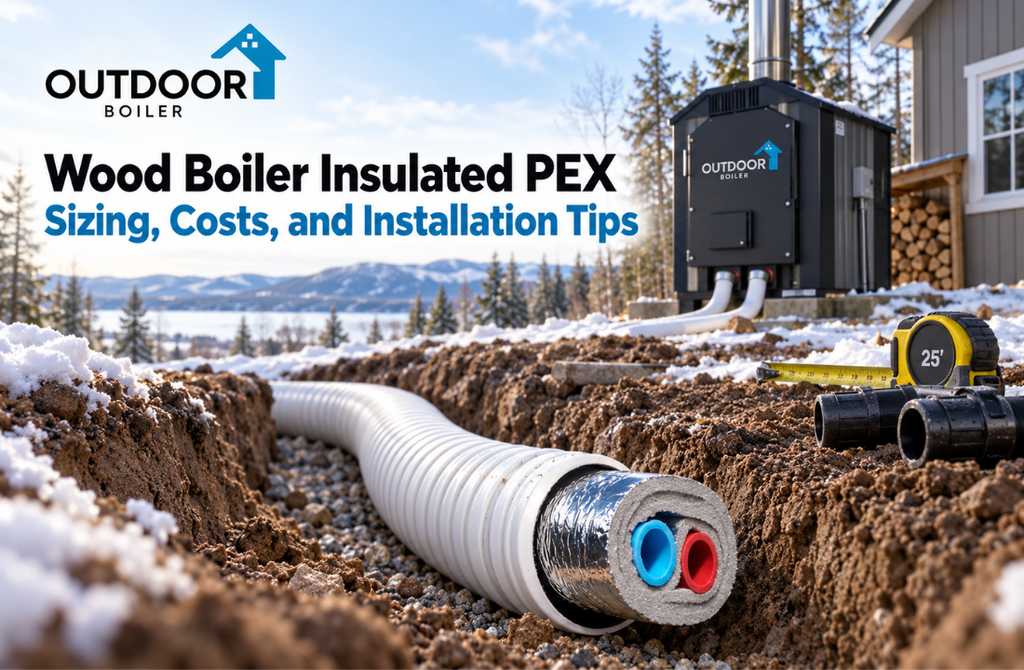
If you are planning a wood boiler project, choosing the right wood boiler insulated PEX can make a noticeable difference in comfort, efficiency, and long-term reliability. In most residential installations, one-inch oxygen barrier PEX is a practical starting point, but the best size depends on heat demand, pipe length, pump capacity, and the boiler manufacturer’s requirements.
Why insulated PEX matters
An outdoor wood boiler may sit a considerable distance from the house, shop, garage, or barn it serves. The supply line carries heated water to the building, while the return line brings cooler water back to the boiler. Without strong insulation around those lines, a surprising amount of useful heat can disappear into the soil.
Factory-assembled insulated PEX usually contains two flexible PEX lines, insulation around the tubing, and a protective outer jacket. This arrangement limits heat loss and protects the tubing from moisture and ground conditions. It also reduces the number of underground connections, which can lower the chance of a buried leak.
How to choose the right PEX size
The most common choices for a residential wood boiler are one inch and one and one-quarter inch PEX. Smaller tubing may work for a short, modest load, but choosing a size based only on the boiler outlet can create flow problems. The system must move enough water to carry the required heat from the boiler to the building.
Start with the building’s heat demand rather than guessing from distance alone. A small, well-insulated home may need much less flow than a large older home, workshop, or several buildings connected to one boiler. The designer should also consider the total circuit length, elevation changes, fittings, heat exchangers, valves, and the temperature difference between supply and return water.
Longer underground runs generally create more resistance. If the run is long or the load is substantial, one and one-quarter inch PEX may help maintain flow while reducing pump strain. For many typical residential systems, one-inch insulated PEX provides a useful balance between cost, flexibility, and performance. Central Boiler states that one-inch ThermoPEX is recommended for all installations, while its 25 millimeter option is intended for shorter distances. That is useful manufacturer guidance, but it is not a substitute for a complete flow calculation.
What does insulated PEX cost?
Pricing varies by brand, pipe size, insulation quality, shipping distance, and seasonal demand. A short run of smaller insulated PEX may appear affordable, while a long run of larger tubing can become a significant part of the project budget.
When comparing prices, look beyond the cost per foot. Include the supply and return lines, trenching, bedding material, fittings, valves, pumps, insulation at building entries, and required transition pieces. Factory-assembled piping often costs more than improvised underground arrangements, but it may save labor and provide more consistent insulation.
Installation tips that prevent problems
Plan the route before digging. Keep it as direct as practical, while avoiding areas that may be disturbed by future construction, vehicles, drainage work, or tree planting. Check local requirements for trench depth, utility locations, and entry points before excavation begins.
Use a smooth trench base free of sharp rocks and debris. Rough ground can damage the protective jacket during installation, especially when the pipe is pulled around bends. Do not drag the tubing over broken stone or force it into a tight radius. Follow the product instructions for minimum bend radius and handling temperature.
Install the underground piping in one continuous run whenever possible. Every buried connection creates another possible failure point and makes future repair more difficult. If a connection is unavoidable, place it where it remains accessible and protect it according to the manufacturer’s instructions.
At the house and boiler, protect the tubing as it passes through the foundation or wall. Use suitable sleeves, seals, and transition fittings. Leave enough room for movement and service work, and keep PEX away from flue pipes, direct flame, and other high-temperature surfaces. The Plastic Pipe Institute advises that PEX should not be used where water temperatures can exceed its approved limits, and it recommends following the tubing manufacturer’s installation instructions.
Before covering the trench, inspect the jacket for cuts and confirm that the supply and return lines are correctly identified. Pressure test the system before backfilling. After the system is operating, check accessible connections for leaks and verify that the supply and return temperatures make sense.
Insulation and winter performance
If the boiler will be shut down during freezing weather, ask the installer how the system will be protected. Draining, antifreeze, or maintaining circulation may be appropriate depending on the design. Do not add antifreeze without confirming that it is compatible with the boiler, pumps, seals, and heat exchangers.
Final thoughts
Choosing wood boiler insulated PEX is not simply a matter of buying the largest pipe available. The right decision balances heat demand, distance, flow, insulation quality, installation conditions, and future service needs. For a typical home, one inch may be suitable, while a longer or higher demand circuit may justify one and one-quarter inch. A proper design calculation is the safest way to avoid heat loss, noisy pumps, and disappointing performance.
For additional technical guidance, review the Central Boiler ThermoPEX piping information and thePlastic Pipe Institute PEX installation guide. Then discuss your project with a qualified heating professional who can size the piping and verify that the complete system meets local code.
Ready to plan your project?
Measure the approximate distance, list every building and heating zone you want to serve, and note the boiler model under consideration. With those details in hand, request a complete piping and installation estimate so you can make an informed decision before excavation begins.
Visit outdoorboiler.com to learn more and explore additional heating resources.