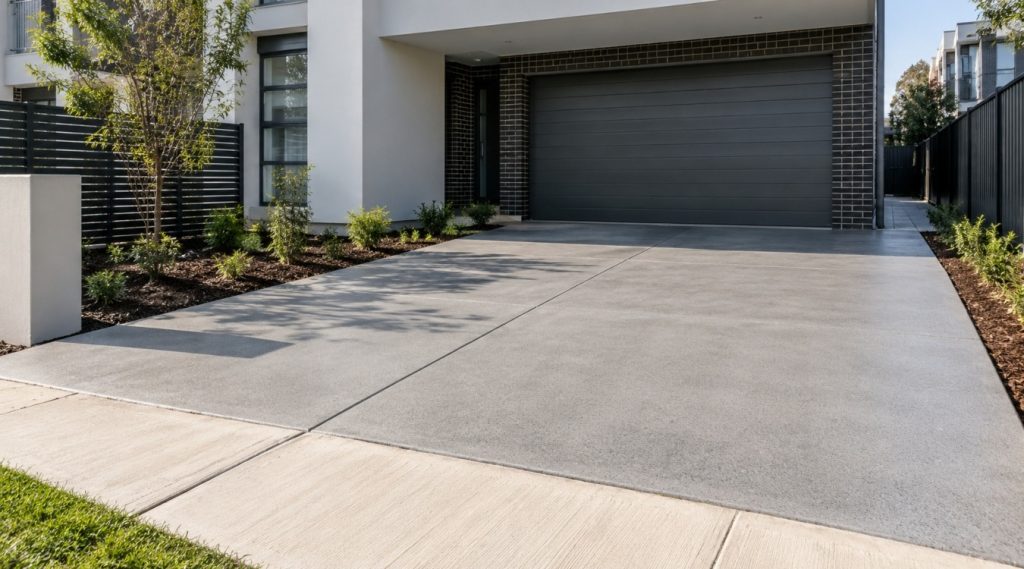
When a driveway on a managed property starts cracking, pooling water or looking tired, it’s usually the property manager who fields the first calls from owners and residents, and the property manager who has to bring a recommendation to the owners corporation. A concrete driveway upgrade is a significant common-property decision, not a minor maintenance item, and getting it wrong (a rushed quote, an unlicensed contractor, or a scope nobody actually agreed to) tends to cost far more in disputes and rework than it does in cement.
Unlike a single dwelling, a shared driveway sits at the intersection of everyone’s daily access, the sinking fund, and whatever compliance obligations apply to the property as a whole. That makes the decision more complicated than simply picking the cheapest quote, and it’s usually the property manager who has to hold that complexity together on behalf of a committee that may never have been through the process before.
Here’s what to work through before you put a driveway upgrade to a vote.
Confirm the actual scope
“Fix the driveway” can mean several different jobs, and it’s worth being precise before anyone starts pricing them: resurfacing an existing slab, repairing isolated cracked sections, or a full removal and repour. Getting the scope wrong before anyone even quotes on the concrete driveway construction is one of the most common reasons these projects blow out mid-way through, since each option carries a different cost, disruption window and lifespan.
Before you get quotes, walk the site and note where the driveway sits relative to lot boundaries and common property, whether it connects to a council crossing that will need a permit for any structural change, and whether the surface carries only resident vehicles or also services garbage trucks, delivery vans or emergency access. That last point matters more than it sounds: a driveway rated for passenger cars will fail early under repeated heavy-vehicle loading, so the intended use has to be part of the brief from the start, not an afterthought once cracks appear.
Budget and cost apportionment
A driveway upgrade is typically funded from the sinking fund or, if the fund is short, a special levy, and either route needs to be flagged to owners early, with the reasoning behind it clearly explained. Owners are far more likely to support a levy when they understand what’s driving the cost (compliance requirements, load rating, staged works to limit disruption) rather than being presented with a final number and no context.
Get at least two or three itemised quotes rather than a single lump-sum figure, so the owners corporation can see what it’s actually paying for: excavation, base preparation, reinforcement, drainage, and sealing. A cheap quote that’s missing half of these line items isn’t a bargain, it’s a smaller version of the same job, and the gap usually resurfaces as a defect within a year or two.
Compliance is not optional on shared property
Common-property works usually carry more compliance obligations than a single dwelling, and this is where a lot of committees get caught out. If the driveway meets the street, altering it will likely need council approval for the crossover, and that approval process can take longer than the construction itself if it isn’t started early. If the driveway is used by trucks or other heavy vehicles, it should be engineered to the relevant Australian Standard for load-bearing concrete rather than built to a residential specification and hoped along.
It’s also worth treating an upgrade as an opportunity rather than a cost to minimise. If any part of the property has accessibility requirements under the Disability Discrimination Act, this is the moment to address gradient, tactile ground surface indicators or kerb ramps, rather than leaving it for a future, more expensive retrofit once the new concrete is already down. Our guide to concrete driveway construction Melbourne owners corporations need to plan for covers these compliance and planning questions in more detail, and is worth sharing with your committee before the first quote comes in.
Plan for disruption, not just for the pour
Concrete work on a shared driveway affects everyone who uses it, not just the unit closest to the work. Ask any civil contractor in Melbourne how they’ll stage the job to keep at least partial access open, how long the new surface needs to cure before it can bear vehicle weight again, and how they’ll communicate timing and access changes to residents throughout the project. A contractor who can’t answer this clearly at quoting stage usually can’t manage it well on site either.
Our owners corporation installation timeline guide sets out what a realistic schedule looks like stage by stage, from initial site preparation through to final cure, which is a useful document to circulate to a committee that hasn’t been through a shared-property concrete project before. It also gives residents something concrete to refer back to when questions come up mid-project.
Vet the contractor properly
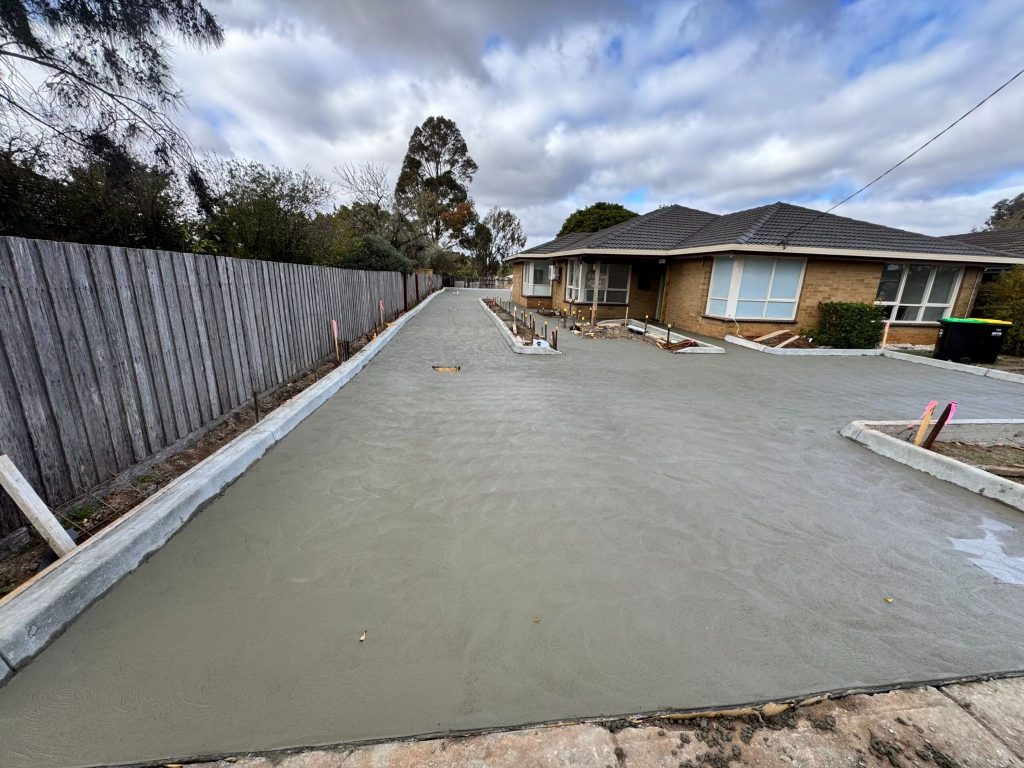
This is the step that gets skipped most often, usually because a committee just wants the cheapest available quote and a start date. Ask for VBA registration and current insurance before engaging any concrete driveway contractor Melbourne for shared-property work, and ask specifically whether they’ve completed jobs for an owners corporation or body corporate before, rather than only residential driveways. A contractor who’s only ever built house driveways isn’t automatically equipped for a shared site: sequencing around residents, handling committee sign-off, and documenting the job properly for future reference are skills that come from having done it before, not from a standard residential quote template.
It’s reasonable to ask for two or three recent references from similar properties, not just photos. A contractor confident in their commercial and multi-unit experience will usually offer these without being pushed.
Get the warranty in writing
Before the vote goes to owners, the quote should specify a warranty period and what it actually covers (workmanship, materials, or both), plus any maintenance recommendations for the years after installation. A committee approving a five-figure spend deserves more than a verbal assurance that “it’ll be fine,” and a written warranty is also what protects the next committee if an issue shows up after the current one has moved on.
Time it around the calendar, not just the budget cycle
It’s tempting to schedule works purely around when the special levy clears or when an AGM has signed off on the spend, but weather and curing time matter just as much. Concrete needs a reasonable window to cure properly before it takes vehicle weight, and wet or highly variable weather can extend that window unpredictably. Building a small buffer into the schedule, and asking the contractor how they plan around seasonal weather, avoids the awkward situation of residents being told the driveway is ready when it structurally isn’t.
A short checklist before you bring it to a vote
- A clear, written scope (resurface, patch, or full repour) that everyone quoting has priced against the same brief
- At least two itemised quotes, not just a headline figure
- Confirmation of council or engineering requirements, including load rating if heavy vehicles use the driveway
- A construction and access plan that says how disruption will be managed and communicated
- Evidence of past work on owners corporation or commercial properties, not only residential jobs
- A written warranty period and scope, attached to the contract, not promised verbally
The bottom line
A concrete driveway upgrade doesn’t need to be contentious if the property manager has done the groundwork: a clear scope, comparable quotes, a compliance checklist, and a contractor who can demonstrate real experience with shared and commercial property. Bring that package to the owners corporation instead of a single quote and a recommendation, and the vote tends to take care of itself, because the committee can see exactly what they’re approving and why.
Infra Projects is a VBA-registered, council-approved concrete driveway contractor in Melbourne with more than 75 completed projects across Victoria, including commercial driveways, car parks and DDA-compliant infrastructure for owners corporations and multi-unit properties.