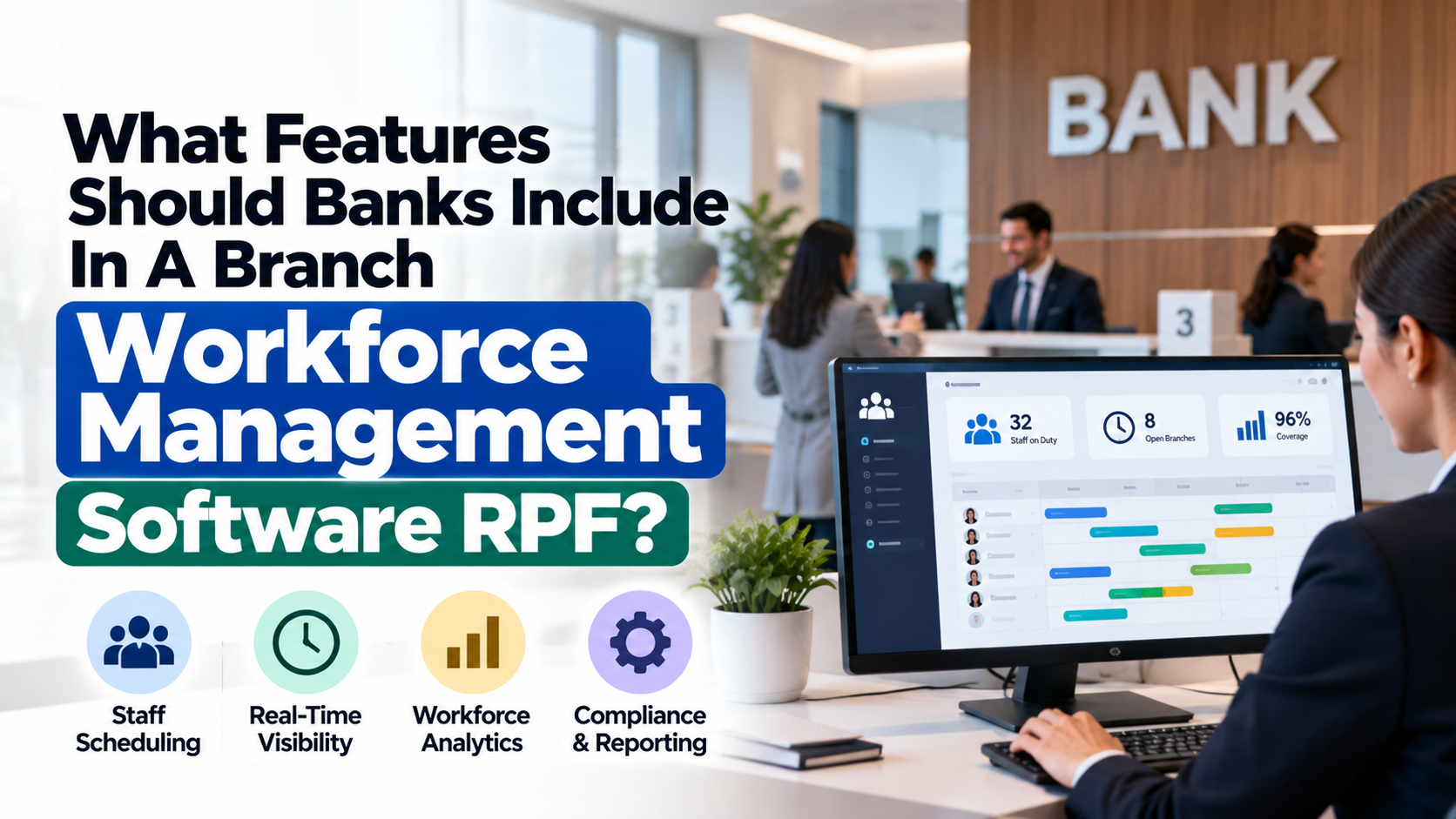
Banks should include demand forecasting, workforce planning, employee scheduling, skills matching, and performance analytics in a branch workforce management software Request for Proposal (RFP).
These features help banks align staffing with customer demand, manage employee availability, and improve branch operations.
The right bank branch workforce management software should help managers forecast staffing needs, identify coverage gaps, and allocate employees based on workload. It should also provide visibility into workforce capacity and performance across locations. Banks should evaluate vendors on their scheduling capabilities, data integrations, reporting, security, and ability to support workforce planning across multiple branches.
1. Demand Forecasting and Workforce Planning
Banks need demand forecasting to determine staffing requirements across different branches and time periods. The software should analyze historical customer activity and available appointment and walk-in data to identify expected workload.
The RFP should include:
- Historical demand analysis and forecasting.
- Staffing recommendations based on expected workload.
- Identification of peak periods and coverage gaps.
- Skills-based planning for different banking services.
- Forecast accuracy reporting.
These features help managers allocate employees according to demand instead of relying solely on fixed schedules.
2. Employee Scheduling and Shift Management
Workforce management software for banks should simplify scheduling and help managers respond to changes in employee availability. Manual scheduling can consume time and make it difficult to maintain appropriate coverage.
Banks should require:
- Demand-based schedule recommendations.
- Centralized employee calendars.
- Shift adjustments and absence management.
- Employee availability tracking.
- Support for working hours, breaks, and internal scheduling policies.
The software should make it easy to identify scheduling conflicts and adjust coverage when operational requirements change.
3. Multi-Branch Workforce Visibility
Banks operating across multiple locations need centralized workforce planning with flexibility for individual branches. Regional managers should be able to compare staffing requirements, while branch managers should retain appropriate control over local schedules.
Enterprise branch workforce management software should provide:
- Consolidated staffing information across branches.
- Regional workforce reporting.
- Branch-level schedule management.
- Cross-branch resource planning where permitted.
- Consistent workforce planning standards.
These capabilities help banks identify resource imbalances and make better staffing decisions across their networks.
4. Performance Analytics and Reporting
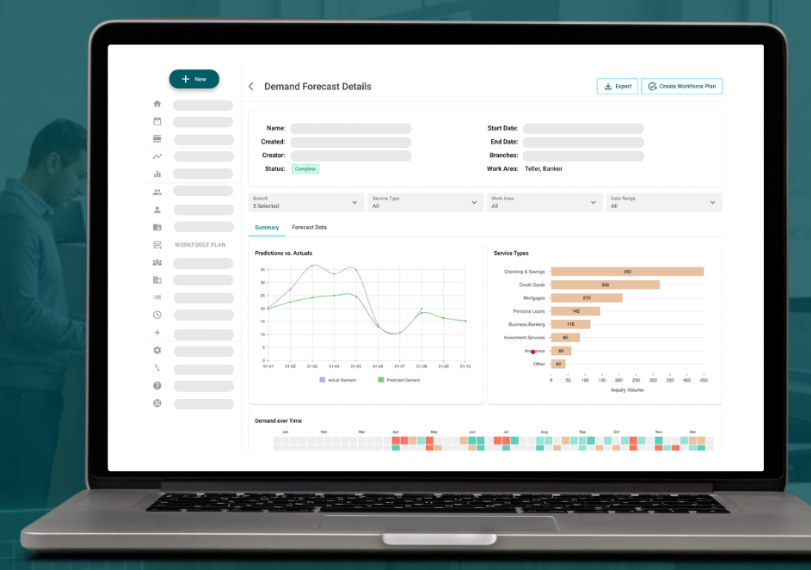
Banks need workforce analytics to evaluate staffing decisions and improve operational efficiency. Branch workforce software for banks should provide dashboards that help managers track performance and identify staffing gaps.
The RFP should include dashboards that track:
- Forecast accuracy: Compare predicted demand with actual activity.
- Employee utilization: Assess how effectively workforce capacity is used.
- Staffing coverage: Identify periods when staffing does not meet requirements.
- Schedule adherence: Compare planned schedules with actual working patterns where data is available.
- Staffing costs: Compare planned workforce expenditure with actual costs.
- Branch performance: Compare workforce patterns across locations.
Reports should support filtering by branch, region, employee role, and time period. These insights help managers identify recurring issues and adjust workforce plans.
5. System Integrations and Automation
Branch workforce management software should connect with relevant appointment scheduling, HR, timekeeping, and reporting systems. These integrations help managers access employee availability and operational data without relying on disconnected spreadsheets.
Banks should ask vendors to document supported integrations, data synchronization, APIs, implementation requirements, and additional costs.
Automation can further simplify workforce planning through schedule recommendations, coverage alerts, and automated identification of staffing gaps. Vendors should demonstrate how these features work and explain how managers can review or adjust automated recommendations.
6. Security, Implementation, and Support
Banks must assess security alongside software functionality. The RFP should cover role-based access controls, authentication, audit trails, data protection, and business continuity.
Vendors should provide evidence that their controls meet the bank’s internal policies and applicable regulatory requirements.
Implementation requirements also matter. Banks should evaluate data migration, integration support, employee training, technical assistance, service-level commitments, and total cost of ownership. Reliable bank branch staffing solutions should also help banks maintain staffing continuity during employee absences, unexpected demand, and branch-level schedule changes.
A practical vendor demonstration should show how the software forecasts demand, creates staffing recommendations, manages schedules, and reports workforce performance.
What Automation and AI Features Should the Software Provide?
Banks should prioritize automation and AI features that reduce manual scheduling, improve staffing accuracy, and help managers respond to changing branch demand.
The RFP should ask vendors whether their software supports:
- Automated staffing recommendations: Allocate employees based on forecast demand.
- Schedule generation: Create schedules based on employee availability and staffing needs.
- Coverage alerts: Identify staffing gaps and scheduling conflicts.
- Scenario planning: Compare staffing options before making changes.
- Explainable recommendations: Show why the software suggests specific staffing decisions.
- Manager approvals: Let authorized managers review and approve schedules.
Banks should also evaluate forecasting accuracy, recommendation testing, and how the software handles unexpected changes in branch demand.
Branch Workforce Management Software RFP Checklist
| Requirement | What to evaluate |
| Demand forecasting | Historical data analysis and staffing recommendations |
| Workforce planning | Employee skills, availability, and coverage |
| Scheduling | Shift management and schedule adjustments |
| Multi-branch management | Centralized visibility and local flexibility |
| Analytics | Utilization, forecast accuracy, and staffing costs |
| Integrations | HR, appointment, timekeeping, and reporting systems |
| Security | Access controls, audit trails, and data protection |
| Implementation | Training, technical support, and total cost |
Conclusion
Banks should prioritize demand forecasting, workforce planning, scheduling, multi-branch visibility, and performance analytics when evaluating bank branch workforce management software. Integrations, automation, security, and implementation support should also form part of the RFP.
The objective is to select software that helps managers make informed staffing decisions, use employee capacity effectively, and maintain consistent branch operations. A structured RFP allows banks to compare vendors against clear requirements and choose a solution that fits their workforce planning needs.