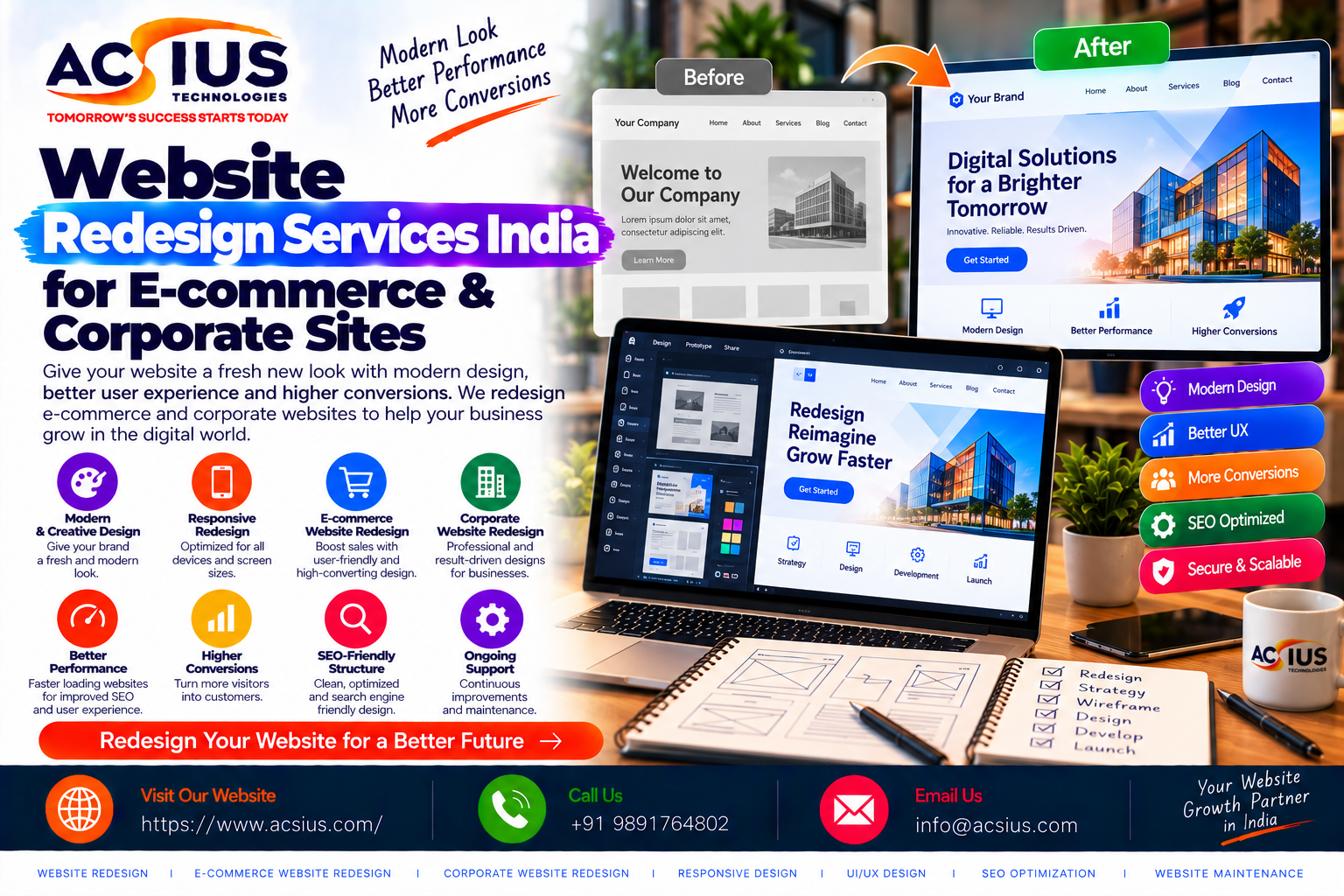
Every website has a shelf life. What looked modern and converted well three or four years ago can quietly become a liability today, slower than competitors, confusing to navigate, and visually out of step with how your brand has evolved. For e-commerce stores, this directly costs revenue through abandoned carts and lost sales. For corporate sites, it quietly erodes credibility with prospects, partners, and investors who form an opinion within seconds of landing on the homepage.
A redesign done well is not just a fresh coat of paint. It’s a structured process that preserves what’s working, SEO rankings, existing content, customer familiarity, while fixing what isn’t: outdated design, poor mobile performance, confusing navigation, and technical debt that’s been accumulating for years. Businesses that approach this correctly typically partner with experienced providers of website redesign services in India who understand both the technical migration risks and the design opportunities a redesign presents. This guide covers how to approach a redesign for e-commerce and corporate websites, what to prioritize, and how to avoid the mistakes that turn a redesign into a step backward.
Signs Your Website Is Overdue for a Redesign
Many businesses wait too long to redesign simply because the website “still works.” But functional and effective are not the same thing. Common warning signs include declining conversion rates despite stable or growing traffic, high bounce rates on product or service pages, a visual identity that no longer reflects your current brand positioning, slow page load times caused by years of accumulated plugins and unoptimized media, and a mobile experience that feels like an afterthought rather than a priority.
For e-commerce sites specifically, watch for cart abandonment rates significantly above industry averages, product pages that fail to answer common customer questions upfront, and checkout flows with unnecessary steps or friction. For corporate sites, warning signs often include outdated case studies, unclear value propositions above the fold, and navigation structures that no longer reflect the company’s current service lines or organizational growth.
E-commerce Redesigns: What Actually Moves Revenue
E-commerce redesigns carry higher stakes than most other website projects because every design decision has a direct, measurable connection to revenue. A confusing checkout flow doesn’t just look bad, it actively loses sales in real time.
Product page optimization deserves particular attention. High-quality imagery with zoom functionality, clear pricing and availability information, prominently displayed reviews and ratings, and a visible, unambiguous add-to-cart button all reduce the hesitation that leads to abandoned sessions. Product descriptions should answer the questions customers actually have, sizing, materials, shipping timelines, rather than generic marketing copy.
Checkout flow simplification is one of the highest-leverage redesign priorities for any online store. Every additional field or step in checkout introduces another opportunity for abandonment. Guest checkout options, saved payment methods, transparent shipping costs shown early rather than as a surprise at the final step, and progress indicators that show customers how many steps remain all contribute to higher completion rates.
Site search and filtering matter more than many businesses realize, especially for stores with large catalogs. Customers who can’t quickly filter by size, price, or category often leave rather than scroll through pages of irrelevant products. Autocomplete suggestions and typo-tolerant search further reduce the friction between intent and purchase.
Mobile commerce performance has become non-negotiable, since a majority of online shopping traffic now arrives via mobile devices. Thumb-friendly tap targets, simplified mobile checkout, and fast load times on mobile networks directly determine whether mobile visitors convert or bounce.
Corporate Website Redesigns: Building Trust and Credibility
Corporate websites serve a different purpose than e-commerce stores, but the stakes are no less real. For B2B companies, professional services firms, and enterprises, the website often functions as a digital first impression for prospects, investors, and potential hires who research a company long before ever speaking to someone on the team.
Clear value proposition above the fold is essential. Visitors should understand within seconds what a company does, who it serves, and why it’s different from competitors, without having to scroll or dig through dense paragraphs of corporate language.
Case studies and social proof carry significant weight in B2B decision-making, where purchase cycles are longer and involve multiple stakeholders. Detailed case studies showing measurable outcomes, paired with client logos and testimonials, help build the credibility that drives a prospect toward a sales conversation.
Service and solution pages need clear, specific content rather than vague industry jargon. Prospects researching a specific problem should land on a page that speaks directly to that problem, not a generic overview page that forces them to guess whether the company can actually help.
Lead generation pathways should be woven naturally throughout the site rather than confined to a single contact page. Strategic calls to action, contact forms, resource downloads, demo requests, positioned at relevant points in the user journey convert more effectively than a single generic “Contact Us” link in the navigation.
The Role of Landing Pages in a Redesign Strategy
While a full website redesign addresses the entire user journey, standalone landing pages serve a more targeted purpose and often deserve dedicated attention during a redesign project, particularly for businesses running active paid advertising campaigns. A landing page built for a specific campaign needs a singular focus: one offer, one call to action, minimal distractions pulling visitors away from converting.
Because landing page performance directly impacts the return on ad spend, many businesses choose to work with specialized Landing Page Design Services India providers alongside their broader redesign project, ensuring campaign-specific pages are optimized independently from the main site’s navigation-heavy structure. A well-designed landing page strips away the general site navigation, focuses entirely on a single conversion goal, and loads quickly enough to retain visitors arriving from paid traffic, where patience for slow pages is especially limited. Treating landing pages as a distinct discipline within a redesign, rather than just another page template, consistently improves campaign performance.
Choosing the Right CMS for Your Redesign
A redesign is also the natural moment to evaluate whether your current content management system still serves your business, or whether it’s quietly limiting what your team can do. Businesses often inherit CMS platforms chosen years earlier for reasons that no longer apply, and a redesign presents an opportunity to correct that.
Platforms like WordPress, Shopify, and headless CMS solutions each suit different needs. WordPress remains a strong choice for content-heavy corporate sites and blogs due to its flexibility and massive plugin ecosystem. Shopify dominates e-commerce for good reason, offering robust inventory management, payment processing, and app integrations built specifically for online retail. Headless CMS architectures, where content management is decoupled from the front-end presentation layer, are gaining traction among larger businesses that need to push content across multiple channels, web, mobile app, in-store displays, without duplicating effort.
Because this decision has long-term implications for how easily your team can update content, add features, and scale the site, it’s worth bringing in a specialized CMS Website Design Agency India that can assess your specific content and workflow needs rather than defaulting to whatever platform is most familiar or heavily marketed. The right CMS choice should be driven by your team’s technical comfort, your content complexity, and your growth plans, not by habit or sales pressure from a particular platform vendor.
Protecting SEO Rankings During a Redesign
One of the most common and costly redesign mistakes is losing organic search rankings built up over years, often due to careless technical execution rather than any flaw in the new design itself. Protecting SEO equity requires deliberate planning throughout the redesign process, not an afterthought handled in the final week before launch.
URL mapping and 301 redirects are essential whenever page structures change. Every old URL with existing rankings or backlinks needs a clear redirect path to its new equivalent, preventing broken links and lost link equity.
Preserving high-performing content matters just as much as refreshing outdated pages. A redesign shouldn’t mean deleting blog posts or product pages that already rank well and drive traffic, even if their visual template changes.
Maintaining site speed improvements, not regressions, is critical, since a redesign focused purely on visuals can sometimes introduce new performance problems through heavier images, unoptimized code, or excessive third-party scripts.
Updating and resubmitting XML sitemaps, along with monitoring Google Search Console closely in the weeks following launch, helps catch indexation issues early before they compound into meaningful traffic loss.
Planning a Redesign Without Disrupting Business Operations
For businesses generating significant revenue or leads through their existing site, a redesign needs to happen without a prolonged period of downtime or broken functionality. A staged approach typically works best: building and testing the new site on a staging environment, running thorough quality assurance across devices and browsers, and planning the launch during lower-traffic periods to minimize disruption if issues arise.
A phased rollout, redesigning high-impact pages first while maintaining the existing site elsewhere, can also reduce risk for larger, more complex sites where a full simultaneous launch carries too much uncertainty. Clear internal communication with sales, marketing, and customer support teams ahead of launch ensures everyone is prepared to address questions or issues as they come up.
Measuring Redesign Success
A redesign should be evaluated against clear, predefined metrics rather than subjective opinions about whether the new design “looks better.” Before launch, establish baseline measurements for conversion rate, average session duration, bounce rate, page load speed, and, for e-commerce specifically, cart abandonment rate and average order value.
Comparing these metrics in the weeks and months following launch provides concrete evidence of whether the redesign achieved its goals. It’s also worth setting up proper event tracking and goal configuration in analytics tools before launch, rather than scrambling to retrofit measurement after the new site is already live and early data is being lost.
Common Redesign Mistakes to Avoid
Even well-funded redesign projects can underperform due to avoidable missteps. Watch for redesigning based on internal preferences rather than user data and testing, launching without adequate cross-device and cross-browser QA, neglecting to redirect old URLs and losing search rankings as a result, over-customizing a CMS in ways that make future updates difficult without developer involvement, and treating the redesign as a one-time project rather than planning for ongoing iteration based on real user behavior after launch.
Final Thoughts
A website redesign, done thoughtfully, is one of the highest-leverage investments a business can make, directly improving conversion rates, credibility, and long-term scalability for both e-commerce and corporate sites. The businesses that get the most value from a redesign treat it as a strategic process grounded in data, user research, and careful technical execution, not simply a visual refresh handed off without a clear plan.
Whether you’re rebuilding a high-traffic online store, modernizing a corporate site that no longer reflects your brand, or evaluating a CMS migration alongside your redesign, ACSIUS brings the technical expertise and design process needed to execute a redesign that protects what’s working while genuinely improving what isn’t.