In the petrochemical industry, pipelines, heat exchangers, and pressure vessels depend on safe bolted joints. These joints require proper clamping force to prevent any leakage that may occur due to the rigorous nature of operations.
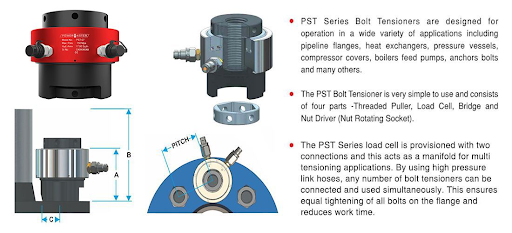
Multi-stage bolt tensioners help in loading bolts through the use of hydraulic power for stretching the studs before securing the nuts. Through proper selection of tensioning patterns by engineers, loading becomes uniform in crucial joints.
How Do Multi-Stage Bolt Tensioners Work?
In the hydraulic bolt tensioner, pressurized fluid is used to operate the piston, and thus the axial tension is applied to the stud. When the stud is held under tension, the nut is moved into its final position. Once the pressure is removed, the stud relaxes back elastically, and thus creates the clamp load between the joint.
The multi-stage loading process consists of applying the loads in stages or sequences, depending on the equipment and bolting technique used. In some cases, more than one tensioner can be operated at once through the hydraulic system. This may assist in the distribution of the load in many bolts and also decrease the flange assembly time.
Key Applications in Petrochemical Plants
1. Pipeline Flanges
Flanges on pipelines are joints that connect pipeline sections together. Unbalanced bolt loading may impact gasket compression and cause leakage problems. Proper tensioning ensures the flange reaches the required bolt load.
2. Heat Exchangers
Heat exchangers facilitate heat transfer from process fluids through bolted connections that need periodic maintenance inspections and disassembly. Proper tensioners assist the technicians in achieving the appropriate stud load.
3. Pressure Vessels
Pressure vessels function at specified pressure and temperature levels. The bolted joints on the pressure vessels need proper installation to ensure that the joint is properly maintained. Thus the correct use of tensioners is very important.
Benefits of Multi Stage Bolt Tensioning
There are several advantages to using this technique when applied to the specific application:
- Reduced torsional stress: Tensioning through axial pull of the fastener eliminates the need for rotation of the bolt to create bolt load.
- Loading uniformity: Simultaneous tensioning helps achieve uniform bolt loading.
- Precision: Controllable hydraulic pressure allows for a precise and repeatable process.
- Maintenance efficiency: The proper equipment may allow for reduced time in tightening several fasteners.
Results depend on the design of joint, equipment selected, training of personnel and methodology.
How to Select the Right Bolt Tensioner
Prior to the selection of a tensioner, verification is needed for the stud diameter, thread size, required bolt load, flange design, and clearance. In addition, it should be confirmed that both the tensioner and the hydraulic pump meet the pressure requirement.
Conclusion
Reliable bolted joints are essential to petrochemical plant maintenance. Having an appropriate multi-stage bolt tensioner assists technicians in loading the bolts properly when there is a need for a particular sequence.
The Bolting Systems offers bolt tensioners for use in the industry. The company’s product line includes hydraulic bolt tensioners, hydraulic torque machines, torque multipliers, nut splitters, and flange spreaders. The equipment meets different needs for bolting, maintenance, and flange handling in industrial plants. Maintenance personnel can review the available equipment and choose the right one for their specific application needs.