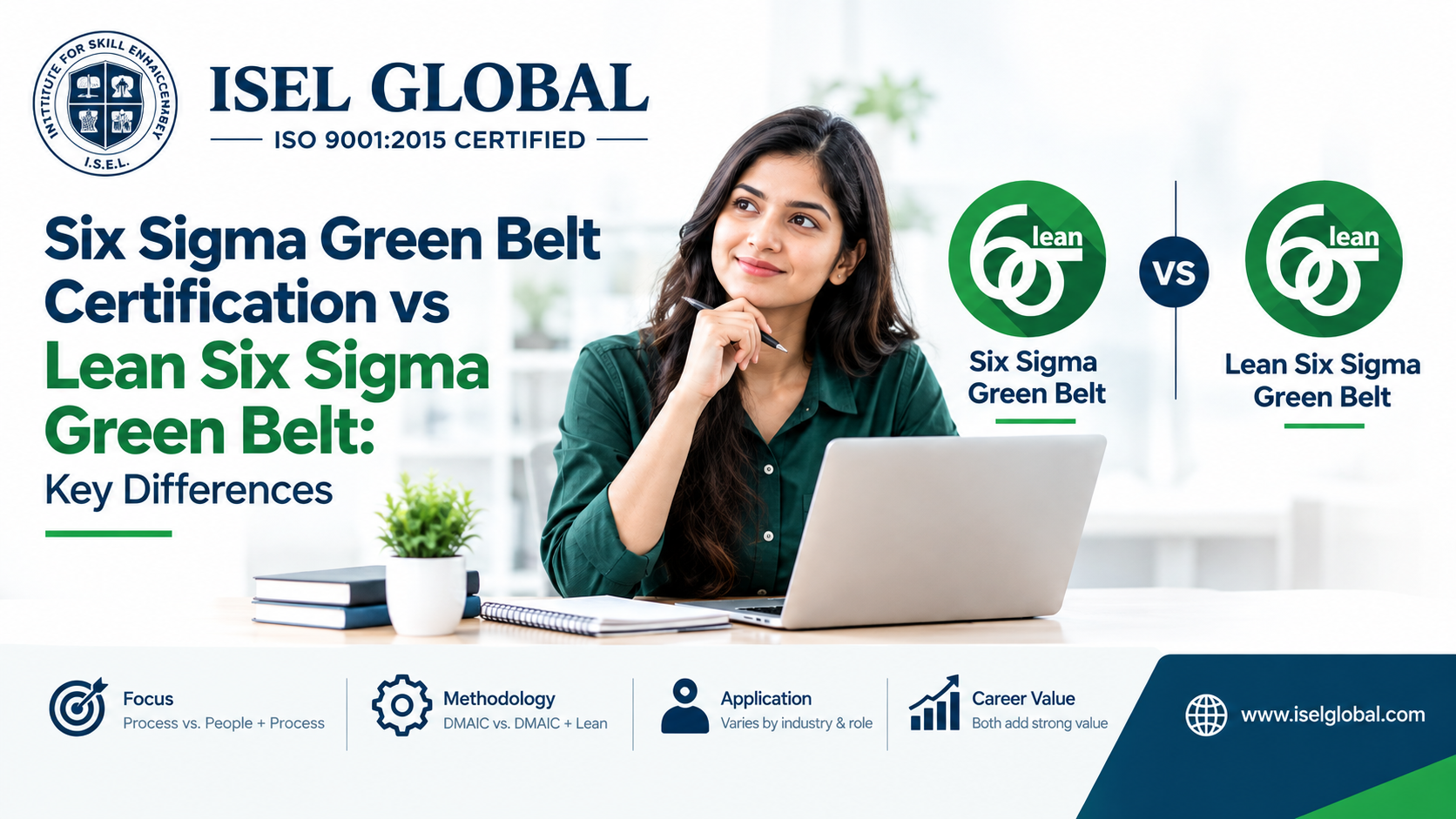
Choosing the right professional certification can be confusing when two programs have similar names and overlapping concepts. Lean Six Sigma Green Belt and Six Sigma Green Belt both teach professionals how to identify process problems, analyze data, reduce defects, and improve business performance. However, their emphasis is slightly different.
A Six Sigma Green Belt generally focuses more strongly on variation reduction, statistical analysis, process capability, and the DMAIC methodology. Lean Six Sigma Green Belt combines these Six Sigma techniques with Lean principles that target waste, delays, unnecessary activities, and poor process flow.
For working professionals, engineers, quality professionals, IT specialists, project managers, and students, understanding this difference can make it easier to choose the right lean six sigma certification for a career goal.
What is Six Sigma Green Belt?
Six Sigma Green Belt is a professional-level methodology focused on improving process quality by reducing defects, variation, and inconsistency. Green Belt professionals learn how to use data and structured problem-solving methods such as DMAIC to analyze processes and support measurable improvements.
The Six Sigma approach typically follows five stages:
- Define the problem and project objective
- Measure current process performance
- Analyze root causes
- Improve the process
- Control the improvement over time
A Green Belt may work on improvement projects alongside regular job responsibilities. The skills are relevant across manufacturing, healthcare, finance, IT, logistics, engineering, and service operations.
What is Lean Six Sigma Green Belt?
Lean Six Sigma Green Belt combines Six Sigma’s data-driven problem solving with Lean’s focus on eliminating waste and improving process flow. It helps professionals address both process variation and activities that consume time or resources without creating customer value.
Lean commonly looks at issues such as:
- Waiting time
- Excess inventory
- Unnecessary movement
- Overprocessing
- Defects and rework
- Overproduction
- Poor workflow
- Unused employee capability
This broader approach is why many organizations use Lean Six Sigma for continuous improvement projects.
Lean Six Sigma Green Belt vs Six Sigma Green Belt: What is the Difference?
The main difference is scope. Six Sigma Green Belt emphasizes variation, defects, statistical analysis, and process control, while Lean Six Sigma Green Belt adds Lean methods for reducing waste and improving flow. Both use structured improvement methods, and there is considerable overlap between their tools and project applications.
The easiest way to understand the difference is to look at the type of problem each approach emphasizes.
Six Sigma Green Belt
A traditional Six Sigma project may focus on:
- Reducing product defects
- Improving process capability
- Reducing variation
- Improving consistency
- Finding statistically significant root causes
- Establishing process controls
For example, a manufacturing company may discover that 8% of products fail a particular quality inspection. A Green Belt can collect process data, identify the major sources of variation, test improvement ideas, and establish controls to prevent the problem from returning.
Lean Six Sigma Green Belt
Lean Six Sigma can address the same quality problem while also examining the overall process.
For example, the company may discover that:
- Operators wait for materials.
- Inspection steps are duplicated.
- Products move unnecessarily between workstations.
- Rework creates additional queues.
- Poor workflow increases cycle time.
The project can therefore address both variation and waste rather than looking at quality performance alone.
Why is Lean Six Sigma Green Belt Important for Professionals?
Lean Six Sigma Green Belt is valuable because it gives professionals a structured way to improve quality, efficiency, productivity, and customer outcomes. Instead of relying only on experience or intuition, professionals learn to define problems, use evidence, identify root causes, implement improvements, and measure whether those improvements actually work.
These skills can support professionals who want to move into:
- Quality management
- Process improvement
- Operations
- Project management
- Business excellence
- Supply chain
- Manufacturing
- IT process management
- Continuous improvement
A professional can also use the methodology within an existing role rather than moving immediately into a dedicated quality position.
Who Should Take Lean Six Sigma Green Belt?
Lean Six Sigma Green Belt is suitable for professionals who participate in process improvement or want practical skills in quality, efficiency, and problem solving. It can be particularly useful for engineers, quality professionals, manufacturing specialists, project managers, IT professionals, operations teams, and business professionals working with measurable processes.
It may be a good choice if you:
- Work with recurring process problems
- Manage projects or teams
- Analyze operational data
- Want to improve productivity
- Work in quality or manufacturing
- Want to build a process-improvement career
- Plan to progress toward Black Belt-level responsibilities
Students can also study Lean Six Sigma concepts to build an understanding of structured problem solving before entering the workplace.
How does Lean Six Sigma Green Belt Training Work?
Lean Six Sigma Green Belt Training normally combines methodology, improvement tools, practical examples, and project-based problem solving. A strong program should help learners understand not only what each tool does, but also when to use it and how to interpret the results.
A practical Lean Six Sigma Green Belt Training program may cover:
Lean Fundamentals
Professionals learn to identify non-value-added activities and understand concepts such as:
- Value-added and non-value-added work
- 5S
- Kaizen
- Value Stream Mapping
- Visual management
- Standardized work
- Waste reduction
Six Sigma Fundamentals
Training generally introduces:
- DMAIC
- Process mapping
- Voice of the Customer
- Critical-to-Quality requirements
- Root cause analysis
- Basic statistics
- Process capability
- Control methods
Improvement Tools
Depending on the program, learners may work with tools such as:
- SIPOC
- Pareto analysis
- Fishbone diagrams
- 5 Whys
- FMEA
- Control charts
- Histogram
- Cause-and-effect analysis
- Measurement system concepts
The real value comes from understanding how these tools fit into a complete improvement project.
What Skills Will You Learn?
A Green Belt certification develops practical skills in structured problem solving, data analysis, process mapping, root cause analysis, waste reduction, and process control. These skills can be applied to real operational problems rather than being limited to one industry.
Important skills include:
- Problem definition
- Data collection
- Process analysis
- Root cause identification
- Waste identification
- Basic statistical thinking
- Improvement planning
- Risk analysis
- Team collaboration
- Process monitoring
For professionals comparing six sigma green belt and Lean Six Sigma options, the important question is not simply how many tools a course lists. The better question is whether the training teaches you how to select and apply those tools correctly.
Which Certification is Best for Your Career?
For professionals who want a broader process-improvement skill set, Lean Six Sigma Green Belt is often the more versatile option because it combines waste reduction with Six Sigma problem solving. A Six Sigma Green Belt can be a strong choice when the role has a greater focus on quality, variation, data analysis, and statistical improvement.
Consider your current work.
Choose a Six Sigma Green Belt when your primary interests are:
- Quality improvement
- Defect reduction
- Statistical analysis
- Process variation
- Process capability
- Quality control
Consider Lean Six Sigma Green Belt when your work also involves:
- Productivity improvement
- Waste reduction
- Cycle-time reduction
- Workflow optimization
- Operational efficiency
- Continuous improvement
Neither certification is automatically better for everyone. The better option depends on the projects you expect to handle.
What Comes After Green Belt?
Green Belt can be a foundation for professionals who later want to take on larger improvement projects and leadership responsibilities. Depending on experience and career goals, the next step may be a Black Belt certification, advanced Lean Six Sigma training, or eventually a Master Black Belt-level role.
Professionals considering a six sigma black belt should first build practical experience applying improvement methods.
A black belt certification generally involves greater project ownership, deeper analytical skills, leadership, and the ability to guide improvement teams.
Experienced professionals may eventually explore a master black belt or six sigma master black belt pathway, where the focus moves toward mentoring, deployment, strategy, and organizational improvement.
Career Opportunities After Green Belt Certification
Lean Six Sigma Green Belt can support careers in quality, operations, manufacturing, engineering, supply chain, project management, business process improvement, and IT operations. The certification itself does not guarantee a particular salary or job title, but it can strengthen a professional profile when combined with relevant experience and measurable project results.
Potential roles include:
- Quality Engineer
- Process Improvement Analyst
- Continuous Improvement Specialist
- Operations Analyst
- Project Manager
- Manufacturing Engineer
- Quality Manager
- Business Process Analyst
- Supply Chain Professional
- Operational Excellence Specialist
Salary varies significantly by location, industry, experience, role, and employer. Certification should therefore be viewed as a skill-building investment rather than a guaranteed salary increase.
Industries Hiring Lean Six Sigma Professionals
Lean Six Sigma methods are not restricted to factories.
Professionals may apply them in:
- Manufacturing
- Automotive
- Healthcare
- Banking and financial services
- IT and software
- Logistics
- Supply chain
- Retail
- Telecommunications
- Pharmaceuticals
- Consulting
- Business services
For example, an IT professional might use process mapping and root cause analysis to reduce ticket resolution time. A hospital team might examine patient waiting time. A logistics company might reduce delivery delays. A manufacturing engineer might reduce defects and production downtime.
The methodology stays similar, but the process and performance measures change.
Common Mistakes When Choosing a Certification
The most common mistake is choosing a certification based only on the course name, price, or certificate instead of evaluating the curriculum, practical learning, project exposure, assessment method, and relevance to the learner’s career.
Avoid these mistakes:
Choosing a course without checking the curriculum
Look beyond the title. Check whether the program covers DMAIC, Lean principles, data analysis, root cause analysis, process control, and practical applications.
Treating the certificate as the entire qualification
Employers often want evidence that you can apply what you learned. A completed improvement project can make the learning much more meaningful.
Selecting Black Belt too early
A Black Belt can be valuable, but professionals should consider their experience and responsibilities before jumping to an advanced level.
Focusing only on theory
A six sigma book or six sigma ebook can help with concepts, but reading alone does not create project experience. Training should connect theory with realistic business problems.
Ignoring the certification provider
Compare the trainer’s expertise, course structure, assessment process, project work, learner support, and industry relevance before enrolling.
Best Practices for Getting Value From Your Certification
The best way to benefit from Lean Six Sigma certification is to connect learning with a real process problem. Start with a measurable issue, establish a baseline, identify verified causes, test improvements, and monitor the result.
A practical approach is:
- Choose a process you understand.
- Define one measurable problem.
- Collect reliable baseline data.
- Map the current process.
- Identify potential root causes.
- Select appropriate Lean and Six Sigma tools.
- Test improvement ideas.
- Measure the result.
- Standardize the improved process.
- Continue monitoring performance.
This approach helps turn certification knowledge into professional experience.
Is Lean Six Sigma Green Belt Worth It?
Yes, Lean Six Sigma Green Belt can be worthwhile when the certification matches your career goals and you have opportunities to apply the methodology. Its value is strongest when training leads to practical skills, project experience, and measurable process improvements rather than simply adding another certificate to a résumé.
For someone working in operations, quality, engineering, manufacturing, IT, or project management, the methodology can become a useful problem-solving framework.
If you are comparing six sigma certification online India options, focus on practical curriculum, instructor expertise, learning support, assessment, and project application rather than choosing solely on price.
Frequently Asked Questions
Is Lean Six Sigma Green Belt the same as Six Sigma Green Belt?
No. They overlap substantially, but Lean Six Sigma adds Lean principles to the Six Sigma approach. Six Sigma places stronger emphasis on variation, defects, statistical analysis, and process control, while Lean Six Sigma also addresses waste, flow, productivity, and cycle time.
Can beginners pursue a Green Belt certification?
Yes, depending on the certification provider’s eligibility requirements. Beginners should choose a program that explains the fundamentals clearly and provides practical examples. Professionals with existing process or project experience may find it easier to connect the concepts with real workplace situations.
Is Lean Six Sigma Green Belt useful outside manufacturing?
Yes. Lean Six Sigma can be applied to IT, healthcare, banking, logistics, retail, telecommunications, consulting, and service operations. Any environment with repeatable processes, measurable performance, delays, defects, rework, or inefficiencies can potentially benefit from structured improvement methods.
Should I choose Green Belt or Black Belt?
Green Belt is generally a better starting point for professionals who are developing process-improvement skills or participating in improvement projects. Black Belt is more suitable for professionals taking greater ownership of complex improvement initiatives and leading teams or projects.
Can a Six Sigma Green Belt help with career growth?
It can strengthen a professional profile by demonstrating knowledge of structured problem solving, process analysis, and improvement methods. However, certification alone does not guarantee promotion or a salary increase. Practical application, work experience, communication skills, and measurable project results remain important.
Is Lean Six Sigma certification useful for IT professionals?
Yes. IT teams can apply Lean Six Sigma concepts to incident management, service delivery, software processes, customer support, project workflows, and operational efficiency. The key is to adapt the methodology to the process rather than applying manufacturing examples without considering the IT environment.
Do I need a Six Sigma book before taking certification training?
No, a separate book is not always necessary. However, a good six sigma book or six sigma ebook can be useful for revision, terminology, examples, and continued learning. The most important factor is having structured training and opportunities to apply the concepts.
Can Green Belt lead to Black Belt?
It can be a useful progression. Professionals can build Green Belt knowledge, gain practical project experience, strengthen analytical skills, and then evaluate whether a six sigma black belt course or Black Belt certification fits their responsibilities and career direction.
Which is better for working professionals: online or classroom training?
Both formats can work well. Six Sigma certification online India programs offer flexibility for professionals managing work schedules, while classroom or live instructor-led formats can provide more direct interaction. The quality of curriculum, trainer, practical exercises, assessment, and learner support matters more than format alone.
Where should I start if I want a Lean Six Sigma career?
Start by understanding your current role and the type of improvement work you want to perform. A Green Belt program can provide a structured foundation. After gaining practical experience, you can consider advanced lean six sigma black belt or leadership-level pathways based on your career goals.
What is the main difference between Six Sigma Green Belt and Lean Six Sigma Green Belt?
Six Sigma Green Belt focuses primarily on reducing process variation, defects, and quality problems through data-driven methods. Lean Six Sigma Green Belt combines these techniques with Lean principles for eliminating waste, improving flow, reducing delays, and increasing efficiency. Both approaches use structured improvement methods and share many tools.
Which is better: Six Sigma Green Belt or Lean Six Sigma Green Belt?
There is no universal winner. Six Sigma Green Belt may suit professionals focused on quality, variation, and statistical improvement. Lean Six Sigma Green Belt can be more suitable for professionals who also want to improve workflow, productivity, cycle time, and waste. Your current role and career goals should guide the decision.
Who should take Lean Six Sigma Green Belt Training?
Lean Six Sigma Green Belt Training is useful for engineers, quality professionals, manufacturing professionals, IT professionals, project managers, operations teams, business professionals, and students interested in process improvement. It is especially relevant for people who regularly work with measurable processes, recurring problems, delays, defects, or efficiency challenges.
Is Lean Six Sigma Green Belt useful for IT professionals?
Yes. IT professionals can apply Lean Six Sigma to service delivery, incident management, customer support, project workflows, process standardization, and operational efficiency. The methodology can help teams identify bottlenecks, analyze root causes, reduce unnecessary steps, and create more consistent processes.
Does Green Belt certification guarantee a higher salary?
No certification can guarantee a specific salary or promotion. Its value depends on the professional’s experience, role, industry, employer, and ability to apply the methodology. Certification becomes more valuable when combined with practical project experience and measurable improvements in quality, cost, productivity, or customer outcomes.
Should I take Green Belt before Black Belt?
For many professionals, Green Belt is a practical starting point because it develops core process-improvement skills. Black Belt generally requires greater responsibility and deeper project knowledge. Professionals should consider their experience, current responsibilities, career objectives, and the requirements of their chosen certification provider before selecting an advanced level.
Can I study Lean Six Sigma online?
Yes. Online learning can be convenient for working professionals and students. When evaluating an online program, check the curriculum, instructor experience, practical exercises, assessment process, project exposure, learner support, and certification requirements. A flexible format is useful only when the learning experience provides sufficient depth and practical application.
What should I look for in a Lean Six Sigma certification program?
Look for a clearly structured curriculum covering Lean principles, DMAIC, process mapping, root cause analysis, data analysis, improvement methods, and process control. Also evaluate trainer expertise, practical examples, project work, assessments, learner support, and the credibility of the certification provider.
Can Green Belt certification help me move toward Black Belt?
Yes. Green Belt can provide a foundation for professionals who later want to handle larger or more complex improvement projects. Building real project experience, strengthening analytical skills, and understanding business impact can help professionals determine when they are ready to pursue Black Belt-level training or certification.
Is Lean Six Sigma Green Belt worth it in 2026?
It can be a worthwhile professional-development choice when the skills are relevant to your role and you have opportunities to apply them. In 2026, professionals should focus less on collecting certificates and more on developing practical capabilities in process improvement, data-based decision making, efficiency, quality, and measurable business results.