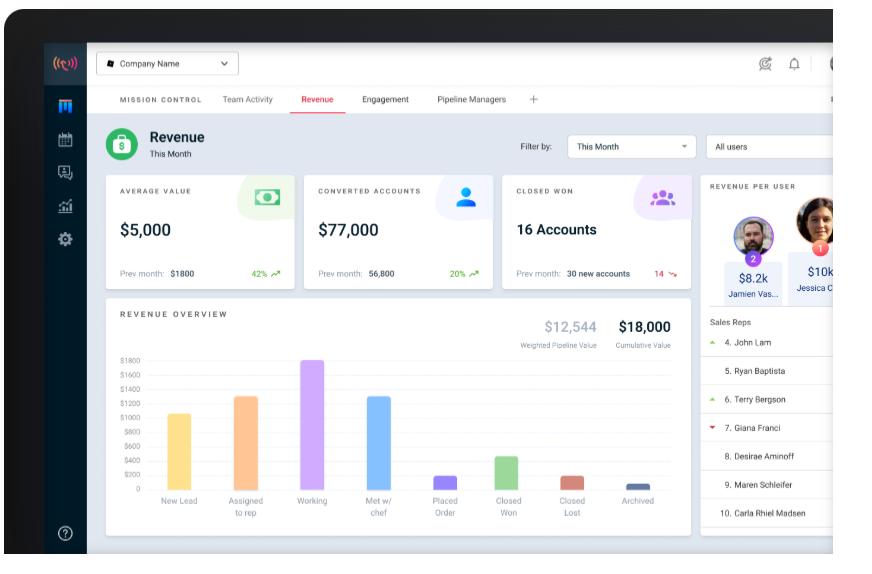
Pipeline management helps businesses organize opportunities, monitor progress, and guide potential customers through the sales process. It provides a structured view of deals at different stages, allowing sales teams to identify priorities, manage follow-ups, and make more informed decisions.
Without a clear pipeline management process, businesses may struggle with inconsistent lead tracking, missed opportunities, unreliable forecasts, and limited visibility into sales performance. A well-managed pipeline helps teams understand which deals require attention and where improvements are needed.
Effective pipeline management creates a more predictable sales process by combining clear stages, accurate data, consistent follow-ups, and measurable performance goals.
What Is Pipeline Management?
Pipeline management is the process of organizing, tracking, and improving opportunities as they move through a defined business workflow. In sales, it focuses on monitoring potential deals from initial lead qualification through negotiation and closing.
Businesses commonly use customer relationship management (CRM) software or specialized pipeline management tools to track opportunities, assign responsibilities, record interactions, and review progress.
Although sales pipeline management is a common application, the concept also applies to project planning, recruitment, partnerships, and other processes where opportunities move through a series of stages.
How Pipeline Management Works
The process begins when a potential opportunity enters the pipeline. Sales representatives collect relevant information, determine whether the opportunity is suitable, and guide it through the appropriate stages.
A typical workflow includes:
- Identifying and capturing potential leads.
- Qualifying leads based on business requirements.
- Assigning opportunities to the appropriate representatives.
- Recording conversations, activities, and deal details.
- Scheduling follow-ups and next steps.
- Updating deal stages as progress occurs.
- Forecasting revenue and reviewing pipeline performance.
Each stage should have clear entry and exit criteria so that opportunities progress based on meaningful actions rather than assumptions.
Why Pipeline Management Matters
A sales pipeline provides a shared view of potential revenue and the work required to generate it. Managers can identify stalled deals, recognize gaps in the sales process, and allocate resources more effectively.
A clearly defined pipeline helps businesses replace guesswork with structured opportunity tracking and evidence-based decisions.
Key Stages of a Sales Pipeline
Sales pipeline stages vary according to the industry, sales cycle, and complexity of the product or service. However, most pipelines follow a similar progression.
| Pipeline stage | Main activity | Desired outcome |
|---|---|---|
| Lead generation | Identify potential customers | Create a pool of potential opportunities |
| Lead qualification | Evaluate fit and business needs | Identify promising prospects |
| Initial contact | Establish communication | Confirm interest and arrange discussions |
| Discovery | Understand challenges and requirements | Determine whether the solution is suitable |
| Proposal | Present the recommended solution and pricing | Provide a clear offer |
| Negotiation | Address concerns and finalize terms | Reach agreement on key conditions |
| Closing | Complete the purchase or agreement | Win the deal |
| Follow-up | Maintain the relationship after the decision | Support retention and future opportunities |
Lead Generation and Qualification
Lead generation introduces potential customers into the pipeline. These leads may come from referrals, marketing campaigns, website inquiries, events, or outbound prospecting.
Qualification determines whether a lead matches the business’s target customer profile and has a plausible need for the offering. Criteria may include budget, authority, business requirements, timing, and organizational fit.
Discovery and Proposal
During discovery, sales representatives learn about the prospect’s challenges, objectives, and purchasing process. This information helps them determine whether the offering is appropriate.
A proposal then outlines the recommended solution, deliverables, pricing, and relevant terms. Keeping the proposal aligned with the discovery conversation improves clarity and reduces misunderstandings.
Negotiation and Closing
Negotiation addresses pricing, scope, implementation, and contractual concerns. Representatives should record important commitments and update the pipeline when the opportunity’s status changes.
A closed deal may be classified as won or lost. Recording both outcomes helps businesses understand conversion rates and improve future sales strategies.
Benefits of Effective Pipeline Management
A structured pipeline can improve sales operations, forecasting, and team coordination.
Better Sales Visibility
Pipeline management provides a consolidated view of active opportunities, their current stages, estimated values, and next actions.
Managers can identify which deals need attention without relying entirely on individual updates or scattered spreadsheets.
More Accurate Revenue Forecasting
Forecasting uses pipeline information to estimate potential future revenue. When deal values, expected closing dates, and opportunity statuses are maintained consistently, forecasts can become more useful for planning.
Forecast accuracy still depends on the quality of the underlying information and the assumptions used to estimate deal outcomes.
Improved Follow-Up Consistency
Opportunities often stall when representatives fail to schedule the next action or respond promptly to a prospect’s questions.
Pipeline tools can provide reminders, task assignments, and activity tracking that help teams maintain consistent communication.
Higher Team Productivity
A standardized process reduces the time spent searching for information, updating disconnected records, and preparing manual reports.
Sales representatives can focus more attention on qualified prospects, meaningful conversations, and opportunities with a realistic chance of closing.
Earlier Identification of Sales Problems
Pipeline analysis can reveal recurring issues, such as low qualification rates, long negotiation periods, or a large number of deals that remain inactive.
Identifying these problems early gives managers an opportunity to improve the process before they significantly affect sales results.
Essential Features of Pipeline Management Software
Pipeline management software helps businesses centralize opportunity information and coordinate sales activities. The most useful features depend on the organization’s size, workflow, and reporting needs.
1. Visual Pipeline Boards
Visual boards display opportunities according to their current stages. Representatives can quickly see where deals stand and identify which ones require immediate attention.
Some platforms also support customizable stages, filters, and different views for teams, territories, or product lines.
2. Contact and Deal Management
A central record for each opportunity can store company information, contact details, estimated deal value, communication history, expected closing date, and assigned owner.
Keeping these details together helps team members understand an opportunity’s history and coordinate their activities.
3. Workflow Automation
Automation can handle repetitive administrative tasks such as creating follow-up reminders, assigning leads, updating fields, and notifying managers about important changes.
Automations should be based on clear rules and monitored regularly to avoid incorrect assignments or unnecessary notifications.
4. Reporting and Analytics
Reporting features help managers track conversion rates, pipeline value, sales cycle length, deal velocity, and representative performance.
These insights support coaching, resource planning, and continuous improvement.
5. CRM and Business Integrations
Integrations connect pipeline management software with email, calendars, marketing platforms, document tools, and other business systems.
A connected workflow reduces duplicate data entry and makes it easier to maintain a consistent record of sales activities.
6. Mobile Access and Collaboration
Mobile access allows sales representatives to update opportunities while traveling or meeting customers. Collaboration features help managers and colleagues share updates, review deals, and coordinate next steps.
These capabilities are especially valuable for teams working across locations or managing complex sales cycles.
How to Choose the Right Pipeline Management Tool
The right tool should match the sales process rather than force the business into an unnecessarily complicated workflow.
Define Business Requirements
Before comparing software, businesses should identify the main problems they want to solve.
Compare Features and Pricing
| Evaluation factor | What to review |
|---|---|
| Pipeline customization | Whether stages match the sales process |
| Automation | Available triggers, rules, and reminders |
| Reporting | Forecasting and performance metrics |
| Integrations | Compatibility with existing systems |
| Ease of use | Training requirements and interface simplicity |
| Security | Permissions, access controls, and data protection |
| Scalability | Ability to support additional users and workflows |
| Cost | Subscription fees, usage limits, and implementation expenses |
Small businesses may need only basic opportunity tracking, while larger teams may benefit from advanced forecasting, automation, and administrative controls.
Test the Tool Before Implementation
A trial or demonstration can reveal whether the software fits real-world workflows. Businesses should test opportunity creation, stage changes, reporting, notifications, and integrations before making a long-term commitment.
The best pipeline management software is one that the team can use consistently and that provides reliable information for decision-making.
Pipeline Management KPIs and Metrics
Key performance indicators help businesses evaluate pipeline health and determine where improvements are needed.
Important Pipeline Metrics
| Metric | What it measures | Why it matters |
|---|---|---|
| Total pipeline value | Combined estimated value of open deals | Shows potential sales volume |
| Win rate | Percentage of opportunities won | Measures conversion effectiveness |
| Average deal size | Average value of closed deals | Helps evaluate deal economics |
| Sales cycle length | Time required to close deals | Reveals delays and process efficiency |
| Pipeline velocity | Speed at which opportunities generate revenue | Helps evaluate pipeline productivity |
| Stage conversion rate | Percentage of deals progressing between stages | Identifies weak stages |
| Forecast accuracy | Difference between predicted and actual results | Measures forecasting reliability |
How to Use Metrics Effectively
Metrics should be reviewed together rather than in isolation. A large pipeline value, for example, may be misleading if many opportunities are poorly qualified or unlikely to close.
Managers should compare performance across appropriate periods and segments while considering differences in deal size, sales cycle, and customer type.
Best Practices for Improving Pipeline Performance
Effective pipeline management requires consistent execution and regular review.
- Standardize pipeline stages: Define clear criteria for moving opportunities forward.
- Keep records current: Update deal values, expected closing dates, and next actions.
- Prioritize qualified opportunities: Focus resources on deals that match the target customer profile.
- Schedule regular pipeline reviews: Discuss progress, risks, and required support.
- Use automation carefully: Automate repetitive work while preserving meaningful human interaction.
- Analyze lost deals: Identify recurring objections, competitive challenges, and qualification gaps.
- Train sales representatives: Ensure team members understand the process and performance expectations.
- Align sales and marketing: Agree on lead qualification criteria and the information needed for handoffs.
Regular reviews should focus on decisions and actions, not merely collecting status updates.
Common Pipeline Management Mistakes to Avoid
Keeping Inaccurate Deal Information
Outdated values, unrealistic closing dates, and incorrect opportunity stages can undermine forecasting. Teams should establish clear rules for updating records and reviewing inactive opportunities.
Creating Too Many Pipeline Stages
An overly complicated pipeline increases administrative effort and makes reporting harder to interpret. Each stage should represent a meaningful change in the buying process.
Ignoring Stalled Opportunities
Deals that remain inactive for long periods can distort the apparent health of the pipeline. Representatives should identify the reason for delays, establish a next step, or update the opportunity’s status.
Relying Only on Total Pipeline Value
The value of open deals does not guarantee future revenue. Businesses should also evaluate deal quality, stage conversion rates, historical outcomes, and closing timelines.
Failing to Review Performance
Pipeline management is an ongoing process. Without regular analysis, teams may repeat ineffective practices and miss opportunities to improve sales execution.
Frequently Asked Questions
What is pipeline management in sales?
Pipeline management is the process of tracking and improving sales opportunities as they move from initial lead generation to a final outcome. It helps teams manage follow-ups, monitor deal progress, and estimate future revenue.
What is the difference between pipeline management and CRM?
Pipeline management focuses on tracking opportunities through defined stages. A CRM is a broader system for managing contacts, accounts, interactions, and customer relationships. Many CRM platforms include pipeline management features.
What is the best pipeline management software?
The best option depends on the business’s sales process, team size, budget, integration requirements, and reporting needs. Businesses should compare usability, automation, forecasting, customization, and scalability before choosing a tool.
How often should a sales pipeline be reviewed?
Many teams review their pipelines weekly, with more frequent reviews for fast-moving or high-value opportunities. The ideal schedule depends on sales cycle length, deal complexity, and the level of management oversight required.
How can pipeline management improve forecasting?
Pipeline management improves forecasting by keeping opportunity values, stages, closing dates, and next actions organized. Reliable historical data and realistic probability estimates further improve forecast quality.
Conclusion
Pipeline management gives businesses a structured way to track opportunities, improve sales coordination, and understand potential revenue. By defining clear stages, maintaining accurate records, using appropriate software, and monitoring meaningful performance metrics, sales teams can identify risks earlier and make better decisions.
The process becomes more effective when representatives follow consistent qualification standards, managers conduct useful pipeline reviews, and teams use data to improve their sales approach.
Successful pipeline management is not simply about tracking more deals. It is about understanding opportunity quality, taking the right actions at the right time, and building a more predictable sales process.