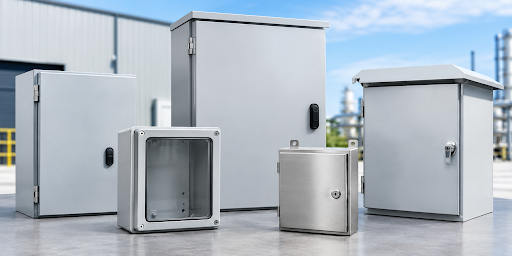
Electrical equipment needs more than functional components to operate safely and reliably. The enclosure surrounding that equipment can play an equally important role by helping protect internal components from environmental conditions, accidental contact, dust, water, and other hazards. Choosing the appropriate enclosure therefore requires an understanding of the installation environment and the protection required.
Although the keyword NEMA Enclosures is often searched with this spelling, the correct industry term is NEMA enclosures. These products are classified according to standards that help users determine the environmental protection an enclosure is designed to provide. NEMA 250, for example, establishes requirements for enclosure construction, testing, rating, and marking.
What Are NEMA Enclosures?
NEMA enclosures are protective housings designed for electrical equipment and are classified according to National Electrical Manufacturers Association enclosure types. The classification system helps describe the environmental conditions against which an enclosure is intended to protect its contents.
NEMA 250 covers enclosures for electrical equipment rated at not more than 1,000 volts and includes classifications for indoor, outdoor, and certain hazardous-location applications. Different enclosure types address different environmental concerns, including exposure to water, dust, corrosion, oil, and other conditions.
Importantly, NEMA ratings describe the protection characteristics of an enclosure rather than establishing one universal enclosure size. NEMA itself notes that there are no standard enclosure dimensions; manufacturers can produce enclosures in different sizes while meeting applicable construction and testing requirements.
Why Does the NEMA Rating Matter?
The environment in which electrical equipment operates can have a significant effect on its service life. An enclosure intended for a clean indoor electrical room may not provide the protection needed for an outdoor installation exposed to rain or snow.
NEMA enclosure classifications help engineers, electricians, and equipment users select protection based on the expected environment. For example, some types are intended primarily for indoor use, while others are designed for indoor or outdoor locations and provide protection against particular forms of water or solid-material ingress.
Some ratings also address additional environmental hazards. NEMA explains that its enclosure classifications can include considerations such as corrosion, rust, icing, oil, and coolants, which means they are not simply another way of describing resistance to dust and water.
Common Applications for NEMA Enclosures
NEMA-rated housings can be used across many electrical installations. Their applications may include control equipment, electrical distribution components, industrial machinery, automation systems, instrumentation, and wiring connections.
Industrial facilities may require enclosures that can withstand exposure to moisture, dust, oils, or cleaning processes. Outdoor electrical installations may require protection against rain, snow, sleet, and other weather conditions.
Junction and pull-box applications are another important area. NEMA’s standards resources specifically include junction boxes, pull boxes, conduit bodies, and related covers within its electrical product standards.
The correct enclosure depends on the equipment being housed and the environmental conditions surrounding the installation. Simply selecting an enclosure because it has a familiar NEMA number may not be sufficient without considering the actual application.
How Should You Choose a NEMA Enclosure?
Start by identifying where the enclosure will be installed. Indoor installations generally have different environmental requirements from outdoor or industrial applications. Consider exposure to rain, water, dust, oil, corrosive substances, temperature changes, and physical conditions.
Next, determine what equipment will be installed inside the enclosure. Available internal space, cable-entry requirements, mounting arrangements, access requirements, and heat management can all influence the appropriate design.
The enclosure’s material can also matter. Depending on the environment, manufacturers may offer metal or nonmetallic construction with characteristics suited to particular applications. Corrosive environments, for example, may require different considerations from a clean indoor electrical room.
Finally, verify the applicable standards and installation requirements. NEMA 250 establishes enclosure requirements, while the National Electrical Code and manufacturer instructions may also affect how equipment must be installed and used.
NEMA Ratings and IP Ratings Are Not Identical
NEMA classifications are sometimes compared with IP ratings, but they should not automatically be treated as interchangeable. NEMA explains that its enclosure types can address additional hazards beyond the ingress protection evaluated by the IP system.
For example, NEMA Type 4 and Type 4X address protection against specific solid and water exposure, while Type 4X additionally addresses corrosion. NEMA also notes that IP ratings cannot simply be converted into NEMA enclosure types because the testing criteria are different.
Understanding this distinction helps prevent incorrect enclosure selection when equipment specifications reference both systems.
Conclusion
Selecting NEMA enclosures is ultimately about matching the enclosure’s construction and environmental rating to the conditions of the electrical installation. Factors such as location, moisture exposure, dust, corrosion, equipment size, wiring requirements, and applicable electrical standards should all be evaluated before choosing a design. For installations involving electrical pull boxes, the enclosure must also accommodate practical requirements such as cable routing, accessibility, mounting, and protection of electrical connections. A properly selected enclosure can contribute to equipment protection and dependable operation while supporting compliance with applicable installation requirements.