

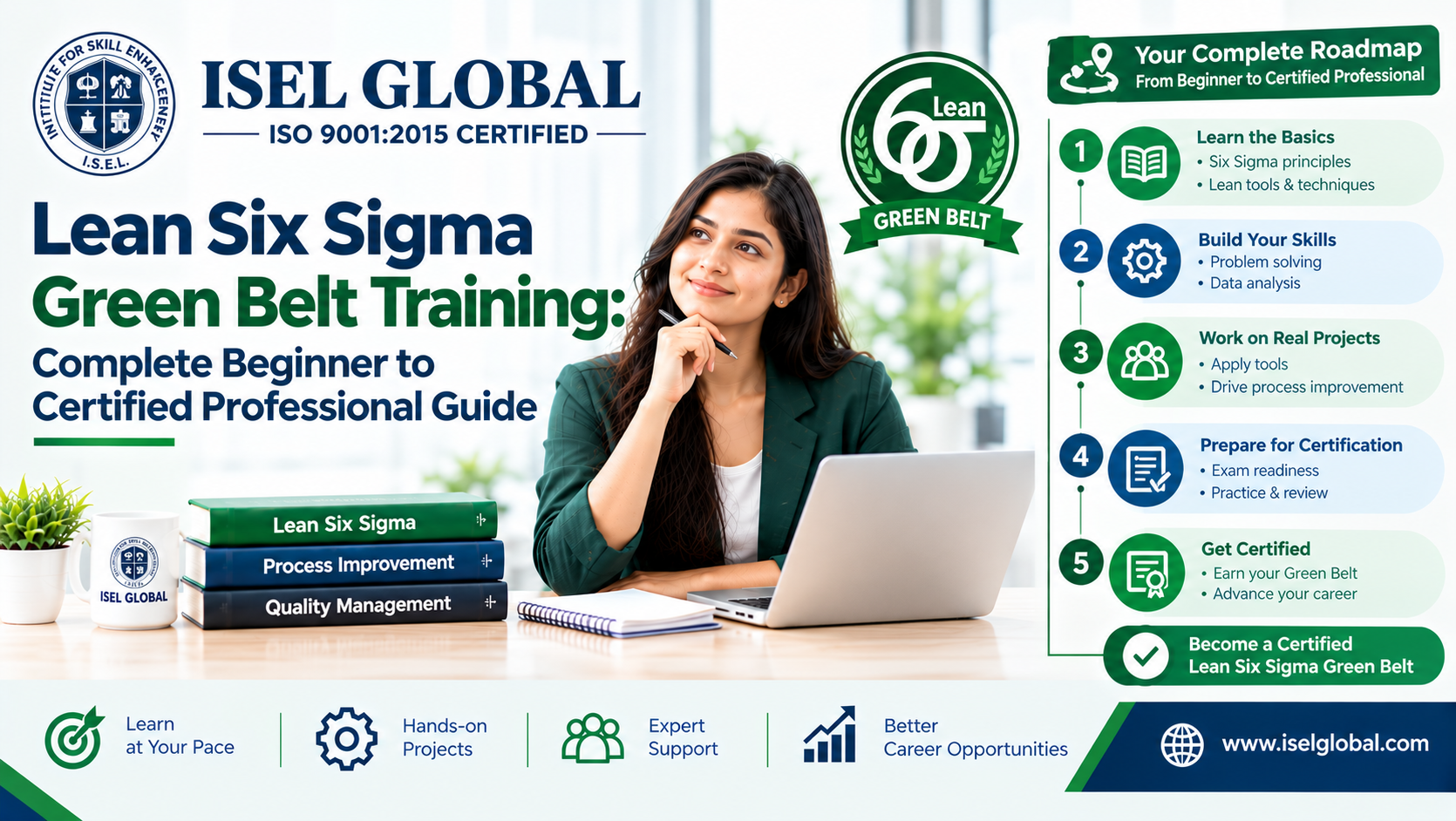
The Lean Six Sigma Green Belt Training equips professionals with the ability to identify inefficiencies and improve upon them, reduce defects and improve the efficiency of their organisations. It highlights the techniques that save costs and improve quality control.
In this article, we will learn about the topics under the Lean Six Sigma Green Belt certification, the skills you gain through it, the DMAIC methodology, the advantages of getting it and how to choose a good training course.
What Is Lean Six Sigma Green Belt Certification?
The purpose of Lean Six Sigma Green Belt training is to provide instruction to professionals in the implementation of the process improvement technique, which is used for getting rid of waste, reducing defects and making decisions based on facts and not on opinions.
There are two methodologies involved in this process; one of them is Lean, which involves elimination of non-value-added activities, and the other is Six Sigma, which focuses on the removal of defects from the process.
Lean Six Sigma Green Belt is the certification that assists organisations in improving their performance, empowering employees, having more satisfied customers and obtaining competitive advantage.
What You Learn in Lean Six Sigma Green Belt Training
One of the key benefits of Lean Six Sigma Green Belt Training is its practical approach to problem-solving. Learners develop the ability to understand processes, identify inefficiencies, test potential solutions and evaluate results using data. These skills help professionals make informed decisions and contribute to continuous improvement initiatives.
The DMAIC framework—Define, Measure, Analyse, Improve and Control—is a structured problem-solving method used to improve existing processes. Lean Six Sigma Green Belt professionals use this approach to identify problems, measure performance, investigate root causes, test solutions and maintain improvements over time.
Step 1: Problem Definition
This step entails defining the problem, its implications and the desired outcome.
For instance, a warehouse can experience problems with order dispatch delays. Before suggesting ways to solve the problem, the Green Belt defines the problem statement, pinpoints the process and sets measurable goals.
Clear definition of the problem helps not to waste time on trying to solve issues which are not related to the real causes.
Step 2: Measurement of the Current Process
In this step, professionals collect data to see how the process works at present.
When speaking about the warehouse issue, the learner could define the average time of order dispatching, the percentage of late orders and orders processed during each shift.
Measurements help set the baseline. Without a baseline, it will be difficult to evaluate if the suggested solution brought any improvements.
Step 3: Analysis of the Problem Root Causes
This step implies investigation of why the problem exists using various tools such as a fishbone diagram, Five Whys, Pareto and process mapping.
Thus, the team can find out that the problem happens because of inaccuracies in the inventory record and not the lack of personnel.
Step 4: Process Improvement
Once the root cause of the problem is found, the team continues by formulating and testing possible solutions to the problem. The possible solutions could range from improvement in the inventory audit process, a quick authorisation process or a new picking process.
The emphasis here is on formulation of possible solutions to the identified problem and the value addition from such solutions.
Step 5: Control and Sustain Improvement
This is the last step of any improvement process whereby efforts are made to ensure the maintenance of the improvements achieved even after completion of the improvement project. This can be done through the formulation of standard operating processes, performance dashboards, audits and training of the staff members.
The essence of any improvement process is not only in improving but also sustaining the same in future.
Example: Applying DMAIC to Reduce Order Dispatch Delays
Suppose a warehouse finds that 25% of customer orders are dispatched late. A Green Belt team could begin by defining the problem and measuring current dispatch performance. The team would then analyse potential causes, such as inaccurate inventory records or unnecessary approval steps, before testing improvements to the picking and dispatch process.
For illustration, if the late-dispatch rate fell from 25% to 10% after the changes, the team would document the results and monitor performance through dashboards and regular audits. These figures are hypothetical and demonstrate how DMAIC can be applied in practice.
Career Opportunities After Lean Six Sigma Green Belt Certification
The Lean Six Sigma Green Belt certificate can be useful for those looking to enhance their skills in problem-solving and assume additional responsibilities in the workplace. The ability to improve processes can be helpful in any industry such as manufacturing, health care, IT, and supply chain management.
Based on your education, experience, and industry, you can consider applying for a number of jobs, depending on your Green Belt training. The certificate itself does not ensure employment or advancement in your career.
·Quality Analyst: defect detection, development and control of processes and standards, providing recommendations.
·Process Improvement Analyst: knowledge of limitations of processes, designing and implementing new processes.
·Operations Executive/Manager: increasing productivity, controlling and using resources.
·Business Analyst: dealing with business problems through process analysis.
·Project Coordinator: project and process improvement coordination.
·Supply Chain: cost and inventory control, distribution, waste management, delivery time of goods control.
Six Sigma Belt Levels Explained
In Six Sigma training, there is a belt system, which is like that in martial arts where each stage has its own level of process improvement. Knowing more about these belts will help people select their career track in Six Sigma:
· White and Yellow Belts
White and Yellow Belts usually possess a basic understanding of process improvement concepts and can assist in data collection, process mapping and problem identification activities.
Green Belts usually use process improvement techniques to implement their projects. They can conduct small projects or assist Black Belts according to their experience and organisational roles.
· Six Sigma Black Belt
Black Belts usually conduct large-scale process improvement projects, carry out statistical analysis to uncover root causes and assist teams in implementing the DMAIC technique.
Master Black Belts usually mentor other belts, provide technical assistance and conduct strategic process improvement projects.
How to Choose the Right Lean Six Sigma Green Belt Training Course
When selecting an appropriate Lean Six Sigma Green Belt training course, it is important to look at other elements besides just the cost of the training course. A training course that includes the content on the DMAIC approach, root cause analysis, process mapping, basic statistics, and project management of improvement would be ideal.
Check the Course Syllabus and Practical Training
Choose the course that covers such topics as DMAIC approach, root cause analysis, process mapping, basic statistics, performance measurement, and improvement project management.
Practical application is crucial. The presence of case studies, assignments, and projects will enable you to gain some experience with the practical application of the tools under discussion.
Inquire about the presence of instructor assistance, assessments, downloadable materials, and discussions of project issues.
Online vs. Classroom Lean Six Sigma Training
Online training may suit working professionals and those who want flexibility in their schedule. When looking for Six Sigma certification online in India, it is essential to find recorded training sessions, live sessions, available trainers, and information about the test procedure.
Offline training may help individuals who prefer interacting in the classroom. Someone who wants to opt for Six Sigma certification in Mumbai may consider both types of training depending on commuting time and the help available.
Study Materials and Green Belt Certification Preparation
Revisions are better than cramming definitions just before a test. Have a study timetable, do questions, and revise the difficult aspects like variation in process, measurements, and root cause analysis. An efficient Six Sigma book will provide you with proper guidance, whereas a Six Sigma eBook related to your syllabus can be handy revision material on your phone or laptop.
Conclusion
The Lean Six Sigma Green Belt Training assists individuals in acquiring hands-on knowledge in process improvements, cause-and-effect studies, and data-based decision-making. This is achieved by gaining skills such as DMAIC framework knowledge and application and using tools such as process mapping and statistical tools to analyse issues and look for improvement opportunities.
When selecting a course in Lean Six Sigma Green Belt certification, one needs to evaluate the syllabus of the course and the various exercises involved, among other important areas to consider.
FAQs
1. What is a Six Sigma Green Belt?
Six Sigma Green Belt indicates a practitioner’s level of expertise in the field of process improvement, quality management and data analysis. In general, a green belt is aware of the DMAIC methodology and quality tools such as process mapping, root-cause analysis, control charts and basic statistical analysis. Green Belts often lead smaller-scale projects or support Black Belts with larger-scale initiatives.
2. Is Six Sigma Green Belt worth it?
Six Sigma Green Belt certification may be valuable for professionals involved in quality management, manufacturing, operations, project management and business analysis. Its value depends on the relevance of the skills to your role, the credibility of the certification and your ability to apply the methods in practice. Before enrolling, compare the course cost, assessment requirements and practical project opportunities.
3. Who Should Participate in Six Sigma Green Belt Training?
Participants in Six Sigma Green Belt training can be engineers, manufacturing personnel, quality analysts, project managers, business analysts, information technology experts and many others. This type of certification applies to people who deal with processes, process data, customer needs, quality management and other similar spheres. The experience required for Six Sigma Green Belt certification varies depending on the certificate being pursued.
4. What Skills Can Be Developed via Six Sigma Green Belt Certification?
People who are assigned the position of a Six Sigma Green Belt need to be aware of a wide range of issues, including lean principles, basics of Six Sigma, the DMAIC approach, process mapping, data gathering, descriptive statistics, root cause analysis, process capability, control charts, statistical process control, and many other things. Moreover, many Six Sigma Green Belts are trained in managing projects.
5. What is the difference between Six Sigma Green Belt and black belt?
The major distinction between a black belt and green belt is the difference in the range of responsibilities and skills. In general, green belts deal with small-scale projects, which can be performed either alone or under the leadership of a black belt holder. Black belts, in turn, work with complicated projects that require greater experience in Six Sigma methodologies and statistics.
6. Can I do Six Sigma certification online in India?
Six Sigma certification online in India is possible, but it is critical to clarify all details with the selected provider. Generally speaking, there are two types of online Six Sigma courses: training programs and examination preparation services. For example, IASSC offers a range of web-based certification exams, whereas ASQ conducts computer-based testing and provides relevant training resources.
7. What type of job opportunities will I have with the Green Belt certification for Six Sigma?
Jobs that are open to the Six Sigma Green Belt holder are quality analyst, process improvement specialist, manufacturing engineer, industrial engineer, operations manager, business analyst, IT operations specialist, supply chain analyst, and much more. Jobs that are available to the Six Sigma Green Belt are numerous and can be found in the manufacturing sector, healthcare industry, IT industry, and many more.
8. Is it necessary to have Green Belt Six Sigma or black belt Six Sigma?
It all comes down to personal preference and what one aims to accomplish in his/her career. Normally, Green Belt Six Sigma is ideal for those participating in quality improvement projects, whereas Black Belt Six Sigma is more appropriate for individuals aiming to conduct advanced analysis or manage teams.

