

Choosing the right lean six sigma certification can help you develop practical problem-solving skills, improve business processes and prepare for new career opportunities. However, the right level depends on your experience, career goals and the responsibilities you want to handle.
A Green Belt is generally suitable for professionals who want to participate in improvement projects while managing their regular duties. A Black Belt is better suited to those who want to lead complex projects, analyse performance data and guide improvement teams. Understanding these differences can help you invest in training that matches your professional goals.
What Is the Difference Between Green Belt and Black Belt?
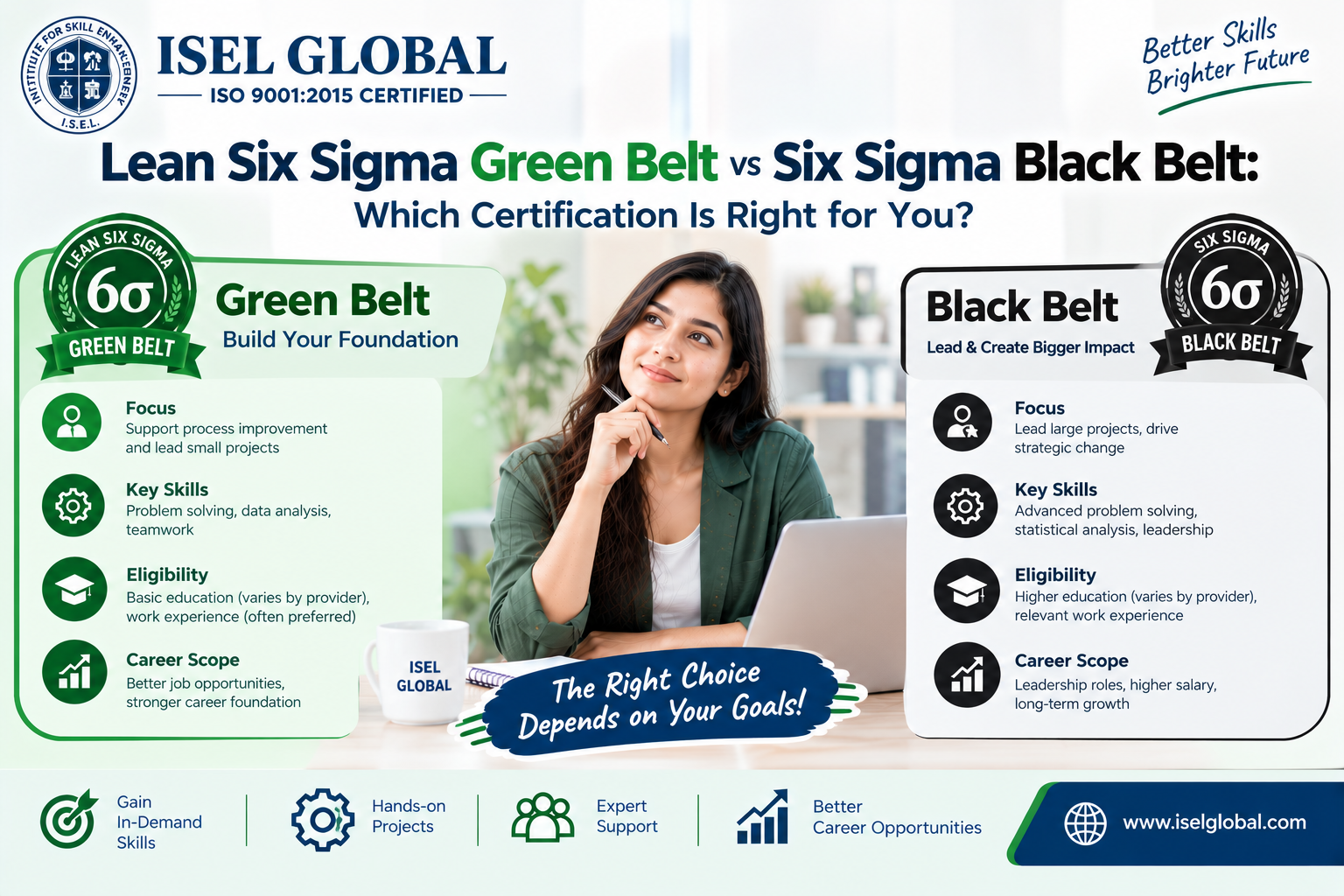
A Green Belt develops the skills needed to identify process problems and support improvement projects. A Black Belt builds on these foundations, focusing on complex problem-solving, project leadership and measurable business improvements. Both levels use structured methods, including DMAIC, but differ in project scope, analytical depth and leadership responsibilities.
What Is Lean Six Sigma Green Belt?
A lean six sigma green belt introduces professionals to methods for reducing waste, preventing errors and improving process efficiency. Green Belt professionals often work on projects within their departments or support larger initiatives led by Black Belts.
For example, an IT professional might use Green Belt methods to reduce recurring support tickets, while a manufacturing engineer could investigate production defects and identify their causes.
What Is Six Sigma Black Belt?
A six sigma black belt prepares experienced professionals to lead improvement initiatives involving multiple teams, complex data and significant operational challenges. Black Belts use statistical analysis, project management and root-cause investigation to address persistent performance issues.
Consider a manufacturing company experiencing high rejection rates across several production lines. A Black Belt may coordinate the investigation, evaluate process data, test solutions and track whether corrective actions deliver lasting improvements.
Why Is Lean Six Sigma Certification Important?
Lean Six Sigma certification provides a structured approach to solving workplace problems rather than relying on assumptions. It helps professionals connect process analysis with measurable outcomes such as fewer defects, shorter turnaround times, reduced waste and improved customer satisfaction.
Its value is particularly relevant when organisations need employees who can interpret data, collaborate across departments and demonstrate the impact of process changes.
Green Belt vs Black Belt: Key Differences
The main differences involve project complexity, leadership responsibilities and the depth of technical knowledge required.
- Learning level: Green Belt establishes core improvement skills; Black Belt develops advanced analytical and leadership capabilities.
- Project scope: Green Belts commonly support departmental projects, while Black Belts often lead larger, cross-functional initiatives.
- Data analysis: Both levels use data, but Black Belt work typically involves more advanced statistical techniques.
- Responsibilities: Green Belts may work alongside project leaders; Black Belts coordinate teams, manage project risks and monitor outcomes.
- Career direction: Green Belt can support progression into quality and operations roles, while Black Belt can help prepare professionals for improvement leadership.
Certification requirements vary by provider. Check the curriculum, assessment method, practical project requirements and recognition before enrolling.
Who Should Take Green Belt or Black Belt Certification?
Green Belt is a practical starting point for students, working professionals, engineers and quality specialists who want to learn process improvement. Black Belt is generally more appropriate for professionals with relevant experience who are ready to manage larger projects and take responsibility for measurable business outcomes.
Consider your current role, available study time and opportunities to apply the methods at work before choosing.
Green Belt Is Suitable For
- Students and early-career professionals building quality management skills.
- Engineers and manufacturing employees improving everyday processes.
- IT professionals reducing errors, delays and repeated service issues.
- Project coordinators who want to contribute to improvement initiatives.
Black Belt Is Suitable For
- Quality managers and experienced process improvement professionals.
- Project managers responsible for complex operational challenges.
- Engineers leading cross-functional improvement teams.
- Professionals preparing for senior quality, operational excellence or continuous improvement roles.
What Skills and Topics Will You Learn?
Both certification levels teach systematic problem-solving, but Black Belt training usually explores analytical methods and project leadership in greater depth.
A typical curriculum may include:
- DMAIC: Define, Measure, Analyse, Improve and Control.
- Process mapping and identifying root causes.
- Lean concepts, waste reduction and workflow improvement.
- Statistical thinking, data interpretation and process capability.
- Risk assessment, performance measurement and control plans.
- Project management, stakeholder communication and team leadership.
Green Belt learners generally focus on applying these tools to defined problems. Black Belt learners may also study advanced hypothesis testing, regression, design of experiments and more complex statistical methods.
Before selecting a six sigma black belt certification program, review its syllabus and confirm which methods are included. The exact curriculum depends on the training provider.
How Do Certification and Career Opportunities Connect?
Certification can strengthen your professional profile, but it does not guarantee a job or promotion. Employers also consider work experience, communication, technical knowledge and evidence that you can apply improvement methods to real business problems.
Potential roles include:
- Green Belt: quality analyst, process improvement associate, operations analyst and production quality engineer.
- Black Belt: continuous improvement manager, quality manager, operational excellence specialist and process improvement leader.
Industries that use these skills include manufacturing, healthcare, banking, logistics, IT services, retail and telecommunications. For example, a logistics team might reduce delivery delays, while a healthcare organisation could improve appointment scheduling and reduce waiting times.
What About Salary Trends in 2026?
There is no single salary figure that applies to all Green Belt or Black Belt professionals in India. Compensation depends on experience, industry, location, employer, role complexity and demonstrated project results.
When comparing opportunities, review current job postings for your target role and city. Focus on the skills employers request, such as statistical analysis, cost reduction, project leadership and measurable process improvements. Treat certification as one part of your career profile, not a salary guarantee.
Is Online Certification Worth It?
Online learning can be worthwhile for professionals who need flexibility alongside work or study. A well-designed course should offer a clear syllabus, accessible learning materials, meaningful assessments and opportunities to understand how improvement tools work in practice.
If you need flexible study options, explore Six Sigma Certification Online India. Compare course coverage and support before enrolling, and choose a level that fits your existing knowledge.
Common Mistakes and Best Practices
A common mistake is choosing Black Belt simply because it sounds more advanced. Another is completing training without practising the methods on a real process problem. Both approaches can limit the practical value of certification.
Follow these best practices:
- Define your career objective before choosing a level.
- Review the syllabus, assessment and certification requirements.
- Practise DMAIC using a genuine workplace or academic example.
- Measure outcomes with reliable baseline and follow-up data.
- Document your contribution and communicate results clearly.
These habits help turn theoretical knowledge into useful workplace skills.
Which Certification Is Best for You?
Green Belt is often the better choice if you are starting with process improvement or want to contribute to projects alongside your existing responsibilities. Black Belt is more appropriate if you have relevant experience and want to lead complex improvement initiatives. The best option is the one that matches your current skills, practical opportunities and long-term career direction.
Conclusion
The choice between Green Belt and Black Belt depends on where you are in your career and what you want to achieve next. Green Belt builds a strong foundation in process improvement, while Black Belt develops more advanced analytical and project leadership skills.
A well-chosen lean six sigma certification can support your development when you combine training with practical experience. Explore ISEL Global’s certification programs, compare the learning pathways and select a course that aligns with your professional goals.

