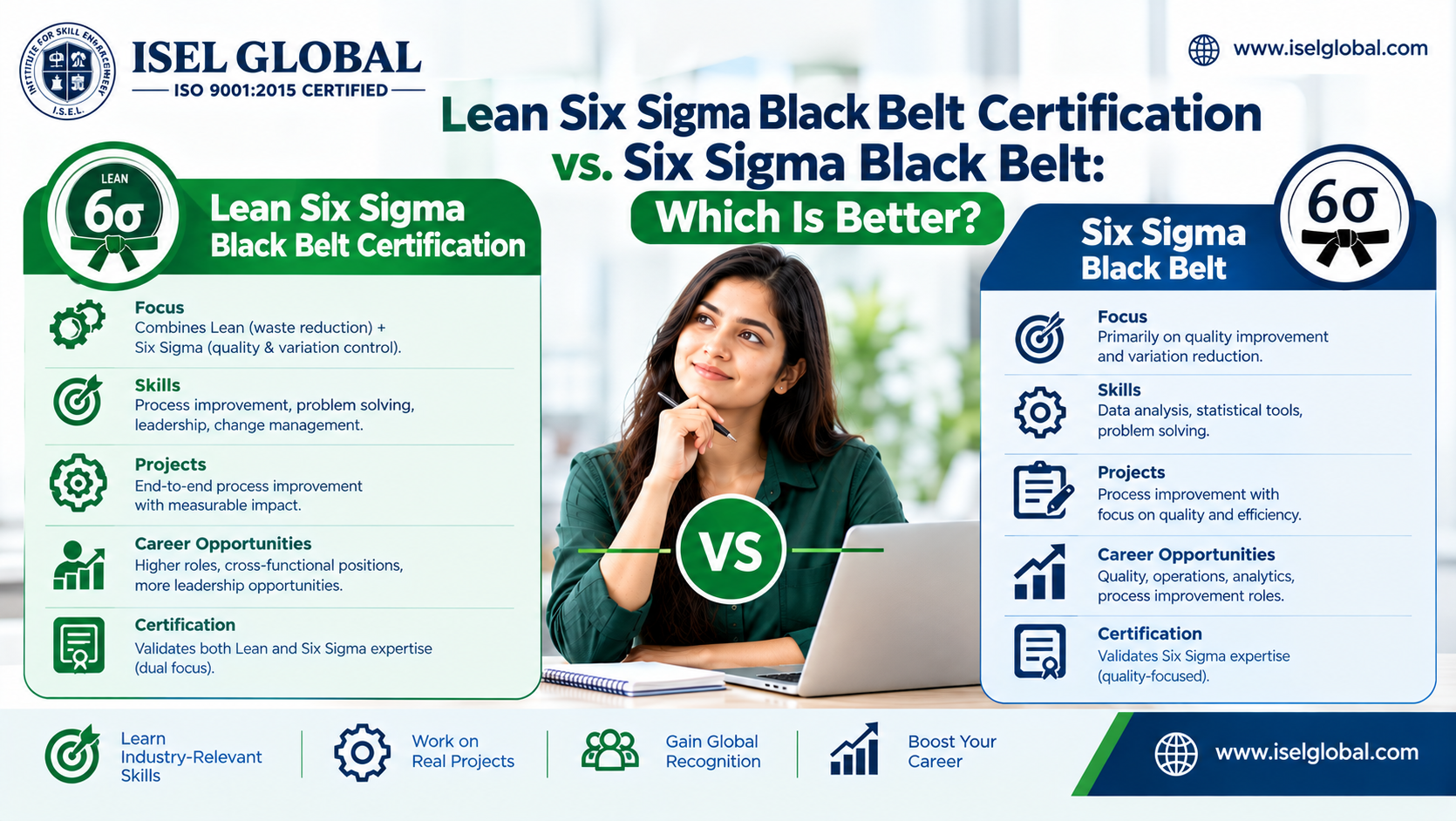
Choosing between the Lean Six Sigma Black Belt Certification and the Six Sigma Black Belt Certification is based on what kind of career path, industry and kind of process improvement one wishes to engage in. Even though the belts have the same objective of improving quality, the methodologies applied by them are different.
Six Sigma focuses on eliminating process variations and defects, whereas Lean Six Sigma is a combination of Six Sigma and Lean methodologies that seek to remove wastes and delays from processes. This article will compare the two belts, highlight their differences, and discuss how they can be applied in different industries. In addition, we will also go through some pointers on how to choose the best Six Sigma Certification in India.
What Is Six Sigma Black Belt Certification?
Six Sigma Black Belt Certification refers to an individual who has shown high levels of proficiency in a certain methodology whose main objective is to minimise defects, minimise variations in the processes and improve the quality of products. The individual has the skills to initiate improvements, make analyses of the operations data, identify the sources of problems and provide solutions to those problems.
The various areas involved are statistics, hypothesis testing, process capability, measurement system analysis and the DMAIC process: Define, Measure, Analyse, Improve and Control.
For example, a firm that is engaged in production operations and is having difficulties in regard to product defects may hire a Six Sigma Black Belt to analyse the production data and solve the issue.
What Is Lean Six Sigma Black Belt Certification?
In Lean Six Sigma Black Belt certification, there is an application of Six Sigma methodology principles in terms of reducing defects and variation, as well as adding lean methodology principles in eliminating non-value-adding activities.
There may be many such non-value-adding activities, including unnecessary motions, excess inventories, extra approvals, waits and inefficient process operations. By the use of these two methodologies, a professional can solve quality problems but at the same time make sure that there are no flow inefficiencies.
There will be value stream mapping, waste identification, process mapping, root cause analysis, statistics and change management, among others.
Understanding the Six Sigma Belt System
Six Sigma training includes a belt system similar to martial arts, with each level having its own depth of process improvement and responsibilities. Knowing more about these belts will help people select their career track in Six Sigma:
White and Yellow Belts
White and Yellow Belts usually possess a basic understanding of process improvement concepts and can assist in data collection, process mapping and problem identification activities.
Six Sigma Green Belt
Green Belts usually use process improvement techniques to implement their projects. They can conduct small projects or assist Black Belts according to their experience and organisational roles.
Six Sigma Black Belt
Black Belts usually conduct large-scale process improvement projects, carry out statistical analysis in order to uncover root causes and assist teams in implementing the DMAIC technique.
Master Black Belt
Master Black Belts usually mentor other belts, provide technical assistance and conduct strategic process improvement projects
Who Should Choose Six Sigma Black Belt Certification?
While choosing between Six Sigma Black Belt and Lean Six Sigma Black Belt, one needs to think about what one wants to focus on in one’s career, one’s existing knowledge, and the issues one is going to face. One should pursue black belt certificates if six sigma black belt certification can be beneficial for people whose main job responsibilities are improving quality, performing statistical analyses, and reducing process variations.
This can include people who:
• want to get a position in quality assurance, engineering, pharmaceuticals, or manufacturing,
• are interested in identifying defects and their root causes, • like to solve problems analytically using statistical data
• want to improve the reliability of products and processes,
• and want to spearhead a well-defined program for improvement of quality.
For example, an electronics company that faces product performance issues will benefit from a Black Belt professional, who will analyse various process variables and set up controls to improve the reliability of their production processes.
When Should You Consider Lean Six Sigma Black Belt Certification?
Lean Six Sigma Black Belt training might be more appropriate for professionals looking to boost not only quality but also operational efficiency.
This certification might suit people who:
· Operate in the fields of operations management, supply chain management, logistics, or services delivery.
· Seek to eliminate waste, delays, and any unnecessary processes.
· Have to increase their productivity without reducing quality standards.
· Operate cross-functional teams or complex operations.
· Look to apply process improvement methods in various industries.
For instance, a company that operates in e-commerce and experiences delays in delivery and rising costs of order processing can utilise Lean Six Sigma to evaluate its fulfilment process, find bottlenecks, look into repeated mistakes, and optimise process flows.
For those interested in learning how to achieve all-around operational improvement skills, there is Lean Six Sigma.
Selecting the Proper Six Sigma Black Belt Certification in India
Once you have identified the methodology that would best suit your career, it is time to look at the certification providers and understand what separates them from each other.
1. Curriculum & Training Assessment
A comprehensive training program should cover DMAIC, root cause analysis, process mapping, measurement system analysis, statistical methods and control planning. Lean Six Sigma programs should also include waste identification, value stream mapping and workflow improvement. Regarding Lean Six Sigma, the curriculum should also cover issues related to waste identification, Value Stream Mapping & Workflow Improvement. Practical experience is very important in terms of Black Belt training. Programs like case study, business simulation or improvement project can give opportunity to prove practical skills of trainees.
Nevertheless, prior to enrolment in a program, it is essential to thoroughly examine the curriculum of a program and verify the availability of sufficient practical training.
2. Confirmation of Certification Credibility and Recognition
Requirements are not identical across all providers. Eligibility criteria, examinations, project requirements and recognition can vary by certification body. The curricula and the examination procedures, as well as other requirements to obtain this certification, can vary greatly depending on the certification organisation and training institution.
The candidate must make sure that the credibility of the organisation, the examination process, and the certification itself are relevant for his/her industry.
3. Comparison between Online and Classroom Training Options
Six Sigma Certification Online India program could work well for professionals who need flexibility with respect to their work or education. Online training can be useful if it is facilitated by trained professionals, proper assessments, real-world practice, and chances of getting constructive feedback.
Courses that are conducted in class or offer a combination of classroom as well as online learning can prove to be better suited to those students who are more of an interactive type.
Professionals who are planning to get certified in Six Sigma or Six Sigma Black Belt in Mumbai and Bangalore, respectively, must make comparisons between the curricula, experience of the instructors, assessment procedures, and practical projects. The place where the training program is offered matters, but what really counts is the quality of the program itself.
4. Learning Resources and Longevity
The learning resources will help the learners understand the concepts well. For instance, having access to a Six Sigma Book or Six Sigma eBook will enable learners to gain knowledge of statistical tools, the DMAIC process, exam preparation, and problem-solving.
Some people may require Green Belt certification to become eligible for advanced Six Sigma certifications due to a lack of experience in process improvement.
When selecting the Best Six Sigma Black Belt Certification in India, consider the nature of the training, the credibility of the certifying body, real-life projects, and relevance to your career goals. Expensive certifications don’t necessarily mean the best certifications. They should be credible and relevant.
Conclusion
The decision about choosing Six Sigma Black Belt Certification or Lean Six Sigma Black Belt Certification depends upon one’s personal goals and preferred process improvement approach.
A Six Sigma Black Belt is preferable for individuals who are interested in reducing defects, statistics and process variability. On the other hand, a Lean Six Sigma Black Belt can be a choice for someone who aims at combining quality improvements with waste elimination and cycle time reduction.
Before joining a particular program, you should compare the curriculum, the credibility of the certification body, examination requirements and practical projects. It is also wise to review job descriptions in your area.
In conclusion, both certifications have their advantages and disadvantages. You need to pick the one that will help you achieve your professional goals.
Frequently Asked Questions
1. Is Lean Six Sigma Black Belt superior to Six Sigma Black Belt?
The superiority of either of the two certifications depends on the needs of the individual professionals. The Six Sigma Black Belt certification is mainly concerned with minimising defects and variation using statistical analysis, but Lean Six Sigma incorporates this approach with waste elimination and workflow optimisation. Those who are interested in a wider scope of operation may opt for Lean Six Sigma.
2. Six Sigma vs. Lean Six Sigma: What Is the Difference?
The Six Sigma technique is a scientific approach that seeks to reduce defects and variability in processes. Lean is a process where waste in processes is eliminated for smooth operation. Lean Six Sigma brings together both principles, whereby people can solve the problems of efficiency and quality in a systematic manner.
3. Should Six Sigma Black Belt certification be considered?
Six Sigma Black Belt certification can be considered important for those working within quality management, manufacturing, process improvement, and operational excellence. The certification helps in building the skill set required to solve problems analytically and lead projects, skills which might have professional value to an employer. Nonetheless, the professional value of this certification relies on many things.
4. Should I pursue Green Belt Certification before Black Belt?
Green Belt Certification serves as a basic understanding of DMAIC, process improvement and basic analytical skills. This may be especially helpful for those who have had little or no experience. Nevertheless, getting Green Belt Certification is not mandatory for everyone in advance. You must study the requirements set by your provider and evaluate your experience and knowledge.
5. Is it possible for me to complete Six Sigma Black Belt Certification through Online Training in India?
Yes. There are many institutions that offer Six Sigma Black Belt Certification online for learners in India. Care should be taken to consider the content of the curriculum, credentials of instructors, examination, practical assessment of projects, and the credentials of the organisation offering the course before you enrol in an online course, as the same could be as useful as classroom-based courses.
6. Who Is a Six Sigma Master Black Belt?
A Six Sigma Master Black Belt is an individual who will train and mentor Black and Green Belts in the application of Six Sigma methods. The role may vary according to organisation and certification authority. Six Sigma Master Black Belt is generally the highest professional designation in Six Sigma.
7. Will Lean Six Sigma Black Belt certification help me switch careers?
A Lean Six Sigma Black Belt certification will definitely help you move toward a career in process improvement, operational excellence, quality management, or consulting. But sometimes it might not be enough. Most companies would look at transferable skills, industry knowledge, analysis skills, and achievements as well. So candidates must improve their profile through projects, creating a portfolio of proven improvements and learning tools in their target industry.
8. What are some tips for getting the best Six Sigma Black Belt certification in India?
The credibility of the organisation, its curriculum, testing parameters, project parameters, and relevance to future careers must be taken into account by the candidates. It is better if the training teaches both theory and problem-solving in practical application. In addition, analysing the job descriptions in the selected field will also give you an idea about the skills and certifications required.