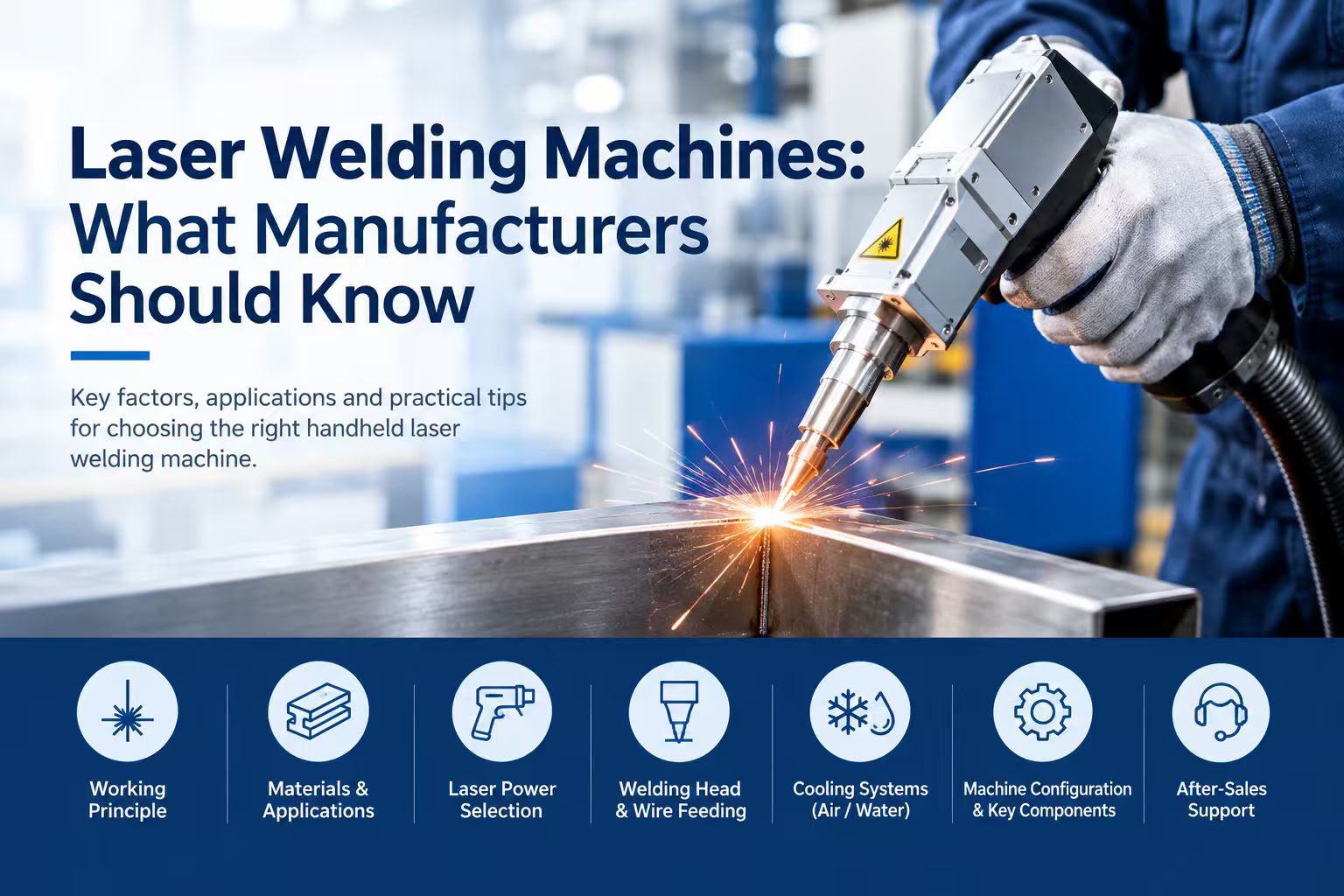
Laser welding has become a practical option for manufacturers working with metal components. Its concentrated heat source allows precise joining across a wide range of fabrication applications.
For manufacturers considering a laser welding machine, the key is to evaluate the full system, not just laser power. Welding heads, cooling, wire feeding, shielding gas, operating parameters, and operator training can all affect the welding process.
The right configuration depends on the material, thickness, joint design, and production requirements.
How Laser Welding Works
A laser welding machine uses a focused laser beam to heat and fuse the joint between two metal components. Filler wire can be introduced when you need additional material to fill a gap or build up the joint.
The welding process is controlled through parameters such as laser power, welding speed, wire feeding speed, and beam movement. These settings need to be adjusted according to the material, thickness, joint condition, and desired result.
For production use, manufacturers should test representative workpieces rather than relying only on general parameter recommendations.
Materials Commonly Used With Laser Welding
Laser welding is used for many metal materials.
Carbon steel and stainless steel are common applications in general fabrication. Aluminum can also be welded with suitable equipment and process parameters.
The material thickness is equally important.
Thin sheet metal may require less laser power, while thicker components can require higher power and carefully selected welding parameters.
Joint design also affects the process. A tight joint may behave differently from a joint with a larger gap.
Manufacturers should therefore test their actual materials before selecting final welding parameters.
Choosing the Right Laser Power
Laser power is one of the first specifications buyers compare. For many handheld applications, 1500W to 3000W covers a practical range of metal fabrication requirements.
A 1500W system can handle many general welding applications, while higher-power systems can provide additional capacity for thicker materials and more demanding work.
However, higher laser power does not automatically mean better welding results. The required power depends on material type, thickness, joint design, welding speed, and other process conditions.
Manufacturers should therefore select laser power according to their actual workpieces instead of choosing a machine based on wattage alone.
The Role of the Welding Head
The welding head is an important part of the laser delivery system.
It directs and focuses the laser beam onto the workpiece. The design of the head can also affect how easily an operator controls the welding process.
Handheld welding heads provide flexibility for different workpiece shapes and welding positions.
This can be useful in workshops where parts are not always identical or where operators need to access different areas of a component.
Weight and cable length can also affect operator comfort.
For businesses using a handheld laser welding machine throughout the working day, these practical details should be considered during equipment selection.
Wire Feeding Options
Filler wire can be useful when a joint requires additional material or when a small gap needs to be filled. A wire feeder supplies the filler material at a controlled rate during welding.
The required wire diameter and feeding speed depend on the material, thickness, joint design, and welding parameters.
Single-wire systems are suitable for many general applications, while multiple-wire configurations can provide additional flexibility for specific production requirements.
When comparing machines, manufacturers should check the compatibility between the wire feeder, welding head, filler wire, and control system. Stable wire delivery is important for maintaining a consistent welding process.
Air Cooling and Water Cooling
The cooling system plays an important role in maintaining stable equipment operation.
Air-cooled systems use airflow to dissipate heat and offer a simpler configuration for suitable power levels and working conditions. They can be a practical choice for workshops with moderate operating hours.
Water-cooled systems use circulating water to control equipment temperature. They are commonly used for higher-power laser welding machines or applications involving longer continuous operation.
When comparing the two options, manufacturers should consider daily working hours, operating environment, laser power, and the machine’s overall configuration. The cooling method should match the expected workload rather than being selected based on power rating alone.
Handheld Welding for Flexible Production
Handheld laser welding machines can be useful for workshops that handle different types of workpieces.
Unlike fixed welding systems, handheld equipment allows operators to move the welding head around the component.
This can be useful for frames, cabinets, panels, metal furniture, machinery parts, and other fabricated components.
The technology can also support repair and maintenance applications where workpieces vary in size or shape.
However, flexibility does not remove the need for proper training.
Operators need to understand machine settings, material preparation, welding techniques, safety procedures, and routine maintenance.
Multi-Function Laser Welding Systems
Some manufacturers need more than welding.
A 4-in-1 laser system can combine welding with functions such as cleaning, cutting, and weld-bead cleaning.
This configuration may be useful for workshops that perform several related metal processing tasks.
For example, a metal surface can be cleaned before welding. After the joint is completed, weld-bead cleaning can be performed with the same equipment.
The usefulness of a multi-function system depends on the workshop’s actual workflow. Businesses should evaluate which functions they will use regularly before selecting a configuration.
What Should Manufacturers Check Before Buying?
Before purchasing a laser welding machine, manufacturers should look beyond the headline power rating.
Check whether the machine is suitable for the materials and thicknesses used in daily production. The welding head, cooling method, wire feeding system, and control interface should also match the intended workflow.
It is also worth checking practical factors such as cable length, machine weight, installation requirements, spare parts availability, warranty terms, and technical support.
For businesses introducing laser welding, supplier training can also make the transition easier. A machine that fits the production process is more useful than a system with specifications that exceed the actual application.
Working With an Experienced Supplier
Choosing the right equipment is only part of introducing laser welding into a production environment. Supplier support can also affect installation, operator training, maintenance, and long-term equipment use.
WINTEK offers handheld laser welding machines in 1500W, 2000W, and 3000W configurations, with air-cooled and water-cooled options. Depending on the application, the systems can also be configured with different welding heads and wire feeding solutions. Multi-function models are available for workshops that need welding, cleaning, cutting, and weld-bead cleaning in one system.
WINTEK Laser also provides installation, training, technical support, and spare parts for customers using its laser equipment.
Conclusion
A laser welding machine should be evaluated as a complete production system rather than as a single power rating.
For manufacturers, the most important step is to match the machine configuration with real production requirements. Materials, workpiece thickness, joint conditions, operating hours, and workflow should all be considered before purchase.
The right equipment can make laser welding easier to integrate into daily fabrication work. With suitable machine configuration, operator training, and supplier support, manufacturers can build a more consistent and practical welding process around their existing production needs.
Address: Room 19A10, 18th Floor, Building S3, Huashan Area 2 Project, No. 136 Choufu Road, Huashan Street, Licheng District, Jinan City, China
Phone: 86-18769786070
Email: [email protected]
Website: https://winteklaser.com/