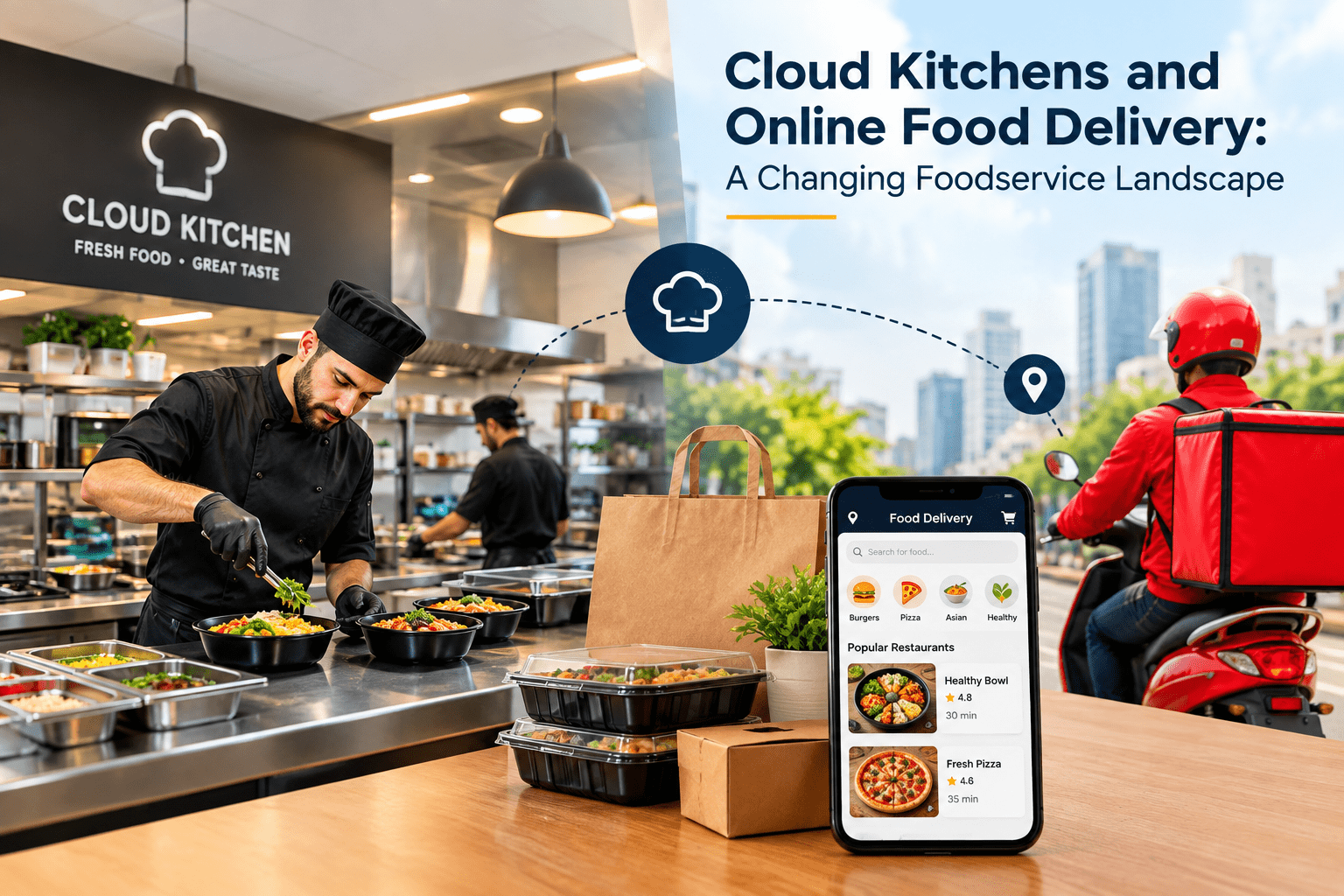
The foodservice sector is going through a structural change as consumers discover, order, pay for, and review through digital means. The core of this transformation is that of cloud kitchens and the online food delivery market. Cloud kitchens are online-only kitchens designed specifically for online orders and not dine-in orders. The growth of cloud kitchens is highly correlated with that of the food delivery sector, which has brought about a change in the way in which restaurants think about location, labour, menu, marketing, and logistics.
The use of cloud kitchens and the online food delivery market in India has been the most rapidly expanding segment of the food service industry due to the extensive use of smartphones, online transactions, urbanisation, and convenience needs of consumers. Cloud kitchens have a unique advantage as they allow food businesses to concentrate on their strengths of cooking food, packaging, and delivering it without getting involved in the troubles of owning and operating a traditional eatery.
Cloud Kitchen Models and the Need for Flexibility
Cloud kitchens are operated in the same way by one and all. The industry comprises independent kitchens serving a single brand, multi-brand kitchens that produce several concepts, shared kitchens rented by different operators, and hybrid kitchens linked to existing restaurant networks. Multi-brand kitchens can optimise their utilisation through the sharing of equipment, ingredients, labour, and other resources. A 2025 industry study cited multi-brand kitchens as the most popular format in the cloud-kitchen sector in terms of market share in India.
Single-Brand Kitchens:
Such kitchens target specific types of cuisine or client groups and can build specialised food production processes. However, the limited brand identity might facilitate menu management but leaves their demand dependent on the success and relevance of a certain concept.
Multi-Brand Kitchens:
Several virtual brands can be run out of one production location, splitting fixed costs among different income streams. It is also possible to test various cuisines and price points without opening an actual full-service restaurant for each of them.
Shared and Hybrid Kitchens:
Sharing allows small-scale businesses to benefit from professional kitchen infrastructure without investing their entire budget into its development. At the same time, hybrid kitchens provide businesses with both a delivery-focused kitchen and a restaurant for traditional client interaction.
Online Food Delivery Services: The Underpinning of Growth
Cloud kitchens are not to be thought of as separate from the online food delivery marketplace. Through aggregator apps, discoverability, ordering, payment, reviews, and access to the delivery network are enabled, thereby forming an ecosystem of dependencies between the kitchens and platforms.
For cloud kitchens and restaurant operators, an On Demand Food Delivery App can bring ordering, restaurant management, delivery coordination, and customer access together within a single digital platform
Digital Marketplaces:
One major benefit provided by aggregators is that you no longer have the hassle of finding out, contacting and dealing with many restaurants when you want to have a meal at home or get a food takeaway. Each restaurant can now focus on delivering quality products to their existing customers and only rely on a third-party digital platform for ordering from customers. In fact, this can create more pressure on restaurants to attract attention on such digital platforms through enhanced rankings, ratings, menus, successful deliveries, and customer retention increasingly important.
Last Mile Logistics:
One of the key delivery bottlenecks is last-mile logistics, as the speed of deliveries highly depends on the kitchen location, availability of riders, traffic conditions, weather and peak hours, etc. If restaurants have enough orders for their food to be delivered during the same delivery trip, it saves time for delivery. Therefore, cloud kitchens are typically situated in high-density urban catchments where the order volume will allow for effective delivery routing.
Challenges: Efficiency Does Not Ensure Profitability
The apparent ease of a delivery-only restaurant could be hiding potential economic issues. The removal of the dine-in aspect would not mean that the cost of ingredients, labour, packaging, technology, commission, customers, refunds, delivery, rental, and utility costs disappear. Research on the industry describes a transition from rapid expansion toward attention to contribution margin and profitability.
Dependence on Platform:
High dependence on third-party platforms can leave operators vulnerable to changes in commission fees, algorithms, policies, and customer-acquisition costs. As such, operators will look to create other avenues of order fulfilment, loyalty programs, and diversified distribution while using the large platforms.
Brand Awareness:
Since there’s no tangible component like a store, restaurant, or any type of physical experience for customers to learn about the delivery-only brand, brand awareness becomes a challenge as there is no physical interface available, and that means the company has to rely solely on digital marketing, maintaining the quality standards, and establishing a difference in the increasingly online-oriented market.
Consistency and Quality:
Food that is served in a quality restaurant usually tastes great, yet the same may not be said about the delivered food after it’s gone through a 30-40-minute delivery journey without proper care and attention. To ensure food reaches the customers of delivery orders in good condition, the packaging, temperature, portion size, preparation time, ingredients, and even the type of materials of the cooking utensils need to be considered differently when serving for delivery than for dining in.
Future Outlook: Towards a More Integrated Foodservice Ecosystem
Integration between physical restaurants, online platforms, logistics services, technological systems and consumer data is going to be the next stage of cloud-kitchen development. Instead of serving as an independent alternative to regular restaurants, cloud kitchens are becoming an integral part of the wider ecosystem of food production and delivery. The growth of the online food delivery industry can stimulate innovation in terms of experimenting with cuisine variety, smaller kitchens, regional brands and technological operations. At the same time, the expansion of cloud kitchens in the future will be influenced by regulatory requirements, labour factors, food safety standards, packaging waste and the economics of last-mile delivery.
Increased Automation of The Processes:
Ordering systems, automated tracking of inventories, demand forecasting, and kitchen displays can help automate routine tasks. Such implementation can increase accuracy and productivity, as well as allow people to focus on cooking and quality control.
Specialised Concepts:
Virtual brands can appeal to particular eating habits, cuisine types, consumption moments and consumer segments without the need for a physical location. This factor can foster more innovation in the online food delivery market; however, at the same time, an excessive number of virtual brands can make it harder for consumers to navigate digital marketplaces.
Growing Emphasis on Sustainability:
Deliveries require extra packaging and deliveries, which means that environmental impact becomes an important factor. Recycling, optimal portioning, consolidation of deliveries and decreased food waste can become increasingly relevant because of the efforts of businesses and regulators to deal with the environmental consequences of food deliveries.
Growth of Direct Relationships:
Aggregators offer valuable reach to businesses, but the latter can try to establish their own direct digital channels to enhance client retention and decrease dependency on third-party platforms within the online food delivery market.
For food businesses expanding beyond delivery orders, multi service app can provide another digital channel by combining food delivery with other services within the same platform.
A Foodservice Business Seeking Balance
The cloud kitchen business is no longer a stopgap solution to changing consumption habits; it has become a well-established part of the modern foodservice system. Not only is its importance determined by the absence of dining rooms, but also by creating links between food production, digitised demand, flexible branding, data analytics, and logistics. The online food delivery market provides the framework for scaling this system, whereas the role of cloud kitchens is to diversify and expand the geography of the delivery-oriented food businesses. Nevertheless, future success will be dependent on much more than increased orders.
According to Pristine Market Insights, with growing competition, businesses will require not only the ability to operate technologies, but discipline in operations and knowledge of consumer needs as well. Thus, the shifting food service world should be viewed through the lens of evolution and not the replacement of traditional restaurants by cloud kitchens.
Author Bio:
Sandhya Jadhav is a research analyst with expertise in analyzing trends across the food and beverage industry. She focuses on emerging business models, consumer behavior, and market developments shaping modern foodservice. Through her research, Sandhya provides practical insights into evolving industry dynamics, including cloud kitchens and online food delivery.