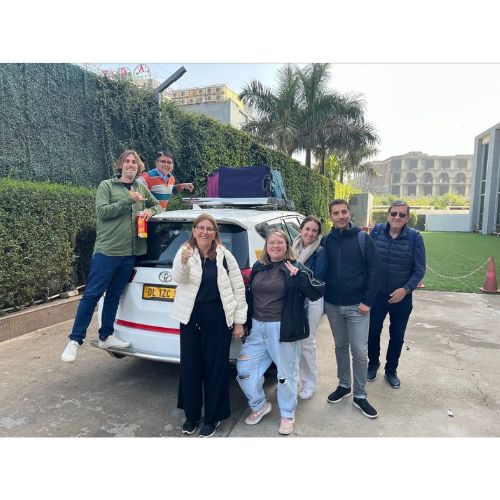
Nobody warns you enough about Delhi traffic before you land. It doesn’t follow the logic you’d expect from a road system — lanes are more of a rough suggestion, signage disappears once you’re off the main roads, and finding parking near somewhere like the Red Fort can eat half an hour on its own. If your week involves the Red Fort, Qutub Minar and a day trip out to Agra, you probably don’t want to spend it deciphering all that. This is really the whole argument for hiring a car with a driver rather than self-driving, or trying to string together ride-hailing apps for ten days straight.
What Actually Changes When You Have a Driver
Two things disappear almost immediately: navigation and haggling. You’re not squinting at a phone map at a red light, and you’re not negotiating a fare with someone who’s already decided the price before you got in. A driver who’s done this for years knows the route, knows which road to avoid when there’s a VIP convoy moving through, and has a rough feel for how long Delhi to Agra will actually take depending on when you leave. For families or first-time visitors especially, that alone is worth paying for.
The safety angle gets underestimated too, mostly because it’s hard to picture from outside the country. Traffic rules exist on paper. In practice, especially during peak hours, lane discipline is optional and everyone treats gaps in traffic as an invitation. Someone who drives Delhi roads for a living reads that chaos without thinking about it. Someone renting a self-drive car and figuring it out as they go is, honestly, taking on more risk than most people realize until they’re in it.
Sorting the Decent Operators from the Risky Ones
Car hire in Delhi isn’t a regulated-enough market that you can assume every company is equally reliable. A little checking before you book saves you the bad version of this story. Ask about pricing up front — does the quote actually include tolls and parking, or will those get added on halfway through the trip? Are the drivers police-verified, because plenty of smaller operators skip this. Does the driver speak enough English to get you through a restaurant order or a change of plans, particularly if you’re heading somewhere off the usual tourist track. And what happens if the car shows up in bad shape, or the driver just isn’t a good fit — does the company actually have a way to fix that, or are you stuck?
Worth asking: How the company pays its drivers. Operators where drivers keep a fair share of the fare tend to hold onto more experienced people, and that shows up in small ways — punctuality, how well they know back routes, whether they’re actually pleasant to spend eight hours in a car with.
Where a Driver Earns Their Keep
Short hops across town, a driver is nice to have but not essential. It’s the longer, messier logistics where the value really shows. Airport runs at 3am when public transport has shut down for the night. A full day of sightseeing that bounces between Humayun’s Tomb, Lotus Temple and Akshardham — sites spread far enough apart that booking a fresh cab at each stop gets old fast. Outstation trips like Delhi to Agra, or the Golden Triangle loop through Jaipur, where one car and one driver for the whole run works out cheaper than trains plus local taxis at every city, and considerably less stressful. And multi-day Rajasthan itineraries, where sticking with the same driver means you’re not re-explaining your plans and preferences to a new person every morning.
One Operator Worth Knowing About
Car Rental Delhi With Driver has been running in the city since 1995, which puts it ahead of most competitors just on longevity. They work with a network of over 200 drivers, all police-verified and English-speaking, and — notably for anyone booking from overseas without a way to inspect the car first — they don’t ask for a deposit upfront. You pay the driver as the trip happens, not before it.
Their fleet runs from standard sedans up to Innova Crysta and Kia Carnival models for bigger groups or families with luggage, and they cover both round trips back to Delhi and one-way drop-offs elsewhere in North India. It’s not the only legitimate option in the city, but it’s a reasonable benchmark for what a properly run operator looks like: clear pricing, verified drivers, and an actual process if something goes wrong.
Before You Book
A few things are worth confirming in writing before you hand over any commitment. Get the quote itemized — tolls, parking, driver allowance for outstation trips, all of it, not just the headline number. Ask which car model you’re actually getting and whether it’s air-conditioned; this matters far more than it sounds like once you’re in Delhi in May. If you’re travelling with a baby and need a car seat, say so early, because not every operator keeps one on hand. And save the driver or operator’s direct number somewhere other than your inbox — you’ll want it if plans change mid-trip and you can’t wait on an email reply.
The Bottom Line
You could drive yourself, or piece together buses, trains and local taxis across three or four cities. Plenty of people do. But for a trip built around a handful of famous, spread-out sites and limited time, it’s rarely worth the hassle. A properly vetted driver takes the getting-there problem off your plate entirely, and on a trip that includes the Taj Mahal, that’s exactly where your attention should be going instead.