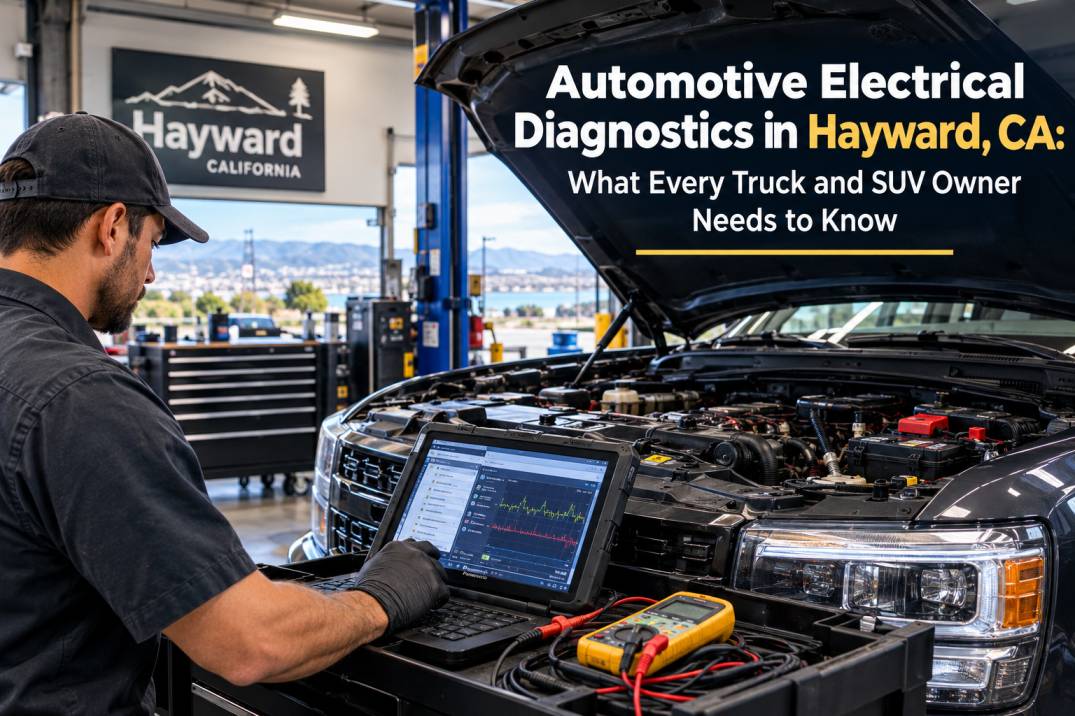
Your check engine light has been on for five days. Your power windows respond slower than they should. Your audio system cuts out randomly at highway speed, and your truck takes a beat longer to start than it used to. None of these problems have sidelined you yet, but every single one of them is a signal that something inside your vehicle’s electrical system is not working correctly. For truck and SUV owners in Hayward, CA, ignoring these warning signs rarely ends well. Professional automotive electrical diagnostics is the process that identifies exactly what is wrong, where the fault is occurring, and why, before a manageable issue becomes a breakdown on the side of the road or a repair bill that proper diagnosis could have prevented entirely. Modern vehicles are built around complex electrical architectures where every system communicates with every other system through shared networks of wiring, sensors, and control modules. Chasing an electrical fault without professional diagnostic tools and genuine hands-on experience wastes time, misses the real problem, and frequently results in replacing parts that never needed replacing.
What Professional Automotive Electrical Diagnostics Actually Involves
Many drivers assume that automotive electrical diagnostics means plugging a code reader into the OBD port under the dashboard and reading whatever numbers come up on the screen. That step is where a professional diagnostic process begins, not where it ends. A thorough evaluation works through your vehicle’s electrical systems layer by layer, using specialized equipment and trained interpretation to identify faults that a visual inspection or a basic consumer-grade scanner will never surface. Understanding what the full process covers helps explain why professional diagnostics consistently produces results that guesswork and parts-swapping cannot.
OBD Scanning and Code Interpretation
Every vehicle built after 1996 stores fault codes in its onboard diagnostic system that record when a sensor reading, circuit condition, or system behavior falls outside the parameters the manufacturer defined. Reading those codes is the starting point, but experienced technicians treat them as leads rather than final answers. A code pointing to a mass airflow sensor fault might indicate a failing sensor, a wiring fault in the sensor circuit, an intake leak affecting the sensor’s readings, or a software issue inside the engine control module. Following the code to its actual root cause requires circuit testing and system evaluation beyond the code itself, and that deeper process is where professional automotive electrical diagnostics separates itself from basic code reading available at any auto parts store.
Voltage, Resistance, and Circuit Testing
Every electrical circuit in your vehicle operates within specific voltage, resistance, and current parameters that define correct function. Testing circuits against those parameters using a digital multimeter, a lab scope, or a current clamp identifies exactly where a circuit deviates from specification and why. A circuit with excessive resistance due to a corroded connector delivers less voltage to its connected component than it should, causing that component to underperform or behave erratically. A circuit with an intermittent open connection causes the component it feeds to cut out unpredictably, producing symptoms that are frustratingly difficult to reproduce consistently during a basic visual inspection. Systematic circuit testing finds these faults with a precision that no amount of visual examination can replicate.
The Most Common Automotive Electrical Diagnostics Findings in Trucks and SUVs
Certain electrical problems appear more frequently in trucks and SUVs than in standard passenger vehicles, partly because of how these vehicles are driven and partly because of the additional electrical loads that aftermarket accessories and overlanding builds place on factory systems over time. Recognizing the most common fault categories helps you identify developing problems early and get professional attention before they escalate into more serious failures.
Battery and Charging System Faults
A battery losing capacity and a charging system failing to maintain correct voltage are among the most common findings in automotive electrical diagnostics work on high-mileage trucks and SUVs. When battery voltage drops below the threshold that control modules require to operate correctly, the vehicle begins producing a wide range of seemingly unrelated symptoms. Warning lights illuminate for systems that are functioning normally, infotainment systems reset without warning, and transmission shift behavior changes because the transmission control module is not receiving stable supply voltage. A thorough battery and charging system evaluation that measures cold cranking amps, battery state of health, alternator output, and voltage drop across the charging circuit identifies these problems accurately and resolves confusion that parts-swapping never clears up.
Ground Connection Degradation
Ground connections are the return path for every electrical circuit in your vehicle, and degraded grounds are one of the most common and most frequently overlooked sources of difficult electrical faults. A ground connection that has developed resistance through corrosion, paint contamination, or physical loosening affects every circuit that shares that ground path. The symptoms appear across multiple unrelated systems and rarely point obviously toward a grounding issue, making this category of fault particularly difficult to diagnose without a systematic approach. Vehicles in the Bay Area that experience regular exposure to coastal moisture and temperature cycling are especially susceptible to ground connection degradation over time, and a comprehensive ground inspection belongs in every automotive electrical diagnostics process performed on a Bay Area truck or SUV.
Aftermarket Accessory Integration Conflicts
Every aftermarket accessory added to a vehicle introduces additional wiring, additional load on the electrical system, and new opportunities for installation errors that create conflicts with factory systems. A remote start system wired incorrectly can trigger persistent security system faults. A dash cam tapped into the wrong fuse circuit can cause other accessories sharing that circuit to lose power intermittently. An audio amplifier with a poor ground connection can introduce noise into multiple vehicle systems that share the same ground path. Professional automotive electrical diagnostics that evaluates aftermarket installation quality alongside factory system function identifies these conflicts accurately, which is why drivers who have had multiple aftermarket installations performed over the years benefit most from a comprehensive diagnostic evaluation.
Automotive Electrical Diagnostics for Overlanding Builds: Why It Matters Before You Build
For overlanders planning a serious vehicle build, professional automotive electrical diagnostics before installation begins is one of the most valuable investments in the entire project. Adding a dual battery system, solar charging setup, high-output lighting array, portable power station, and security system to a vehicle with pre-existing electrical weaknesses creates a build that underperforms from day one and produces layered faults that are difficult to untangle after the fact because new installations and pre-existing problems overlap in confusing ways.
Establishing Your Electrical Baseline
A pre-build diagnostic evaluation establishes the current health of your vehicle’s battery, charging system, wiring, and ground connections before any new components are added. If the alternator is showing early signs of overload stress, addressing it before adding a high-draw audio amplifier and auxiliary battery system prevents a premature failure that would otherwise occur on a remote trail with no support nearby. If the factory wiring shows signs of heat damage or insulation degradation, addressing it before routing new circuits through the same channels prevents future faults that would be extremely difficult to isolate after the build is complete and multiple new circuits have been added.
How Audio Mobile Hayward Integrates Diagnostics Into Every Build
The team at Audio Mobile Hayward on Mission Boulevard in Hayward, California treats automotive electrical diagnostics as a foundational part of every overlanding build consultation rather than a separate service that only applies when something is already broken. Before recommending specific components or planning installation sequences, their technicians assess the vehicle’s electrical condition to ensure the build is planned around a foundation that can genuinely support it. This approach consistently produces builds that perform reliably from the first trip rather than requiring troubleshooting and corrections after installation is complete. Drivers across the East Bay who have worked with the shop on complex builds consistently point to this diagnostic-first approach as the reason their installations work correctly from day one and continue working correctly on every trip after that.
Why Hayward and Bay Area Drivers Trust Audio Mobile Hayward for Automotive Electrical Diagnostics
Across Hayward, Fremont, Oakland, San Leandro, Union City, and the broader East Bay, truck and SUV owners dealing with electrical problems have found that working with a specialist who combines genuine diagnostic depth with extensive hands-on experience across aftermarket installations produces faster and more accurate results than a general repair shop. Automotive electrical diagnostics at Audio Mobile Hayward reflects years of working with complex vehicle electrical systems across car audio, vehicle security, GPS tracking, remote start, window tinting, and full overlanding builds, giving their diagnostic team a perspective on vehicle electrical problems that a standard repair shop simply cannot replicate. Their location at 24031 Mission Boulevard puts them at the center of the East Bay vehicle enthusiast community, and their reputation for accurate, efficient diagnosis has made them the first call for drivers across the region when electrical problems resist simple solutions. For Bay Area truck and SUV owners who need diagnostics backed by real expertise, reviewing the complete range of automotive electrical diagnostic and installation services available at Audio Mobile Hayward is the right starting point for getting accurate answers and repairs done correctly the first time.
Protecting Your Vehicle Starts With Knowing What Is Wrong
Professional automotive electrical diagnostics gives truck and SUV owners in Hayward and across the Bay Area the accurate, efficient path to resolving electrical problems that guesswork and parts-swapping consistently fail to deliver. From OBD scanning and circuit testing to ground inspection, charging system evaluation, and aftermarket installation conflict resolution, a thorough diagnostic process identifies the real source of every electrical symptom and guides the right repair the first time. For overlanders planning a build, pre-build diagnostics protects every dollar invested in accessories by ensuring the electrical foundation is solid before the first component goes in. If you are in Hayward or anywhere across the East Bay and dealing with an electrical problem you cannot resolve, Audio Mobile Hayward has the diagnostic tools, the technical depth, and the hands-on experience to find the answer and fix it right. Reach out today and get your vehicle’s electrical system working exactly the way it should.