

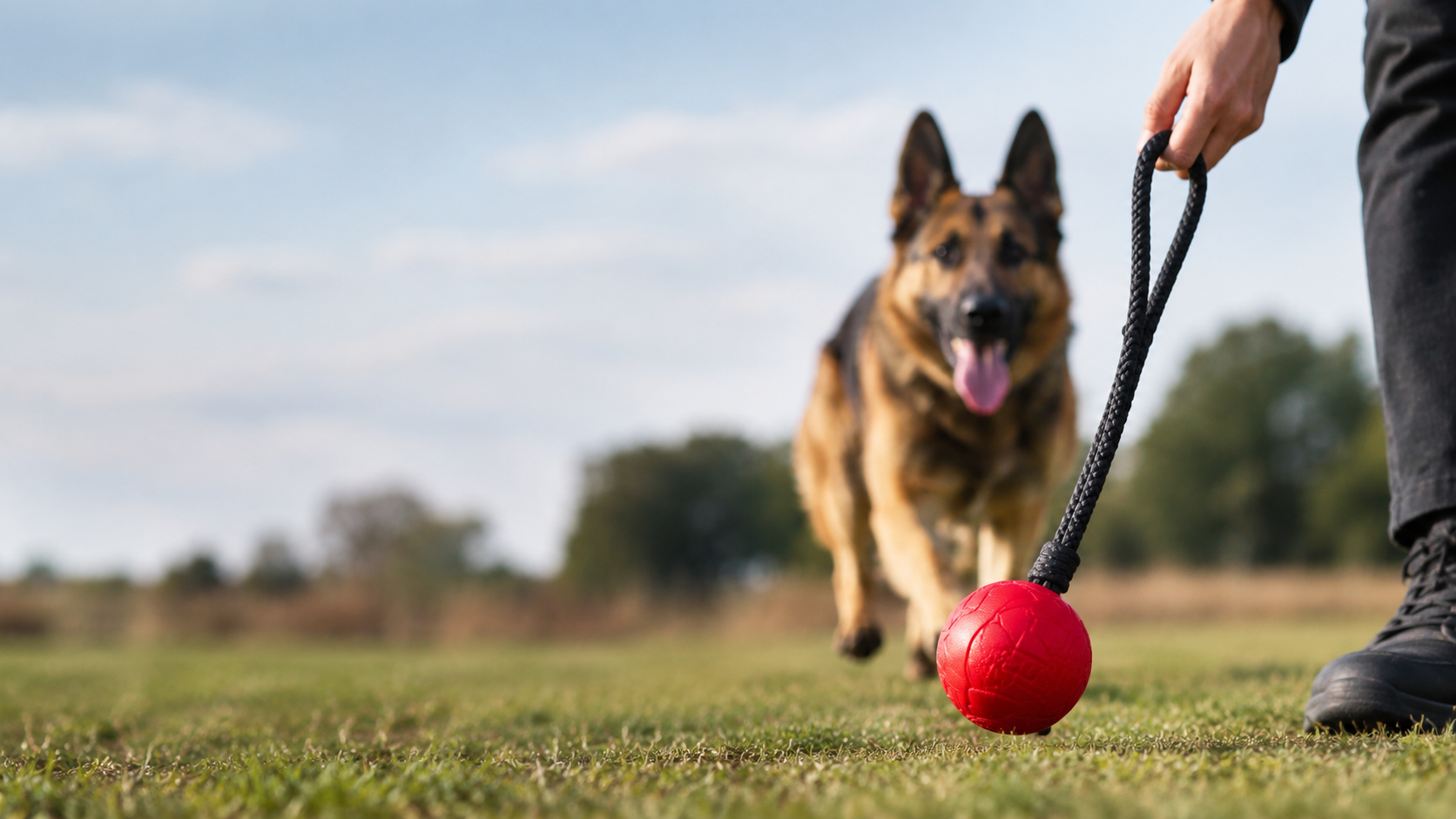
Dog balls are commonly used for games of fetch, interactive play and reward-based training. Although a ball may look like a simple toy, its size, material, shape and design can affect how a dog carries it, interacts with it and responds during a training session.
The right choice depends on the dog’s size, chewing habits, play style and the activity you want to practise. Some dogs enjoy chasing and retrieving a ball, while others are more interested in carrying it or engaging with a handler during short training exercises.
Understanding the different types of dog balls can help owners and trainers select equipment that suits the dog’s needs.
What Are Dog Balls Used For?
Dog balls can serve several purposes beyond ordinary play. Their usefulness depends on the dog’s interests and how the handler incorporates them into an activity.
Common uses include:
- Fetch and retrieval: Encouraging a dog to chase, collect and return a ball.
- Reward-based training: Using a ball as a reward when a dog completes a familiar exercise.
- Engagement with the handler: Building interest in interactive activities and encouraging the dog to focus on the person holding the toy.
- Impulse-control exercises: Practising behaviours such as waiting, releasing a toy or returning when called before another repetition begins.
- Physical activity: Providing opportunities for movement through short, controlled games.
A ball does not automatically improve a dog’s training. Its value depends on whether the individual dog finds it rewarding and whether the activity supports a clear training goal.
Types of Dog Balls for Dogs
Dog balls are available in different materials and designs. Choosing between them starts with understanding how each type is intended to be used.
Rubber Dog Balls
Rubber balls are commonly used for retrieving games and interactive play. They come in different sizes, shapes and levels of firmness.
When choosing a rubber ball, consider how easily the dog can grip it and whether the material is appropriate for its chewing habits. Extremely hard toys may pose a risk to teeth, while balls that break apart easily can create swallowing hazards.
Tennis-Style Balls
Tennis-style balls are familiar options for casual fetch. However, their suitability depends on their construction, size and the individual dog’s behaviour.
The outer covering can become abrasive, particularly when it collects dirt and grit. Dogs that chew tennis balls may also damage the covering or expose the inner material. Inspect them regularly and avoid using damaged balls.
Dog Balls on a String
A dog ball on a string combines a ball with a handle or cord that allows the handler to hold and move the toy during interactive activities.
This design can be useful for engagement exercises, controlled play and reward delivery. The string gives the handler a way to present or retrieve the toy without repeatedly picking up the ball itself.
For example, the Raddog Ball On String 7cm is a ball-and-string design. Its listed 7 cm size provides a specific measurement to consider when assessing whether it is appropriate for an individual dog. The measurement alone does not establish suitability for every breed or training purpose.
Balls on strings are not automatically suitable for every dog. The handler should supervise their use and prevent the dog from chewing or swallowing the cord.
Soft and Textured Balls
Some dog balls have softer surfaces or textured designs intended to make gripping and carrying easier.
These may suit certain dogs, but softness should not be confused with durability. A dog that tears toys apart may damage a soft ball quickly, while a dog with a strong bite may require a different design. Check the manufacturer’s guidance and supervise use.
Dog Balls for Training vs Play
Although training and recreational play can overlap, the way a ball is used often matters more than the type of ball itself.
| Activity | How the ball is used |
|---|---|
| Casual fetch | The dog chases and retrieves the ball during play. |
| Recall practice | The handler rewards the dog for returning when called. |
| Obedience training | The ball is presented as a reward after a completed exercise. |
| Engagement exercises | The handler uses the ball to encourage attention and interaction. |
| Retrieval practice | The dog learns to collect, carry and return an object. |
During training, consistency is important. The handler should establish when play starts, what behaviour earns the reward and when the activity ends.
For example, a dog learning recall might receive a brief game with a ball after returning to the handler. This creates an opportunity to reward the desired response while keeping the exercise structured.
Not every dog is equally motivated by toys. If a dog shows little interest in a ball, food rewards, praise or another preferred activity may be more effective.
How to Choose the Right Dog Ball
Before selecting a ball, consider the following factors.
1. Size
The ball should be easy for the dog to interact with without creating a choking risk. A ball that is too small may fit too far into the mouth or become lodged in the throat. One that is too large may be difficult to carry comfortably.
Do not choose a ball based on breed name alone. Individual dogs vary in jaw size, mouth shape and the way they hold toys.
2. Material and Firmness
Consider whether the ball is designed for retrieving, interactive play or another activity. A suitable material should withstand the intended use without being excessively hard for the dog’s teeth.
No ball should be assumed to be indestructible. Dogs that chew aggressively may need different toys and closer supervision.
3. Design
Think about how the ball will be used. A plain ball may suit straightforward retrieving games, while a ball attached to a string may be more practical for handler-led interaction.
Choose the design according to the exercise rather than assuming that one type will suit every situation.
4. Your Dog’s Play Style
Observe how your dog interacts with toys. Does it chase moving objects, carry them back, chew them persistently or prefer playing directly with a handler?
These behaviours can help guide your decision. A toy that encourages useful interaction for one dog may be unsuitable for another.
5. Ease of Inspection and Cleaning
Balls used outdoors can collect dirt, sand and moisture. Select a design that can be checked for damage and cleaned according to the manufacturer’s instructions.
Replace a ball if it becomes cracked, split or damaged enough to create a swallowing or injury risk.
Why Are Dog Balls with Strings Used in Training?
A ball with a string gives the handler additional control over how the toy is presented during an exercise. Rather than relying only on throwing the ball, the handler can hold it, move it within a limited area or collect it more easily after a reward.
Depending on the dog’s motivation and the training plan, this may help with:
- Presenting a toy as a reward after a behaviour.
- Encouraging interaction between the dog and handler.
- Reducing the need to bend down to retrieve the ball repeatedly.
- Keeping the toy available for short, structured play sessions.
- Supporting exercises that involve toy engagement and release.
The string is a handling feature, not a guarantee of better training results. The dog still needs to learn the relevant behaviours, and the handler should use the toy in a way that is appropriate for the dog’s experience and temperament.
A ball on a string should not be used as an unsupervised chew toy. If the dog starts biting through the cord, damaging the ball or swallowing pieces, stop the activity and remove the toy.
What Size Dog Ball Should You Choose?
There is no single ball size that suits every dog. A useful starting point is to consider the dog’s mouth size, ability to carry the ball and intended activity.
A 7 cm ball, for instance, may be appropriate for some dogs but too small or too large for others. The measurement should be assessed alongside the dog’s physical characteristics and the ball’s construction.
Before using a ball, check that:
- The dog cannot swallow it whole or get it lodged in its throat.
- The ball can be carried without causing obvious discomfort.
- The dog can interact with it without excessive chewing or destructive behaviour.
- Any attached string or handle can be managed safely by the handler.
If you are uncertain about a particular design, seek advice from a veterinarian or a qualified trainer who can assess the dog’s individual needs.
How to Use Dog Balls Safely During Training
Safe play involves more than choosing an appropriate toy. The environment, the dog’s condition and the way the game is managed also matter.
Keep these precautions in mind:
Supervise play. Watch how the dog handles the ball, especially when using a new toy or one with an attached string.
Check the toy before and after use. Look for cracks, tears, loose parts and damaged cords. Stop using the ball if it becomes unsafe.
Avoid excessive throwing and sudden turns. Repeated sprinting, jumping and abrupt changes of direction can place stress on muscles and joints. Allow the dog to approach a stationary ball rather than encouraging high jumps to catch it.
Take regular breaks. Some dogs continue playing even when they are tired. Keep sessions appropriate to the dog’s age, fitness and health, and stop if it shows signs of fatigue or discomfort.
Teach a reliable release. Practise exchanging the toy or asking the dog to release it without turning every interaction into a physical struggle.
Store the ball safely. Put away toys with strings or other components that the dog might chew or swallow when unsupervised.
If a dog chokes, has difficulty breathing or may have swallowed part of a toy, seek urgent veterinary assistance.
Frequently Asked Questions About Dog Balls
Are dog balls good for training?
Dog balls can be useful rewards for dogs that enjoy toy-based play. They may support retrieving, recall, engagement and obedience exercises. Their effectiveness depends on the dog’s motivation and how the handler uses the reward.
What is the difference between a regular dog ball and a ball on a string?
A regular ball is commonly used for retrieving and independent interaction. A ball on a string gives the handler an additional way to hold, present and retrieve the toy. The more suitable option depends on the activity and the dog’s behaviour.
Is a 7 cm dog ball suitable for every dog?
No. A 7 cm diameter is a measurement, not a universal recommendation. Consider the dog’s mouth size, ability to carry the ball and risk of swallowing or choking before choosing it.
Can puppies use dog balls?
Some balls may be suitable for puppies, but the choice should account for their size, developing teeth and chewing behaviour. Use age-appropriate toys, supervise play and avoid designs that can break into swallowable pieces. Ask a veterinarian if you are unsure which material or design is appropriate.
How often should I replace a dog ball?
There is no fixed replacement schedule for every ball. Inspect it regularly and replace it when it becomes cracked, torn, misshapen or otherwise damaged. Heavy chewing and frequent outdoor use may cause some toys to wear out faster than others.
Are balls on strings suitable for tug games?
They may be used for certain handler-led interactive games, provided the product is designed for that purpose and the activity is controlled. Avoid forceful pulling, sudden jerks or allowing the dog to chew the string. Stop if the dog becomes uncomfortable or overly aroused.
Should I leave a dog alone with a ball?
That depends on the dog’s behaviour and the toy’s design, but balls with strings and toys that can be chewed apart should be supervised. If a dog tends to swallow pieces or destroy toys, remove the toy when direct supervision is not possible.
Final Thoughts
Dog balls can support play, exercise and structured training when the toy suits the dog and the activity has a clear purpose. Size, material, design and chewing habits are all important considerations.
A plain ball may be enough for everyday retrieval, while a ball on a string may offer additional handling options during interactive training. In either case, appropriate sizing, supervision and regular inspection help reduce avoidable risks.
The best choice is not necessarily the most complex or durable-looking ball. It is one that suits the individual dog, supports the intended activity and can be used safely.

