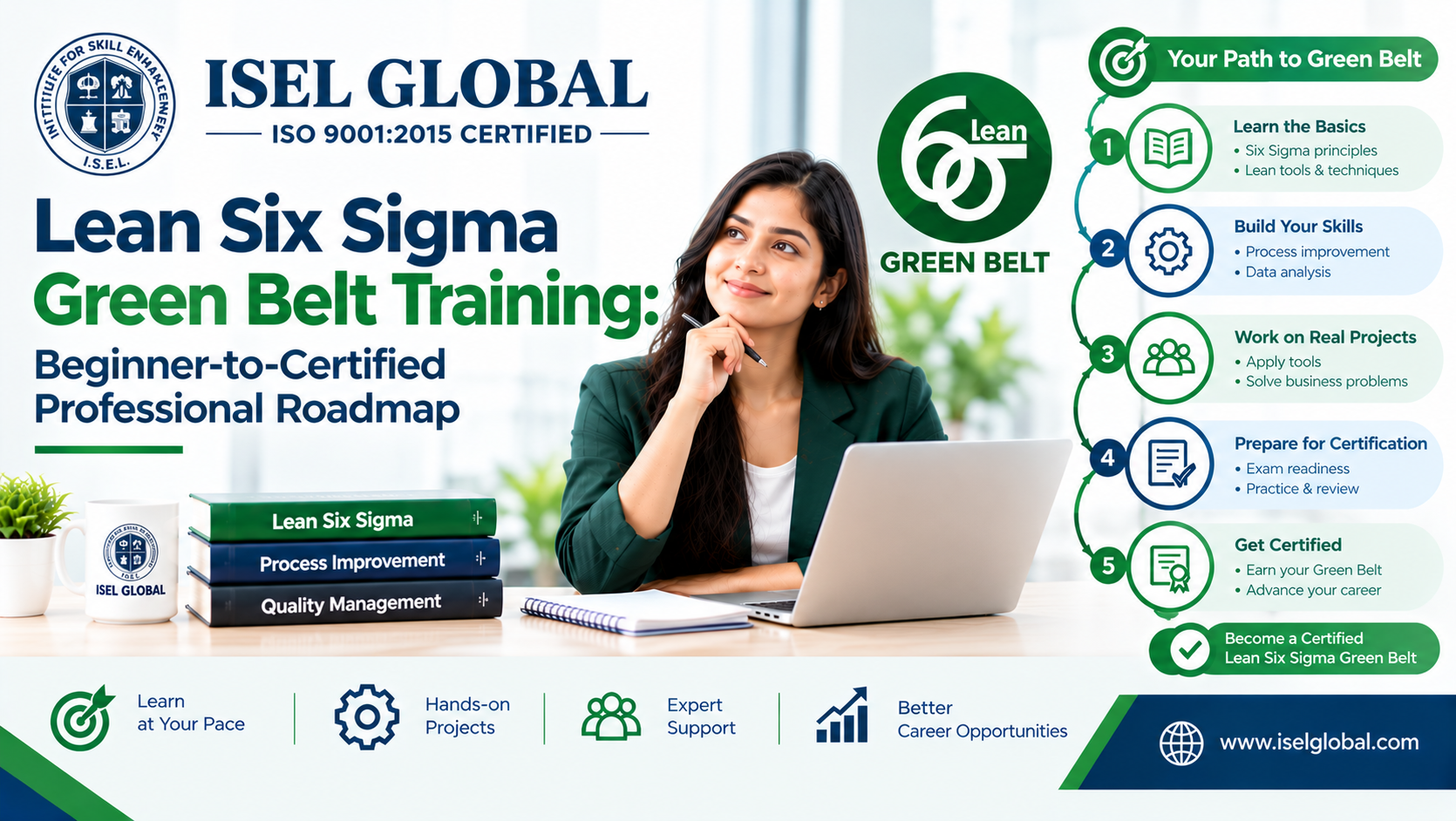
Businesses need professionals who can solve problems, reduce waste, improve quality and deliver better results. Lean Six Sigma Green Belt Training helps learners develop these skills through structured problem-solving methods, data analysis and process improvement techniques.
Whether you are an engineer, quality professional, project manager, IT specialist or student, learning Lean Six Sigma can help you understand how organisations identify inefficiencies and improve performance. A Green Belt is a practical starting point for professionals who want to contribute to improvement projects while developing their careers.
This guide explains the training process, eligibility, curriculum, career opportunities and the steps to choosing a suitable certification programme in 2026.
What Is Lean Six Sigma Green Belt Training?
Lean Six Sigma Green Belt Training teaches professionals to identify process problems, analyse performance data, reduce defects and eliminate activities that do not add value. It combines Lean principles, which focus on reducing waste, with Six Sigma methods, which aim to reduce variation and improve quality.
Green Belt professionals often support or lead improvement projects within their departments. They use structured methods such as DMAIC to turn workplace problems into measurable improvements.
Why Is Lean Six Sigma Important?
Lean Six Sigma provides a systematic way to improve processes instead of relying on assumptions. For example, a manufacturing team can investigate recurring product defects, while an IT team can analyse software incident resolution times. Both can use data to identify root causes and measure whether changes improve performance.
In 2026, organisations continue to value process improvement, operational efficiency, data-informed decisions and customer experience. These skills can be useful across industries, although certification alone does not guarantee employment or promotion.
Key Benefits of Lean Six Sigma Green Belt Training
A well-structured Green Belt programme can help professionals develop practical skills that apply to everyday business challenges.
- Problem-solving: Identify root causes instead of repeatedly treating symptoms.
- Data analysis: Use process data to understand variation and performance.
- Waste reduction: Recognise unnecessary steps, delays and rework.
- Project management: Plan improvement activities and track results.
- Career development: Build knowledge relevant to quality, operations and continuous improvement roles.
- Cross-functional collaboration: Work with colleagues to implement and sustain process changes.
For example, a customer service team might use DMAIC to investigate why complaint resolution takes too long, test a revised workflow and compare results before and after implementation.
Who Should Take Lean Six Sigma Green Belt Training?
Lean Six Sigma Green Belt Training is suitable for working professionals, engineers, manufacturing specialists, quality teams, IT professionals, project managers and students interested in process improvement. Beginners can start by learning the fundamentals, while experienced employees can apply the methods to existing workplace challenges.
Prior experience in quality management may be helpful, but entry requirements depend on the training provider and certification scheme.
What Skills Will You Learn?
Green Belt learners develop a combination of analytical, technical and communication skills.
- DMAIC: Define, Measure, Analyse, Improve and Control.
- Process mapping: Understand workflows and identify bottlenecks.
- Root cause analysis: Investigate problems using methods such as the 5 Whys and fishbone diagrams.
- Statistical fundamentals: Interpret variation, process capability and basic performance data.
- Lean tools: Understand waste reduction, standardisation and continuous improvement.
- Project measurement: Establish baselines, monitor outcomes and document results.
These skills help professionals make evidence-based decisions and explain improvement opportunities clearly to managers and colleagues.
Course Curriculum: A Step-by-Step Roadmap
A typical Green Belt curriculum moves from basic concepts to practical application. The exact syllabus and examination requirements vary by provider.
Step 1: Learn Lean Six Sigma fundamentals
Understand customer requirements, process variation, defects, waste and continuous improvement.
Step 2: Study the DMAIC methodology
Learn how to define a problem, measure current performance, analyse root causes, implement improvements and maintain results.
Step 3: Practise improvement tools
Explore process mapping, Pareto charts, fishbone diagrams, 5 Whys, basic statistical analysis and control charts.
Step 4: Apply the methods and prepare for assessment
Work through realistic case studies or an eligible workplace project, revise the syllabus and meet the provider’s assessment requirements.
Learners may also use a suitable six sigma book or six sigma ebook to revise terminology, practise examples and reinforce their understanding.
Career Opportunities After Green Belt Certification
A Green Belt can support career development in roles where quality, efficiency and process performance matter. Depending on experience and job requirements, relevant opportunities include:
- Quality Analyst or Quality Engineer
- Process Improvement Analyst
- Operations Executive or Operations Manager
- Manufacturing or Production Engineer
- Business Process Analyst
- Project Coordinator or Continuous Improvement Specialist
Green Belt training can also provide a foundation for advanced learning, including a Six Sigma Black Belt or lean six sigma black belt programme. Professionals seeking broader technical expertise may eventually consider a master black belt pathway.
What Are the Salary Trends in India?
Salary depends on the role, experience, location, industry, technical expertise and demonstrated project results. Green Belt certification does not guarantee a particular salary increase.
When evaluating opportunities in 2026, compare current job postings for quality, operations and process improvement roles. Experienced professionals who can demonstrate measurable savings, lower defect rates, shorter cycle times or improved customer satisfaction may be better positioned to compete for relevant roles.
Which Industries Hire Green Belt Professionals?
Green Belt skills can be applied wherever organisations need consistent, efficient processes.
- Manufacturing: Reduce defects, scrap, rework and production delays.
- Healthcare: Improve patient flow, scheduling and administrative processes.
- IT and software: Reduce recurring incidents and improve service delivery.
- Banking and finance: Streamline document processing and reduce transaction errors.
- Logistics: Improve inventory accuracy, delivery performance and warehouse workflows.
- Retail and customer service: Reduce waiting times and improve complaint resolution.
Common Mistakes and Best Practices
Some learners focus only on passing an examination without practising the tools. Others begin an improvement project without establishing a reliable baseline or involving the people who perform the work.
To get more value from training:
- Choose a genuine process problem with a measurable outcome.
- Collect reliable data before proposing solutions.
- Validate root causes rather than relying on assumptions.
- Involve stakeholders who understand the process.
- Track results after implementation to ensure improvements last.
The strongest evidence of learning is the ability to apply the methods responsibly, explain decisions and show what changed.
Conclusion
Lean Six Sigma Green Belt Training provides a structured way to build problem-solving, data analysis and process improvement skills. It can help beginners understand continuous improvement and give experienced professionals tools to address workplace inefficiencies.
Before enrolling, compare the curriculum, assessment method, practical learning opportunities and recognition of the certification. Explore ISEL Global’s Lean Six Sigma certification programme to review the available learning pathway and decide whether it aligns with your professional goals.
Frequently Asked Questions (FAQs)
1. What is Lean Six Sigma Green Belt Training?
Lean Six Sigma Green Belt Training teaches professionals to improve business processes by reducing waste, defects and unnecessary variation. It covers DMAIC, root cause analysis, process mapping and basic statistical tools. Learners develop skills they can apply to manufacturing, IT, healthcare, finance and service operations. The course structure, examination and practical requirements depend on the selected training and certification provider.
2. Is Green Belt certification suitable for beginners?
Yes. Beginners can learn Lean Six Sigma fundamentals before progressing to more advanced techniques. Basic numerical and analytical skills can be helpful, but previous quality management experience is not always required. Before enrolling, check the provider’s eligibility criteria, course syllabus and assessment requirements. Practising with simple process improvement examples can help new learners understand how the tools work in real situations.
3. How long does Lean Six Sigma Green Belt Training take?
Training duration varies according to the provider, learning format and depth of the curriculum. Self-paced online courses offer flexibility, while instructor-led programmes may follow a fixed schedule. Examination preparation and workplace project requirements can add time. Review the total learning hours, assessment deadlines and any project submission requirements before selecting a programme that fits your work or study schedule.
4. What is the difference between Green Belt and Black Belt certification?
Green Belt training generally prepares professionals to contribute to improvement projects and lead suitable initiatives within their area of responsibility. Black Belt training typically develops more advanced skills in statistical analysis, project leadership and complex process improvement. The exact differences depend on the certification scheme. Professionals should compare prerequisites, syllabus depth, project expectations and assessment requirements before choosing a level.
5. Can I complete Six Sigma certification online in India?
Yes. Several providers offer online learning options for professionals in India. Online study can make it easier to balance training with work and personal commitments. Compare the course syllabus, instructor support, assessment method, practical exercises and certification terms before enrolling. You can explore Six Sigma Certification Online India at ISEL Global to review the available programme information.
6. What career opportunities are available after Green Belt certification?
Green Belt knowledge can support applications for quality analyst, process improvement analyst, operations, manufacturing and business process roles. Actual opportunities depend on your qualifications, work experience and the employer’s requirements. Candidates can strengthen their profiles by documenting practical projects, explaining how they used data to identify problems and showing measurable improvements rather than relying on the certification title alone.
7. Is Lean Six Sigma Green Belt certification worth it?
It can be worthwhile if you want to develop structured problem-solving and process improvement skills. The value depends on your career goals, course quality and opportunities to apply the learning. Before investing, check whether relevant employers value the credential and whether the curriculum includes practical exercises. Certification is most useful when supported by demonstrable skills and relevant work experience.
8. What should I study for the Green Belt examination?
Start with the official syllabus for your chosen certification scheme. Common subjects include DMAIC, process mapping, root cause analysis, Lean principles, basic statistics, process capability and control charts. Practise interpreting data and solving scenario-based questions, rather than memorising definitions alone. A suitable Six Sigma book, course notes and practice exercises can help you identify knowledge gaps before the assessment.
9. Can Green Belt professionals progress to Black Belt or Master Black Belt?
Yes. Green Belt can be a starting point for further professional development. Some learners progress to Black Belt Certificate to develop advanced project and analytical skills, then consider Master Black Belt programmes for deeper methodological expertise, coaching or organisational improvement leadership. However, progression requirements differ across providers, and some programmes require relevant experience or completed projects. Check prerequisites before planning your next certification.
10. Which Six Sigma certification is best for my career?
The right certification depends on your experience and career objectives. Beginners and professionals seeking foundational process improvement skills may consider Green Belt. People managing complex improvement projects may benefit from Black Belt training, while experienced practitioners pursuing advanced expertise may explore Master Black Belt programmes. Compare syllabus content, practical requirements, provider recognition and assessment standards before making your decision.