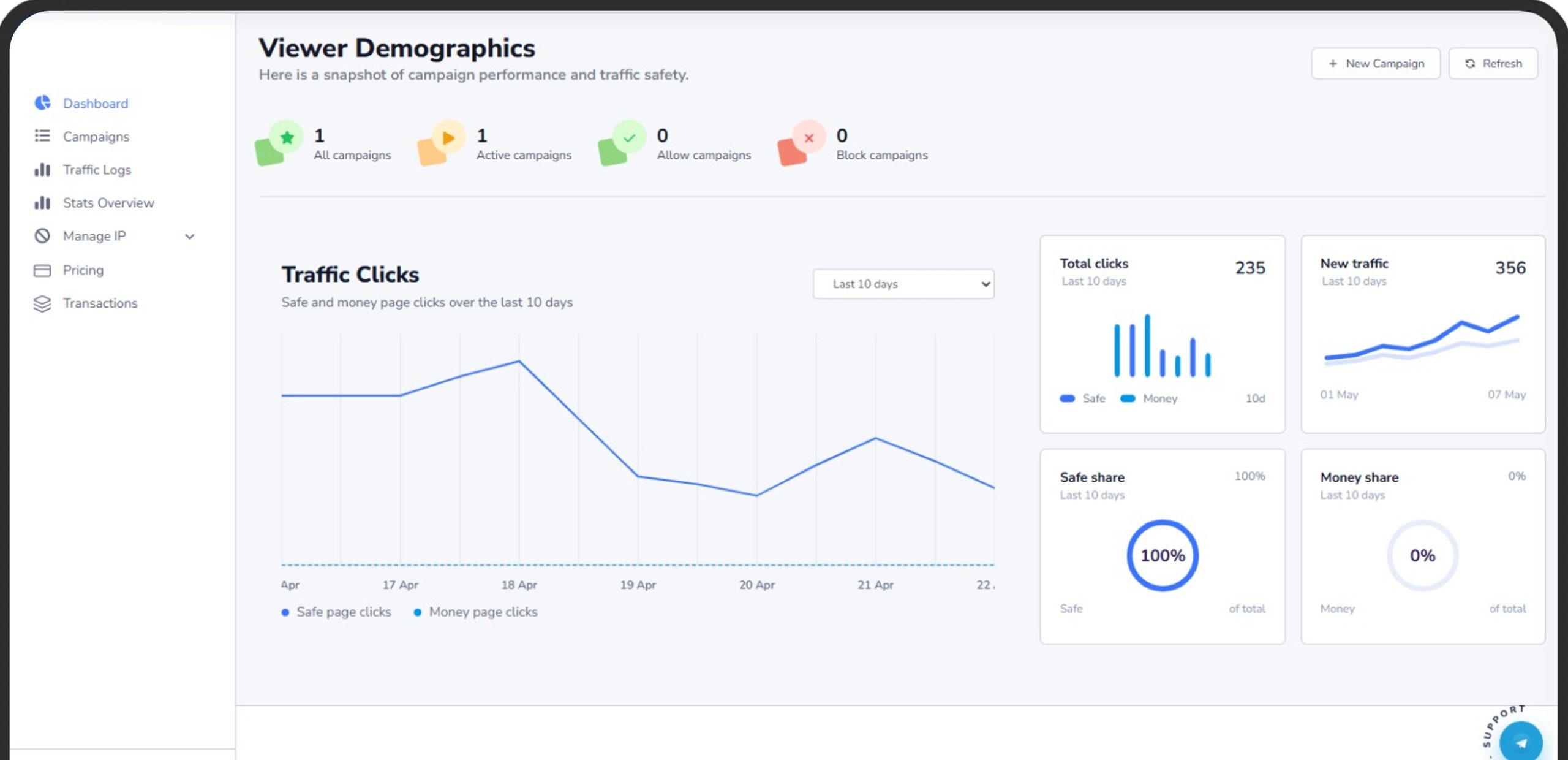
Premium software products like TrafficSaviour, FraudFilter, and JustCloak It uses server-side technology for Google Ads cloaking, offering real-time IP filtering, advanced device fingerprinting, and dynamic safe-page routing. This technology helps prevent traffic leaks, detect invalid traffic, and improve ad traffic quality while protecting marketing funnels from competing scrapers and review bots.
Google Ads Cloaking Explained
The implementation of Google Ads cloaking is a traffic filtering process that allows you to separate incoming users into two groups – the first one will see a safe page that is policy-compliant, and the second group will receive the target offer page that prevents spy tools and competitor scrapers from analyzing your landing page.
Why Traffic Protection Is Critical For Media Buyers
Protection of Marketing Funnel and Assets
Blocks scrapers from accessing high-converting copy, design elements, and direct-offer angles.
Invalid Click Removal
Filters out non-human visits from automated scripts in data centers, cloud hosting, or proxy network nodes.
Protection of Ad Budget
Ensures that daily campaigns spend money on real potential customers and not on click bots.
Strategic Longevity
Protects custom conversion funnel from unnecessary flags or competitor reports.
Key Statistics About Digital Ad Frauds
Global Digital Ad Fraud Losses Growth
According to the Juniper Research report, global losses caused by digital ad fraud were about $84 billion in 2023 and are expected to exceed $170 billion in 2028.
Non-Human Traffic Numbers
More than 40% of non-search paid campaign clicks come from automated scripts, web crawlers, or proxy networks, according to the web traffic patterns analysed by FraudScore.
Critical Features of the Advanced Ad Traffic Quality Tool
Execution Speed
Milliseconds-level server-side traffic filtering is needed to avoid user drop-off and to maintain an updated database of active review IP ranges.
Database Accuracy
Updated database of all ad reviewer IP ranges.
Feature Comparison
| Feature | High-End Solutions | Beginner-Level |
| Filtering Latency | < 50 ms | > 150 ms |
| IP Reputation Updates | Real-Time (API-based) | Weekly/Manual |
| Fingerprinting Depth | WebGL, Canvas, Hardware, Proxies | Basic UA, IP Matching |
| Safe Landing Page | Dynamic Content Injection | URL Rewriting/Redirects |
Core Features
Real-Time IP Reputation Score
Performs immediate checks of all incoming requests about their status in Google Crawler ranges, lists of VPNs, and data centers.
Advanced Device Fingerprinting
Validates canvas graphic rendering, screen resolution, battery charge status, and request headers for headless scraping bot detection.
Server-side Integration Possibilities
Let you utilise PHP, Nginx, or an API to filter content on the web host before the landing page gets to client browsers.
Immediate Redirections
Makes sure your legitimate visitors get redirected to your landing page in less than 50 milliseconds, maintaining your mobile bounce rate.
How to Set Up Cloaking for Google Ads Campaigns
For a successful Google Ads cloaking setup, you will have to create extensive invalid traffic rules for the review of safe pages, and your target audience will be filtered to your money pages.
Creation of a Safe Landing Page Based on Google Ads Requirements
Design fast loading and high-relevant safe landing page at your main domain.
Cloaking Campaign Creation
Create a new cloaking campaign with your filtering tool (e.g., TrafficSaviour), setting target GEOs, ISP ranges, and device filters.
Insertion of Integration Codes
Insert your integration codes into the root directory of your web host in case you choose API-based PHP/Nginx solutions.
Testing of Filtering Solution
Run your campaign on various residential IPs and headless browsers to make sure your target traffic goes to your landing page and all other IPs go to the safe landing page.
Test Methods and Verification
Various Residential IP Test
Make sure your traffic cloaking filter detects residential proxy IPs correctly.
Response Time Audit
Check whether your cloaking filter execution takes less than 50 milliseconds.
Key Missteps That Media Buyers Make While Using Traffic Filters
Client-side JavaScript Only
The most common misstep committed by media buyers is the use of client-side JavaScript, which exposes your page’s source code to automated bots.
Client-side JavaScript only: in the case of simple JavaScript, the page’s source code will be visible after loading the HTML.
Same Safe Page Designs Across Domains
Same safe page designs facilitate correlation for the algorithm among accounts.
Filtering Out Too Many Residential IPs
When you have too many restrictions and when you set the risk score too high, you filter out dynamic mobile IPs.
Neglecting Server-side Latency
Unoptimized remote database calls affect performance, causing slow page loads, which affects quality score negatively.
Advanced Tactics Which Help You To Prevent Your Campaigns From Being Click Fraudsters
High-performing media buyers use server-side header validation and browser canvas fingerprinting for blocking the most sophisticated residential proxy-based click frauds.
Combine Two-Layered Filtering
Combine server-side HTTPS filtering (based on IP and header filtering) together with the browser’s WebGL canvas fingerprinting in order to identify Selenium browsers.
Dynamic Injection of The Content
Use server-side include scripts in order to send the page’s content instead of using browser 301/302 redirects.
Rotations For Media Safe Pages’ Assets
Regular changes in media files, text formatting and HTML code structure of your safe pages.
FAQs
What Is the Difference Between Client-side and Server-side Cloaking?
In server-side cloaking, all requests will be analyzed, and your page’s content will be served by the web server without the possibility of crawling the source code. Client-side cloaking uses a browser scripting language (e.g., JavaScript) to analyze visitors after your page loads.
Can a Cloaker Protect My Account 100%?
There is not any 100% software because Google constantly updates its automated compliance system and its protocol for reviewing process. Premium cloaking system helps you to reduce bot exposures but the safety of your account depends on the clean infrastructure, payment profiles and the ad copy’s compliance.
Conclusion
The protection of your marketing funnel from invalid clicks, competitor scraping tools, and policy review bots is crucial in order to maintain the profitability of your campaigns. The security suite TrafficSaviour software, filtering rules, and safe pages media buyers use to efficiently scale profitable campaigns.