Metal fabrication has changed significantly as manufacturers look for faster, cleaner, and more consistent production methods. Among the technologies supporting this shift, the fiber laser cutting machine has become an important solution for processing sheet metal and other metal materials.
Laser cutting can provide high cutting accuracy while supporting a wide range of production requirements. It is used in industries such as machinery manufacturing, automotive production, electrical equipment, construction, and general metal fabrication.
The technology is also becoming more flexible. Manufacturers can choose different laser powers, working areas, machine structures, and automation features based on their materials and production needs.
What Is a Fiber Laser Cutting Machine?
A fiber laser cutting machine uses a fiber laser source to generate a concentrated beam of light. The beam is directed through the optical system and focused onto the metal surface.
The concentrated energy melts or vaporizes the material along the programmed cutting path. An assist gas then helps remove molten material from the cutting area.
The cutting process is controlled by a CNC system. This allows the machine to follow digital designs with consistent accuracy.
Compared with some traditional cutting methods, laser cutting does not require physical contact between a cutting tool and the workpiece. This reduces mechanical wear and allows manufacturers to produce complex shapes without changing conventional cutting tools.
Fiber laser systems are commonly used for materials such as carbon steel, stainless steel, aluminum, brass, and other metal sheets.
Why Fiber Laser Cutting Is Widely Used
One major advantage of fiber laser cutting is its combination of speed and precision.
Modern machines can process many common sheet metal applications efficiently. The exact cutting speed depends on factors such as laser power, material type, thickness, assist gas, cutting head, and machine configuration.
Precision is another important factor. A stable laser source and CNC control system can help maintain consistent cutting results across repeated production runs.
This is particularly useful for manufacturers producing components with similar dimensions. Consistent cutting can reduce the amount of secondary processing required after cutting.
Laser cutting can also support complicated designs. Small holes, curves, slots, and other detailed shapes can be programmed directly into the cutting system.
For manufacturers handling different orders, this flexibility can be valuable. A CNC laser cutter can switch between different digital cutting files without requiring a new mechanical cutting tool.
Choosing the Right Laser Power
Laser power is one of the first factors manufacturers consider when purchasing a fiber laser cutting machine.
Lower power systems can be suitable for thinner sheet metal and general fabrication work. Higher power systems are generally selected when thicker materials need to be processed.
For example, machines in the 1.5KW to 3KW range can meet many light and medium sheet metal applications. Systems from 6KW upward are often considered for thicker plates and higher production requirements.
However, laser power should not be considered independently.
A machine with higher power may require a suitable cutting head, cooling system, laser source, electrical configuration, and machine structure. The complete system needs to match the intended application.
Manufacturers should therefore evaluate the materials and thicknesses they process most often before selecting laser power.
Machine Size Also Matters
The working area is another important consideration.
A standard 3015 machine provides a working area of approximately 3,000 mm by 1,500 mm. This format is widely used for general sheet metal fabrication.
Larger machines can provide greater working areas for manufacturers handling larger metal plates.
For example, 4020 and 6020 configurations can provide more space for larger workpieces. Long-bed systems can also be designed for specialized applications.
The machine size should match the actual production environment. Buying a machine that is much larger than necessary may increase the required floor space and operating costs.
On the other hand, a working area that is too small can limit production flexibility.
Open or Full-Enclosed Design?
Fiber laser cutting machines are available in different structural designs.
Open machines provide convenient access to the cutting area and are often used for general fabrication applications.
Full-enclosed machines add a protective enclosure around the working area. This design can help contain the cutting process and provide additional protection for operators.
For manufacturers working in a busy production environment, an enclosed structure can also provide a more organized working area.
Exchange tables are another feature worth considering. They allow the finished sheet to be removed while another sheet is prepared for cutting.
A fast exchange process can reduce loading and unloading time. This becomes more valuable as production volume increases.
CNC Control and Production Efficiency
The CNC system is central to modern laser cutting.
Operators can import digital drawings and create cutting programs according to the production requirements. The machine then follows the programmed path automatically.
Good CNC control can help improve repeatability and simplify the transition between different jobs.
Production efficiency also depends on how quickly operators can prepare materials, remove finished parts, manage cutting parameters, and load new files.
For this reason, a laser cutting machine should be evaluated as a complete production system rather than simply by its laser power.
Applications Across Metal Fabrication
Fiber laser cutting is used in many areas of metal manufacturing.
In machinery production, it can be used to cut frames, brackets, covers, panels, and structural components.
In electrical equipment manufacturing, laser cutting can produce cabinets, enclosures, mounting plates, and other sheet metal components.
Construction companies can use laser-cut components for structural and decorative applications.
Automotive suppliers may also use laser cutting for brackets, panels, and other precision metal parts.
The technology is suitable for both prototype production and repeated manufacturing. This makes it useful for businesses that handle different production volumes.
What Should Buyers Consider?
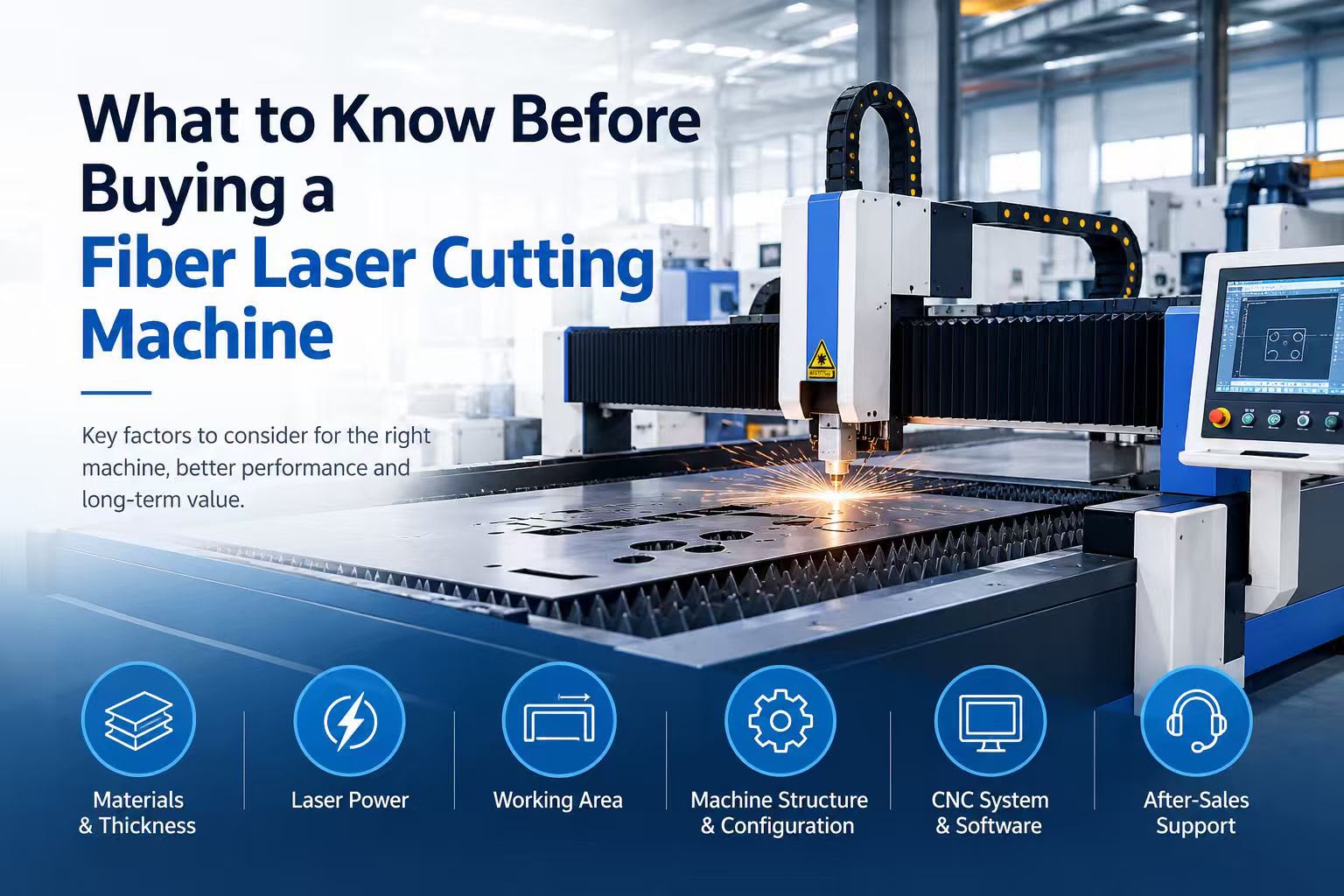
Before purchasing a fiber laser cutting machine, manufacturers should evaluate several factors.
The first is the material range. Identify the metals and thicknesses that the machine will process regularly.
The second is production volume. A machine designed for occasional fabrication may not have the same configuration as a system intended for continuous production.
The third is working area. Make sure the machine can accommodate the largest common workpieces.
The fourth is machine configuration. Consider the cutting head, laser source, CNC system, cooling system, exhaust system, and table structure as a complete package.
After-sales service should also be considered. Installation, operator training, spare parts, technical support, and warranty coverage can affect the long-term ownership experience.
WINTEK Laser Cutting Solutions
Manufacturers looking for different fiber laser cutting configurations can also consider suppliers with experience across multiple applications.
WINTEK Laser offers fiber laser cutting machines for different metal fabrication requirements, with configurations ranging from standard sheet metal machines to larger working areas and higher-power systems.
Its product range includes open and fully enclosed designs, as well as different working table configurations. Higher-power models are available for applications involving thicker metal plates.
The company also provides support for installation, training, spare parts, and technical service.
For buyers comparing laser cutting equipment, evaluating the supplier’s machine range and service capabilities can be just as important as comparing laser power.
Conclusion
Fiber laser cutting machines have become an important part of modern metal fabrication. Their combination of cutting accuracy, processing flexibility, and production efficiency makes them suitable for many industrial applications.
The right machine depends on more than laser power. Material thickness, working area, machine structure, CNC control, production volume, and after-sales support all need to be considered.
By evaluating these factors together, manufacturers can select a laser cutting system that fits their actual production requirements and supports reliable long-term operation.
Address: Room 19A10, 18th Floor, Building S3, Huashan Area 2 Project, No. 136 Choufu Road, Huashan Street, Licheng District, Jinan City, China
Phone: 86-18769786070
Email: [email protected]
Website: https://winteklaser.com/