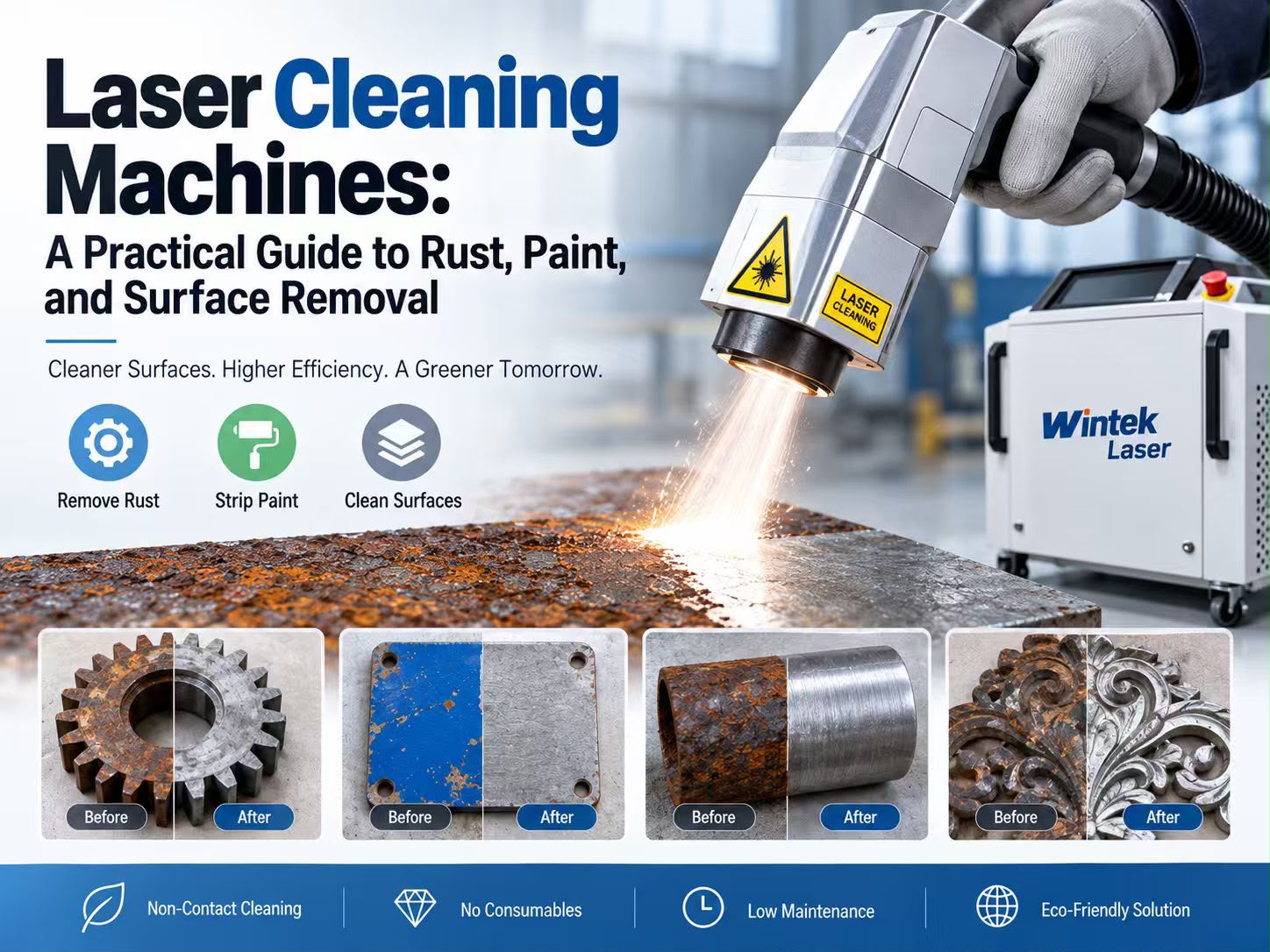
Surface cleaning is an important step in many industrial processes. Rust, paint, oil, oxide layers, dirt, and other contaminants can affect the appearance and performance of metal components.
Traditional cleaning methods can involve chemicals, abrasive materials, grinding, or manual labor. These methods can still be useful, but they may create additional waste or require considerable preparation and cleanup.
As manufacturers look for more precise and efficient cleaning methods, laser cleaning has become an option for a growing range of industrial applications. A laser cleaning machine uses controlled laser energy to remove unwanted material from a surface. The process can be precise and selective, making it suitable for applications where manufacturers need to clean specific areas with limited physical contact.
What Is Laser Cleaning?
Laser cleaning uses a focused laser beam to interact with contaminants on a surface.
When the laser energy reaches the target material, the contaminants absorb energy and are removed from the surface. The exact cleaning mechanism depends on the material, laser parameters, and type of contamination.
Different laser systems can be configured for different applications.
Pulsed laser cleaning systems are commonly used when precise surface treatment is required. Continuous laser systems can provide higher continuous power for certain industrial cleaning applications.
The correct system depends on the material and contamination being removed.
Why Are Manufacturers Considering Laser Cleaning?
One major advantage of laser cleaning is process control.
The operator can adjust laser parameters according to the surface condition and cleaning requirements. This allows manufacturers to target specific contaminants instead of using the same mechanical process across the entire workpiece.
Laser cleaning can also reduce the need for chemical cleaning agents in suitable applications.
This can simplify material handling and reduce the amount of liquid waste produced during cleaning.
Another benefit is reduced physical contact. Because the laser beam performs the cleaning process, there is no conventional abrasive tool directly rubbing against the surface.
This can be useful for components where surface condition needs to be carefully controlled.
Removing Rust and Oxide
Rust removal is one of the most common laser cleaning applications.
Metal components can develop rust during storage, transportation, or exposure to moisture. Before painting, welding, coating, or further processing, the rust may need to be removed.
Laser cleaning can target the contaminated layer and expose the underlying metal.
Oxide removal is another common application. Oxide layers can form during manufacturing and heat treatment processes.
A suitable laser cleaning system can help prepare the surface for subsequent operations.
The actual cleaning result depends on the material, oxide thickness, laser parameters, and operator settings.
Paint and Coating Removal
Laser cleaning can also be used to remove paint and certain coatings.
This can be useful during maintenance, repair, or surface preparation.
For example, manufacturers may need to remove an old coating before applying a new one. Mechanical methods can require significant manual work, especially when the workpiece contains complex shapes.
A laser can follow the target area without physical contact. This provides flexibility when cleaning selected sections of a component.
However, the coating and substrate should always be tested before full production. Laser parameters need to be adjusted to achieve the required cleaning effect without unnecessarily affecting the base material.
Oil and Grease Removal
Oil and grease can accumulate on metal components during machining, transportation, or storage.
Cleaning these contaminants before welding, coating, or assembly can improve the preparation of the workpiece.
Laser cleaning can provide a dry cleaning method for suitable surfaces.
The effectiveness depends on the type and thickness of contamination. Testing is recommended when the surface contains multiple layers or unknown materials.
Pulsed and Continuous Laser Cleaning
Choosing between pulsed and continuous laser cleaning is an important purchasing decision.
Pulsed systems deliver laser energy in short pulses. This allows the operator to control energy input more precisely.
They are often considered for applications where surface protection and detailed cleaning are important.
Continuous systems provide a continuous laser output. They can be suitable for applications requiring higher continuous energy and broader cleaning performance.
For example, continuous laser cleaning systems can be considered for certain heavy-duty industrial cleaning tasks.
Neither configuration is suitable for every application. Buyers should select the system based on contamination type, substrate material, required cleaning speed, and surface sensitivity.
Handheld systems provide another level of flexibility.
The operator can guide the cleaning head across the target surface. This makes handheld laser cleaning useful for large workpieces, maintenance tasks, equipment repair, and areas that are difficult to process with fixed equipment.
Cable length, cleaning head design, machine weight, and operator controls can affect usability.
For frequent manual cleaning, ergonomics should be considered alongside laser performance.
A system that is technically powerful but difficult to handle may not provide the expected productivity in daily operation.
Metal and Non-Metal Applications
Metal cleaning remains one of the main industrial applications for laser cleaning.
Common examples include carbon steel, stainless steel, aluminum, and other metal components.
However, suitable laser cleaning systems can also be used for selected non-metal applications.
Wood surfaces, furniture, and certain decorative materials can sometimes be treated with laser cleaning. Graffiti removal is another potential application.
The laser parameters need to be carefully controlled because different materials react differently to laser energy.
Before purchasing equipment for non-metal applications, users should conduct application testing with the actual material.
What Should Buyers Consider?
The first consideration is the material being cleaned.
Different metals and non-metal materials can require different laser parameters.
The second consideration is the type of contamination. Rust, paint, oil, oxide, and other contaminants may require different cleaning strategies.
The third factor is laser power.
Lower-power systems may be suitable for precision cleaning and lighter contamination. Higher-power systems can provide greater productivity for demanding applications.
The fourth consideration is the laser source and cooling configuration.
Pulsed systems may use air cooling or water cooling depending on their power and design. Higher-power continuous systems generally require a suitable water-cooling system.
The scanning range should also be considered. A larger scanning area can help improve coverage when cleaning broad surfaces.
Finally, buyers should evaluate technical support, training, spare parts, and warranty service.
WINTEK Laser Cleaning Solutions
Manufacturers looking for different laser cleaning configurations can consider WINTEK Laser for a range of industrial applications.
WINTEK offers pulsed laser cleaning systems from 100 W to 500 W, along with continuous laser cleaning systems from 1,000 W to 3,000 W.
Different configurations are available for applications ranging from precision surface cleaning to higher-power industrial cleaning.
The company’s cleaning equipment can be used for removing contaminants such as rust, oil, paint, and oxide from suitable surfaces. Selected systems can also support applications involving materials such as wood and furniture.
WINTEK provides installation, training, technical support, and spare parts to support customers after equipment delivery.
For manufacturers comparing laser cleaning machines, reviewing the supplier’s available power range and application support can help identify a suitable configuration.
Conclusion
Laser cleaning machines provide manufacturers with a controlled alternative for many surface preparation and cleaning tasks.
The technology can be used for rust, paint, oil, oxide, and other contaminants across a range of industrial applications.
The best system depends on the material, contamination, required cleaning speed, surface sensitivity, and working environment.
Pulsed and continuous laser systems each have different characteristics. Handheld designs can also provide useful flexibility for maintenance and large workpieces.
Before making a purchase, manufacturers should test the actual materials and contaminants whenever possible. A suitable machine configuration, combined with proper training and technical support, can help integrate laser cleaning into a reliable industrial workflow.
Address: Room 19A10, 18th Floor, Building S3, Huashan Area 2 Project, No. 136 Choufu Road, Huashan Street, Licheng District, Jinan City, China
Phone: 86-18769786070
Email: [email protected]
Website: https://winteklaser.com/