MobiHub offers a different approach to mobile proxy infrastructure. Instead of simply selling access to a large pool of third-party IP addresses, the platform provides software that allows users to transform compatible Android smartphones into remotely accessible mobile proxy servers.
A phone connected to a 3G, 4G, LTE, or 5G network can be linked to the MobiHub platform, configured through its Android application, and managed from an online dashboard. The resulting proxy can be used privately, integrated into an organization’s workflows, or offered to other users through the platform’s marketplace.
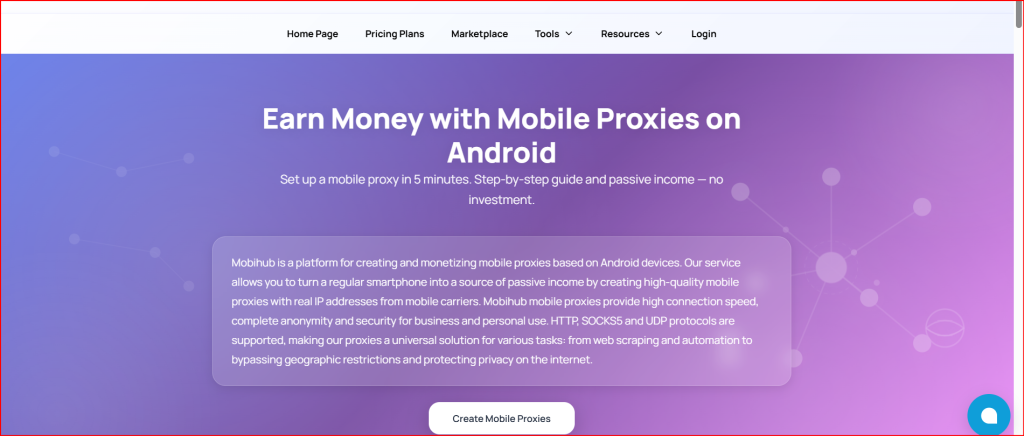
This structure may appeal to individuals, agencies, technical teams, and proxy operators seeking greater control over the physical devices and SIM connections behind their mobile proxy infrastructure.
However, MobiHub should be evaluated as a self-managed proxy creation platform rather than a traditional plug-and-play proxy provider. Users are responsible for supplying the Android devices, SIM cards, mobile data plans, and operational environment required to keep their proxies online.
Editorial note: This review is based on MobiHub’s publicly available features, policies, pricing information, and application documentation. Performance claims and potential earnings have not been independently benchmarked.
What Is MobiHub?
MobiHub is a software-as-a-service platform designed to create and manage mobile proxies through physical Android devices.
After installing the MobiHub application, a user can connect a smartphone to the platform and route authorized internet traffic through the phone’s mobile connection. The external traffic therefore uses an IP address assigned by the device’s mobile carrier rather than an IP originating from a conventional datacenter.
The company’s terms specify that MobiHub provides the software infrastructure used to build and configure proxies. It does not directly provide the Android hardware, SIM card, mobile connection, or carrier-assigned IP address. One physical device can support one proxy, while several connection credentials may point to that proxy depending on the selected subscription.
MobiHub presents two primary use cases:
- Creating private mobile proxies for personal or business operations
- Monetizing Android devices by making their proxy connections available to other customers
The platform reports more than 10,000 active users, over 5,000 available proxies, coverage across more than 50 countries, and uptime of up to 99.9%. These figures are published by MobiHub and should be treated as provider-reported statistics rather than independently audited measurements.
How MobiHub Works
The MobiHub setup process begins with a physical Android smartphone and an active mobile data connection.
Users register an account, download the Android application, sign in, and connect their device to the online dashboard. Once the relevant permissions and network settings are configured, the phone can begin forwarding authorized proxy traffic.
The standard setup process involves:
- Connecting an Android smartphone to a mobile carrier network.
- Registering a MobiHub account.
- Installing the official Android application.
- Signing in and linking the device.
- Creating a proxy through the personal dashboard.
- Configuring authentication, IP rotation, DNS, and connection limits.
- Using the proxy privately or making it available to approved customers.
MobiHub states that initial configuration can take approximately five minutes, although real setup time will depend on the phone model, Android settings, carrier restrictions, and the user’s technical experience. The official terms list Android 9.0 or later as the supported operating-system requirement.
Real Mobile Carrier IP Addresses
The main advantage of MobiHub is that traffic is routed through a genuine mobile connection associated with a physical smartphone and SIM card.
Unlike a datacenter proxy, the resulting address is assigned by a mobile network operator. This can make the connection appear similar to ordinary smartphone traffic, although no proxy can guarantee acceptance by every website or platform.
Because the device owner controls the phone and SIM card, the user has more visibility into the infrastructure supporting the connection. The location of the proxy is also tied to the physical location and carrier network of the connected device.
Changing the mobile IP does not automatically change the device’s geographic region. MobiHub’s terms clarify that even when a new address is assigned, its geolocation will generally continue to correspond to the physical location of the phone.
Supported Proxy Protocols
MobiHub supports several commonly used proxy connection methods.
Its current documentation describes support for:
- HTTP and HTTPS traffic
- SOCKS4
- SOCKS5
- SOCKS5 UDP connections
SOCKS5 support makes the proxy suitable for applications that require more than basic browser traffic. The platform also describes UDP functionality for compatible activities such as DNS requests, voice communication, and video transmission.
Connections can be authenticated through a username and password or, where supported, an IP whitelist. MobiHub states that its connections operate through a proprietary raw-socket stack rather than depending on an external VPN application.
Actual compatibility will still depend on the software receiving the proxy credentials. Users should verify that their browser, automation tool, application, or operating system supports the required protocol and authentication method.
IP Rotation and Connection Management
Mobile carrier networks often assign dynamic IP addresses. MobiHub provides tools intended to help users manage those address changes remotely.
Depending on the configuration and device, users can rotate an IP address on demand, through a scheduled timer, or by using a dedicated rotation link. The system can interact with Android functions such as airplane mode to request a new address from the mobile operator.
The platform also advertises management features such as:
- On-demand IP changes
- Scheduled IP rotation
- Remote rotation links
- Connection credentials
- IP whitelist authorization
- Custom DNS settings
- Traffic limits
- Connection statistics
- Device-status monitoring
- Telegram-based management
IP rotation remains dependent on the mobile carrier. A network operator may return the same address, assign an address from the same subnet, impose connection restrictions, or use carrier-grade NAT. Therefore, rotating the connection does not guarantee that a completely new or previously unused public IP address will always be assigned.
Wi-Fi Relay and Traffic Separation
One of MobiHub’s more interesting technical functions is its ability to separate the phone’s connectivity from the traffic being forwarded through the proxy.
The Android application describes support for traffic splitting with a Wi-Fi connection. In practice, this type of feature may allow the phone to maintain its management connection through Wi-Fi while proxy traffic exits through the mobile carrier network.
This can help reduce unnecessary mobile data usage for background communication and may improve the stability of a permanently connected device. The exact behavior should nevertheless be tested on the intended phone model because Android manufacturers apply different battery, background-process, hotspot, and networking restrictions.
MobiHub Mobile Proxy Marketplace
MobiHub also operates a marketplace where Android device owners can list mobile proxy access for other users.
The marketplace is designed to connect sellers who control phones and SIM cards with buyers seeking mobile connections in specific locations. MobiHub advertises filters based on country, region, mobile operator, and IP characteristics.
Marketplace listings may also include seller ratings and technical information intended to help buyers compare available connections.
According to MobiHub, sellers are verified, transactions are supported by a rating system, data transmission is encrypted, and access to connected devices is controlled. These are platform claims and do not eliminate the need for buyers to evaluate individual sellers, connection quality, permitted usage, and refund conditions.
An important distinction is that MobiHub’s terms place responsibility for third-party proxy services on the device owner or seller. Sellers are expected to manage their customers, establish their own terms, verify end users where necessary, and respond to complaints. MobiHub states that it does not accept responsibility for disputes between a seller and an end user.
Can Users Earn Money Through MobiHub?
MobiHub promotes the possibility of earning income by renting access to a connected Android proxy.
The concept is straightforward: a device owner supplies the phone, SIM card, data plan, electricity, and internet availability. The owner then lists proxy access or provides connections directly to customers.
Nevertheless, this should not be described as guaranteed passive income.
Potential earnings may be affected by:
- The country and city where the phone is located
- Demand for the specific mobile operator
- Connection speed and reliability
- Mobile-data costs
- Device and battery health
- Electricity expenses
- Marketplace competition
- Subscription charges
- Customer support requirements
- Local laws and mobile-carrier policies
MobiHub’s pricing calculator uses illustrative earnings figures and indicates that income can vary significantly by geographic location. Those projections should be viewed as estimates rather than guaranteed financial results. Prospective sellers should calculate expenses using their own data costs, expected utilization, taxes, hardware replacement rates, and realistic marketplace demand.
Pricing and Subscription Structure
MobiHub charges for the software subscription associated with each proxy.
At the time of this review, the pricing calculator displayed a starting example of approximately $7 for one device over a 30-day period. The page also showed discounts for longer subscriptions and larger numbers of devices.
Professional-plan volume discounts were advertised for installations beginning at five devices, with progressively larger reductions for bigger proxy farms. Pricing can change, so customers should confirm the final amount in their account before purchasing.
MobiHub’s pricing comparison lists differences involving:
- Maximum connection speed
- Number of connections per proxy
- IPv4 and IPv6 support
- SOCKS5 UDP availability
- Unique IP functionality
- SmartRelay
- Custom DNS
- IP whitelisting
- Statistics
- Log-storage periods
The platform also advertises a one-time 24-hour trial for new customers. The trial must be requested through support and does not require a bank card, according to the pricing page and terms.
Users should note that subscriptions can renew automatically and that completed subscription payments are generally described as non-refundable unless applicable law requires otherwise. Cancellation and automatic-renewal settings should therefore be reviewed before adding funds.
Dashboard, Telegram Bot, and API Access
MobiHub provides several ways to manage connected devices and proxy connections.
The primary interface is the web-based personal dashboard, where users can review devices, create proxies, manage credentials, and inspect connection information. A Telegram bot is also available for selected management functions and notifications.
MobiHub additionally advertises a REST API for automated proxy management, device-status checks, connection creation, and usage statistics.
However, its public API documentation currently contains only a general description, bearer-token authentication format, and an “in development” notice in the request-example section. Organizations planning a production integration should request complete endpoint documentation and test the API before building important workflows around it.
Android Application Availability
The official MobiHub application is available through Google Play, and the website also advertises a directly downloadable APK.
As of June 17, 2026, the Google Play listing showed more than 500 downloads and identified version 1.1.6 as including performance optimization, interface updates, and a device-memory checking function.
Downloading from Google Play generally provides a more standardized installation and update process. Users choosing a direct APK should verify that it comes from the official MobiHub domain and should avoid installation files distributed through unofficial channels.
Because the application routes third-party network traffic through the phone, it requires meaningful access to device and network information. Installing it on a dedicated Android device rather than a primary personal phone may provide clearer operational separation.
Privacy and Data Collection
MobiHub’s privacy documentation states that the platform may collect account information, device details, Android version, SIM and network information, IP history, battery status, payment-related records, and technical connection logs.
The app-specific policy also describes the collection of traffic volume, timestamps, and destination ports while stating that the content of transmitted traffic is not recorded. The platform says data is used for service operation, analytics, support, fraud prevention, abuse investigation, and legal compliance.
Prospective users should carefully review these policies because there appear to be some points that would benefit from clarification.
For example, one section of the website’s privacy policy refers to two years of technical logging, while its retention section gives an example of one year for end-user logs. The Google Play disclosure also states that collected data cannot be deleted, whereas the website policy describes a right to request deletion and the terms allow users to request account removal, subject to legally required retention.
These statements do not necessarily prove that deletion rights are unavailable, but privacy-sensitive users should request written clarification about:
- The exact log-retention period
- Which records remain after account deletion
- The process for requesting data removal
- The legal entity responsible for processing
- Data accessible to marketplace sellers or buyers
- Cross-border data handling
- Law-enforcement disclosure procedures
The privacy policy states that data is stored in the European Union and that GDPR principles are used as a data-protection baseline.
Security and Acceptable Use
MobiHub states that application-to-server communication is protected with TLS, passwords are stored in hashed form, network firewalls are used, and employee access to personal data is limited. No public security audit or penetration-test report was identified in the materials reviewed, so these protections should be understood as company statements.
The platform prohibits illegal activities, fraud, spam, phishing, malware distribution, unauthorized vulnerability scanning, and denial-of-service attacks.
MobiHub may restrict access to certain categories of websites, including banking and government portals. Accounts may also be suspended when prohibited activity, fraud, sanctions violations, security threats, or breaches of the terms are suspected.
Device owners should also check their mobile operator’s terms. Some carriers prohibit reselling connectivity, operating proxy services, excessive tethering, or commercial use of consumer data plans. MobiHub places responsibility for carrier compliance on the customer.
Practical Use Cases
When operated lawfully and with the authorization of relevant platforms, MobiHub-created proxies may support several professional workflows.
Localized Website Testing
Teams can inspect how websites, search results, advertisements, and application content appear through a mobile connection in a particular region.
Quality Assurance
Developers and testing teams may use carrier-assigned connections to validate mobile experiences, network behavior, and location-dependent functionality.
Advertising Verification
Agencies may review campaign delivery, landing pages, and mobile advertisements from relevant geographic markets.
Authorized Data Collection
Businesses may collect publicly accessible information where permitted by the target website, applicable law, and contractual conditions.
Social Media Operations
Organizations managing approved brand accounts can assign separate network environments to different operational profiles. A proxy does not replace appropriate account permissions, platform compliance, or secure browser-profile management.
Private Infrastructure
Technical users can create a mobile proxy from hardware they control rather than relying entirely on a shared external proxy pool.
Main Advantages of MobiHub
MobiHub’s strongest quality is infrastructure control. Users can choose the physical phone, SIM card, mobile operator, location, and data plan behind their proxy.
Other advantages include:
- Real mobile-carrier connectivity
- Android-based deployment
- HTTP, SOCKS4, SOCKS5, and UDP support
- Remote IP-rotation controls
- Custom DNS and IP-whitelist options
- Multiple connections per proxy
- Dashboard and Telegram management
- Marketplace access
- Volume discounts for device farms
- A 24-hour trial for new customers
This combination makes the platform more flexible than a basic Android proxy application while remaining more accessible than developing a custom mobile proxy stack from the beginning.
Limitations to Consider
MobiHub also comes with operational and commercial limitations.
Users Must Supply the Infrastructure
The subscription does not include a phone, SIM card, carrier plan, electricity, or replacement hardware. The true operating cost can therefore be significantly higher than the software fee.
Reliability Depends on the Device and Carrier
Weak signal quality, Android battery optimization, device overheating, carrier maintenance, data throttling, and power interruptions can all affect availability.
Earnings Are Not Guaranteed
The marketplace does not ensure continuous customers or a fixed monthly return. Income estimates should not be treated as contractual commitments.
The API Documentation Is Incomplete
Developers may need direct support before implementing automated integrations.
Public Independent Feedback Is Limited
There is currently less extensive independent testing and customer feedback for MobiHub than for older, larger proxy providers. A small trial is therefore preferable to an immediate large deployment.
Policy Details Need Clarification
The differences between published retention periods and deletion disclosures should be clarified by support before processing sensitive or regulated workloads.
Marketplace Quality Can Vary
Because marketplace proxies originate from different device owners, performance, uptime, speed, operator quality, and support may differ between listings.
Who Should Consider MobiHub?
MobiHub may be a suitable option for:
- Users who already own spare Android phones
- Operators building small or medium mobile proxy farms
- Agencies that need carrier-specific testing connections
- Developers requiring controllable mobile proxy infrastructure
- Marketplace sellers who understand customer verification and abuse prevention
- Businesses that prefer dedicated devices over large shared IP pools
It may be less suitable for customers who want instant access to thousands of managed IPs without maintaining hardware, SIM cards, or mobile subscriptions.
Large organizations with strict compliance requirements should also request detailed information about contracts, company registration, security controls, data retention, service-level commitments, and incident-response procedures before deployment.
MobiHub Review 2026: Final Verdict
MobiHub offers a practical concept for turning Android smartphones into remotely managed mobile proxy servers. Its combination of real carrier IP addresses, IP rotation, multiple protocols, traffic controls, marketplace access, and centralized device management creates a potentially useful platform for both private operators and proxy sellers.
The service is most compelling for users who value physical control over the devices and SIM cards supporting their connections. It can also reduce the technical work required to build a mobile proxy farm from scratch.
At the same time, MobiHub is not a completely managed infrastructure product. Customers remain responsible for hardware, mobile data, carrier compliance, device stability, end-user activity, and much of the commercial risk associated with reselling access.
The best approach is to begin with the available 24-hour trial, connect one dedicated Android device, test the required protocol and IP-rotation behavior, evaluate support responsiveness, and confirm the applicable privacy and refund conditions before expanding.
Overall, MobiHub appears to be a feature-rich Android mobile proxy management platform with an interesting marketplace model. Its value will depend less on headline earnings estimates and more on the user’s ability to operate reliable devices, control access, follow carrier rules, and manage customers responsibly.
Frequently Asked Questions
Is MobiHub a traditional mobile proxy provider?
Not exactly. MobiHub primarily provides software for creating and managing proxies through Android devices. Users supply the phone, SIM card, and mobile connection. The marketplace can also connect proxy sellers with buyers.
What Android version does MobiHub require?
The published terms list Android 9.0 or later as the supported requirement.
Which protocols does MobiHub support?
The platform documents HTTP, SOCKS4, SOCKS5, and SOCKS5 UDP support.
Does MobiHub provide a free trial?
New customers can request a one-time 24-hour trial through customer support.
How much does MobiHub cost?
The pricing calculator displayed an example of approximately $7 for one device over 30 days at the time of review. The final price depends on the plan, subscription length, and number of devices.
Can MobiHub guarantee passive income?
No. Earnings depend on demand, location, carrier, availability, operating expenses, marketplace competition, and customer usage.
Can users change their mobile proxy IP?
MobiHub supports several IP-rotation methods, but the final address is assigned by the mobile carrier. A completely new IP cannot be guaranteed after every rotation.
Is MobiHub suitable for large proxy farms?
The platform offers volume discounts and centralized management features that may support multi-device operations. Large deployments should first test device stability, carrier limits, automation tools, support, and API availability.
Does MobiHub keep activity logs?
Its policies describe the collection of connection metadata and technical logs for security, operation, and legal compliance. Users should ask support to clarify the exact retention period before using the service for sensitive workloads.
Is MobiHub safe to use?
MobiHub describes encryption, hashed passwords, access controls, and abuse-prevention measures. Users should still secure their accounts, use dedicated devices, limit customer access, review activity, and verify all legal and carrier requirements.