

It’s not very usual for us automotive enthusiasts to learn about a new upcoming vehicle where the specification sheet’s main USP – or perhaps the car’s main talking point – is a piece of technology. Be as it may, technology and some might even call them electronics is what drives the vehicles of our day and age and we’ve come a long way where technology has enabled us to have a lot more safer vehicles than back in the day. The passive safety features, in particular, are a boon for the vehicles as they act silently in the background saving endless lives each day on the road.
We see that our Tata Harrier EV Overview went towards the safety aspect quite quickly, but fortunately the talking point of this SUV – and yes, from a technology perspective – is a first for any manufacturer, a QLED screen taking the centre stage displaying the typical software from Tata Motors. The progress? It’s breathtaking. The advantage of it? We’ll discuss in our overview right below.
The design of it
Holding on to the technology aspect for a bit, let’s actually discuss what sets apart the Tata Harrier EV from its ICE version. First look, and yes it looks largely the same. The manufacturer has made an effort by distinguishing this from its ICE version by making a few changes, as is usually the case with EVs born out of ICE platforms.
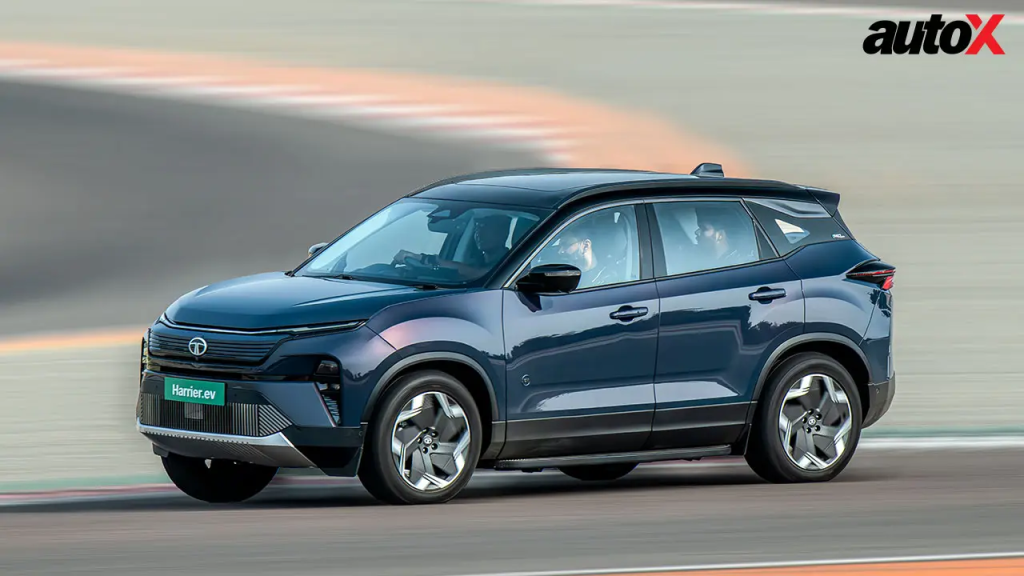
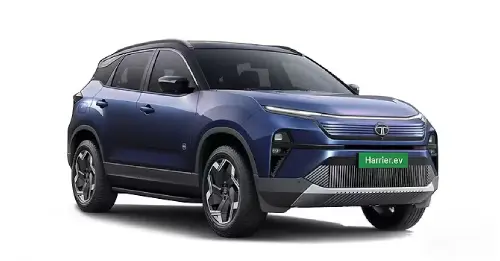
The distinguishing bits include a new bumper design which is now largely concealed thanks to the aerodynamic requirements – or so we believe – of electric vehicles. The grille now houses an illuminated Tata logo and the lower half of the bumper now flaunts a new design language with vertical slats. The changes are much lesser at the side and the rear where we see a new alloy wheel design and a new revised bumper, respectively. What’s interesting is a new light blue shade that’s not available with the ICE version. Lastly, there are emblems that now read Harrier.ev.
Empowered Oxide, Nainital Nocturne, Pristine White, and Pure Grey are the four shades available since the launch of the Harrier EV. The lot has been recently joined by a stealth edition, which as the name suggests carries a blacked-out stealthy look both inside and out. If it’s Dark Edition for the ICEs, it’s Stealth Edition for the EVs, because why not.
The inside of it
The Harrier EV comes with a new 14.53-inch Neo QLED screen that offers a more vivid and contrasty experience in comparison to TFT/LCD units we’ve seen in other cars. Developed in collaboration with Samsung, this is the first vehicle in India with this technology. The screen has been developed with minimal bezels around all corners and displays the software – that we’ve seen on other Tata models – with utmost clarity.
Apart from that, the Tata Harrier EV features vehicle-to-load (V2L) and vehicle-to-vehicle (V2V) functionality, four drive modes (Eco, City, Sport, and Boost) complemented by six terrain modes – Normal, Snow/Grass, Mud-Ruts, Sand, Rock Crawl, Custom, all-digital inside rearview mirror, auto park assist, as part of the additional equipment when compared to the ICE version. The cabin layout, however, remains largely the same and apart from the not so easy to reach USB ports at the front, it’s quite ergonomic.
Lastly, the Harrier EV gets a 540-degree surround camera view that displays a live feed of what’s beneath the vehicle, and there’s a new DrivePay feature that eliminates the need for a mobile device for FASTag and EV charging point payments.
The cabin also has a lot of storage spaces and five people can easily travel in the Harrier EV. The boot space is now 502 litres and there’s a small frunk that can hold a few charging cables at max.
Dual Motors!
The Tata Harrier EV is built on a modified version of Tata’s Acti.ev platform, which we first saw with the Punch EV and later last year with the Curvv EV. So despite having a very similar design, the Harrier EV is built from the ground up as an electric vehicle.
Here is a rundown of its specifications:
- On the lower trims, a 65kWh LFP battery pack powers a single motor on the rear axle, blessing the rear wheels with 235 bhp of power
- The higher trims get dual motors with one on each axle, making a combined output of 308 bhp and 504 Nm. This is powered by a 75kWh LFP battery.
Tata Motors claims that the higher trims with the dual motors can sprint from 0-100kph in just 6.3 seconds with the Boost mode enabled. The dual motors also enable all wheel drive thanks to a new ‘Ultra Glide’ multi-link suspension setup at the rear with frequency-dependent dampers for better off-road drivability, however the overall setup remains rear-biased.
When it comes to range, the 75kWh battery pack features the most range of 627 km and 622 km on a single charge for the RWD and AWD versions, respectively. Both the figures are MIDC-certified. In terms of real-world usage, the Harrier EV can deliver up to 480 – 505 km of total range on a single charge (for the 75kWh RWD version) as a result of the manufacturer’s internal testing cycle.
The Harrier EV supports DC fast charging of up to 120kW, which can charge the EV from 20-80 percent in just 25 minutes. The SUV can also be recharged via a 7.2kW AC charger, good for taking it from 10-100 percent in 10.7 hours.
And the variants
The Harrier EV takes the variant nomenclature from the brand’s other electric vehicles and in a similar fashion, comes in three trims: Adventure, Fearless+, and Empowered. We can confirm in our Tata Harrier EV overview that all the trims of the SUV come with a lifetime warranty of the battery pack from the manufacturer.
Prices and Verdict
The Harrier EV has been launched at INR 21.49 lakhs (ex-showroom) and goes up to INR 30.23 lakhs (ex-showroom). With the Harrier EV, Tata Motors seems to have hit the right spot when it comes to pricing as this seamlessly slots in between its direct rivals offered from another Indian manufacturer. The familiarity of the Harrier EV will help its case when it comes to reliability and ownership. The new tech it brings to the table is also a talking point, however what really sets it apart is the new suspension setup that allows you to take the Harrier EV anywhere, regardless if there’s a road or not.

