1. Market Overview: The Need for SAR Robots
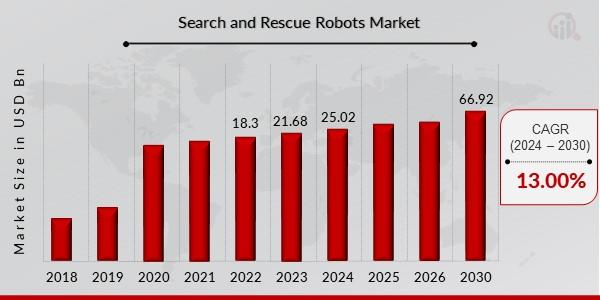
The search and rescue (SAR) robots market is witnessing exponential growth, emerging as an essential component of modern disaster management and emergency response. With a valuation of USD 21.68 billion in 2023, this dynamic sector is projected to surge to USD 66.92 billion by 2030, reflecting a robust compound annual growth rate (CAGR) of 13% during the forecast period (2024–2030). This rapid growth is driven by increasing investments in defense, advancements in SAR technology, and heightened global security concerns.
In this post, we will delve into the factors propelling the SAR robots market, its segmentation, trends, challenges, and regional dynamics, shedding light on the future outlook of this transformative industry.
Search and rescue robots are designed to support emergency responders in high-stakes, often hazardous situations where time is critical. These robots are equipped with advanced technologies like artificial intelligence (AI), sensors, cameras, and GPS to navigate difficult terrains, reach inaccessible areas, and perform tasks such as identifying survivors, assessing damage, and delivering supplies. SAR robots can operate in various environments, including land, sea, and air, making them versatile tools for responding to natural disasters, terrorist attacks, and other emergencies.
Increasingly, SAR robots are seen as a vital asset for governments and private organizations, enhancing the speed and efficiency of rescue missions and minimizing human risk. In the wake of rising global conflicts, climate change, and security threats, the need for SAR robots has become more pronounced, positioning this market for substantial growth over the coming decade.
2. Key Market Drivers
Several factors are propelling the growth of the search and rescue robots market:
a. Increased Defense Spending
Rising defense budgets in many countries have led to a surge in funding for SAR robotics, as military forces recognize their potential in search and rescue missions. Robots can assist in search operations in conflict zones, gather intelligence, and carry out reconnaissance. As countries prioritize security, they are investing in technology to enhance response capabilities, supporting the growth of the SAR robots market.
b. Advancements in Robot Technology
The SAR robots market is benefiting significantly from rapid technological advancements. Developments in AI, machine learning, sensor technology, and robotics are enhancing the functionality and reliability of SAR robots. Robots are becoming more autonomous, resilient, and capable of analyzing complex data to make quick, accurate decisions. These capabilities allow SAR robots to be deployed across diverse scenarios, from urban disasters to underwater rescues.
c. Increasing Terrorist Threats and Security Concerns
The frequency of terrorist incidents worldwide has increased the demand for SAR robots, particularly in countries facing security challenges. SAR robots play a crucial role in locating survivors, handling explosives, and monitoring dangerous zones, reducing human risk during rescue missions. Their use has proven invaluable in both reactive and preventive security measures, enhancing preparedness for high-stakes situations.
3. Market Segmentation
The SAR robots market can be segmented based on type, application, and region.
a. By Type
- Ground Robots: Ground robots are designed for land-based operations and are equipped with advanced sensors and cameras for mobility on rugged terrains. These robots can navigate confined spaces and debris, making them ideal for earthquake and building collapse scenarios.
- Aerial Robots (Drones): Aerial SAR robots, commonly referred to as drones, are used to survey large areas, capture real-time images, and deliver supplies. Drones are especially valuable for their rapid deployment and capability to provide situational awareness in disaster zones.
- Marine Robots: Marine SAR robots operate in water and underwater environments. They are used for search operations in cases of maritime disasters, shipwrecks, or drownings. Equipped with sonar, underwater cameras, and advanced navigation systems, these robots are critical for sea-based rescue missions.
b. By Application
- Defense and Military: In military operations, SAR robots are essential for reconnaissance and locating personnel in hostile or hazardous environments. They are also used to carry out life-saving missions in war zones.
- Disaster Management: SAR robots are widely used in disaster management, responding to natural calamities like earthquakes, hurricanes, and floods. They help in locating survivors, assessing damage, and delivering medical supplies to affected areas.
- Firefighting: Firefighting SAR robots are designed to navigate through smoke and flames, assisting in identifying survivors trapped in buildings. They can withstand high temperatures and provide real-time visuals to help firefighters in making critical decisions.
- Others: Other applications include urban search and rescue missions, crowd control during mass events, and missions in hazardous industrial settings.
4. Trends and Innovations in SAR Robots
The SAR robots market is undergoing rapid technological evolution, with several trends driving the development of advanced SAR solutions:
a. AI and Machine Learning Integration
Artificial intelligence (AI) and machine learning (ML) are transforming SAR robots by enabling them to process data, analyze complex environments, and adapt their operations in real-time. These capabilities allow SAR robots to make quick, autonomous decisions, identify obstacles, and assess the situation more accurately, enhancing their efficiency in time-sensitive missions.
b. Swarm Robotics
Swarm robotics, where multiple robots work together in coordinated teams, is gaining traction in the SAR market. This technology allows a group of small robots to cover large areas more efficiently, communicate with each other, and share information in real-time. Swarm robots are particularly useful in search missions over large or densely packed areas, such as after a natural disaster.
c. Enhanced Durability and Resilience
SAR robots are now being designed with improved durability to withstand harsh environments, including extreme temperatures, heavy rain, and physical impacts. This resilience allows them to operate for longer durations and survive conditions that are challenging for human responders.
d. Remote Connectivity and Real-Time Data Sharing
Advancements in wireless connectivity are enabling SAR robots to share real-time data with command centers, providing vital information that aids decision-making. This trend is especially critical in large-scale disaster scenarios where situational awareness is key to effective response.
5. Regional Insights
The SAR robots market is expanding across multiple regions, with North America, Europe, and the Asia-Pacific leading the way:
a. North America
North America, particularly the United States, is a major player in the SAR robots market. High defense budgets, ongoing investment in disaster management infrastructure, and a strong focus on technological innovation position North America as a prominent region for SAR robots.
b. Europe
Europe has seen increased demand for SAR robots due to its commitment to public safety and counter-terrorism measures. Countries like the UK, France, and Germany are investing in SAR technology for both disaster response and security applications, contributing to the region’s market growth.
c. Asia-Pacific
The Asia-Pacific region is expected to witness significant growth, driven by increasing natural disasters, urbanization, and security concerns in countries such as China, Japan, and India. Governments in this region are investing in robotics and AI technologies to bolster their disaster preparedness and response capabilities.
6. Challenges Facing the SAR Robots Market
Despite its promising growth, the SAR robots market faces challenges that could impact its expansion:
a. High Initial Costs
The cost of developing and deploying advanced SAR robots is high, limiting accessibility for organizations with budget constraints. High costs may hinder the adoption of SAR robots, particularly in developing nations with limited disaster management resources.
b. Technical Limitations
Although SAR robots are becoming increasingly sophisticated, technical limitations remain. Issues like battery life, environmental adaptability, and connectivity in remote or obstructed areas pose challenges. Continuous R&D efforts are required to address these technical hurdles.
c. Regulatory Hurdles
The deployment of SAR robots, particularly aerial drones, is subject to regulatory constraints that vary by country. Regulatory challenges can limit the deployment of these technologies in disaster-prone areas, impacting response efforts and market growth.
7. Future Outlook
The SAR robots market is poised for continued growth as technology evolves, and governments recognize the importance of advanced robotics in emergency response. Innovations in AI, autonomy, and sensor technology will enable SAR robots to become more efficient, versatile, and reliable, enhancing their role in both disaster and defense operations.
As climate change intensifies the frequency and severity of natural disasters, SAR robots will be indispensable assets for timely, effective responses. The increasing threat of global terrorism further cements the necessity of these robots, and as defense budgets grow, so will investments in SAR technology.
Conclusion
The search and rescue robots market outlook is on a promising growth trajectory, with an anticipated value of USD 66.92 billion by 2030. Driven by increased defense spending, technological advancements, and rising global security threats, SAR robots are set to become key players in the realms of disaster management, public safety, and defense. While challenges such as high costs and regulatory hurdles exist, the pace of innovation and growing demand ensure a bright future for SAR robots, with ongoing developments promising to redefine the capabilities and impact of these remarkable machines.
For those in emergency response, security, and defense sectors, SAR robots represent an invaluable investment in both human safety and operational efficiency, making this market one to watch closely in the years ahead.