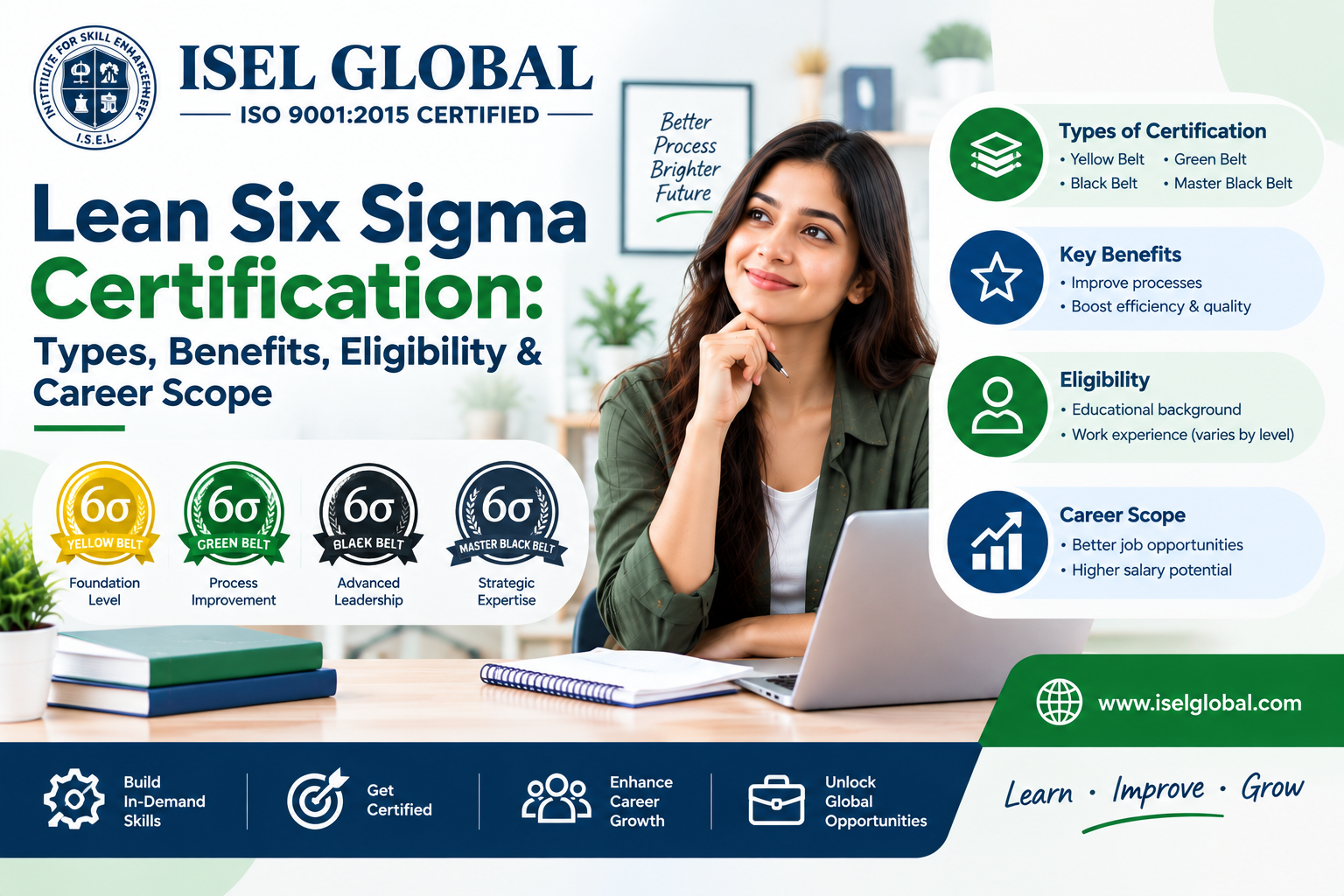
Lean Six Sigma certification helps professionals develop practical skills to improve processes, reduce waste, minimize errors, and achieve better business results. It is relevant to engineers, quality professionals, project managers, manufacturing teams, IT professionals, and individuals who want to build careers in process improvement and operational excellence.
As organizations focus on productivity, customer satisfaction, and cost control in 2026, professionals who can identify problems and make decisions using data can add value across industries. Choosing the right certification depends on your experience, career goals, and the level of responsibility you want to take on.
What Is Lean Six Sigma Certification?
Lean Six Sigma certification is a professional credential that demonstrates knowledge of methods used to improve processes, reduce waste, and control defects. Lean focuses on eliminating activities that do not add value, while Six Sigma uses data and statistical techniques to reduce variation and errors.
Together, these approaches help organizations improve quality, efficiency, and customer satisfaction. Training levels commonly include Yellow Belt, Green Belt, Black Belt, and Master Black Belt, although course structures and certification requirements vary by provider.
Why Is Lean Six Sigma Certification Important in 2026?
Lean Six Sigma is useful because organizations need measurable improvements rather than assumptions. Certified professionals learn to identify the causes of recurring problems, analyze performance data, and implement improvements that support business objectives.
For example, a manufacturing company experiencing frequent product defects can use process analysis to identify root causes and introduce corrective actions. A service company can apply similar methods to reduce customer waiting times and improve response quality.
These skills are relevant to quality management, supply chain operations, healthcare administration, IT services, finance, and project management.
What Are the Different Types of Lean Six Sigma Certification?
The main certification levels represent different stages of learning and responsibility.
- Yellow Belt: Introduces basic concepts, process improvement, and team participation. It suits beginners who want to understand Lean Six Sigma fundamentals.
- Green Belt: Develops skills in data collection, root cause analysis, process mapping, and improvement projects. A six sigma green belt is a useful option for professionals who want to contribute to structured improvement initiatives.
- Black Belt: Focuses on advanced analysis, complex projects, leadership, and mentoring improvement teams. A Lean Six Sigma Black Belt certification can suit experienced professionals seeking greater project responsibility.
- Master Black Belt: Focuses on strategic deployment, coaching, advanced improvement methods, and developing organizational capability.
The appropriate level depends on your current skills, practical experience, and career objectives.
What Are the Key Benefits of Lean Six Sigma Certification?
A well-designed certification program can help professionals develop skills that are useful across different business environments.
Key benefits include:
- Better problem-solving: Learn to investigate root causes instead of repeatedly addressing symptoms.
- Data-driven decisions: Use evidence and performance measurements to evaluate process problems.
- Improved efficiency: Identify waste, delays, unnecessary steps, and opportunities to simplify workflows.
- Stronger career prospects: Demonstrate knowledge relevant to quality, operations, process excellence, and project management roles.
- Project leadership: Develop the ability to plan improvement initiatives, measure results, and coordinate teams.
- Business impact: Help organizations improve consistency, customer experience, and resource utilization.
The actual career benefit depends on the quality of training, practical experience, employer expectations, and the recognition of the certification provider.
Who Is Eligible for Lean Six Sigma Certification?
Eligibility varies by provider and certification level. Introductory courses generally welcome beginners, while advanced programs may recommend professional experience and prior knowledge of quality management or process improvement.
Students, graduates, engineers, IT professionals, manufacturing employees, and working professionals can explore training according to their goals. Before enrolling, check the provider’s prerequisites, examination format, project requirements, and assessment criteria.
What Skills Will You Learn?
Lean Six Sigma training typically develops a combination of analytical, technical, and professional skills, including:
- Process mapping and workflow analysis
- Root cause analysis and problem-solving
- Data collection and interpretation
- Defect measurement and process variation analysis
- Waste identification and reduction
- Statistical process control
- Project planning and team collaboration
- Continuous improvement and performance monitoring
Many programs also introduce the DMAIC framework: Define, Measure, Analyze, Improve, and Control. This structured approach helps teams understand a problem, investigate its causes, test improvements, and maintain the results.
What Does the Course Curriculum Include?
Although the syllabus differs between providers, a typical curriculum may cover:
- Lean principles and the identification of waste.
- Six Sigma fundamentals and quality management concepts.
- Process mapping, metrics, and data collection.
- Root cause analysis and improvement tools.
- DMAIC methodology and project implementation.
- Statistical analysis and process control, according to the course level.
- Practical case studies, assessments, or improvement projects where included.
Review the syllabus before choosing a program. A six sigma book or six sigma ebook may provide supplementary learning material, but reading resources alone may not satisfy a provider’s examination or project requirements.
What Career Opportunities Are Available?
Professionals with relevant Lean Six Sigma knowledge may pursue roles such as:
- Quality Analyst or Quality Engineer
- Process Improvement Specialist
- Operations Manager
- Continuous Improvement Manager
- Business Process Analyst
- Project Manager
- Operational Excellence Consultant
- Quality or Process Excellence Leader
These opportunities exist across manufacturing, healthcare, logistics, banking, IT, business services, and supply chain management. Certification can strengthen a candidate’s profile, but employers also consider experience, technical ability, communication, and demonstrated results.
What Are the Salary Trends?
There is no single salary for Lean Six Sigma professionals. Compensation depends on the job title, industry, location, experience, employer, and complexity of projects handled.
Entry-level professionals may begin in quality or analyst roles, while experienced practitioners can progress into project leadership, operations management, and consulting. Black Belt and Master Black Belt qualifications may support advancement when accompanied by relevant experience and measurable improvement results.
For a realistic salary assessment, compare current job postings for your target role and location instead of relying on certification-level salary promises.
Which Industries Hire Lean Six Sigma Professionals?
Lean Six Sigma skills are useful wherever organizations need to improve quality, efficiency, and consistency. Common sectors include:
- Manufacturing: Reduce defects, downtime, and production waste.
- Healthcare: Improve workflows, patient scheduling, and service delivery.
- IT and technology: Streamline service processes and reduce recurring errors.
- Banking and finance: Improve transaction accuracy and operational controls.
- Logistics: Reduce delivery delays and improve inventory management.
- Retail and business services: Improve customer experience and process consistency.
What Mistakes Should You Avoid When Choosing Certification?
Avoid selecting a program based only on price, course duration, or promotional claims. Check the syllabus, trainer expertise, assessment process, practical learning opportunities, and certificate verification arrangements.
Another common mistake is assuming that a certificate automatically guarantees a promotion or salary increase. Employers value the ability to apply the methods, communicate findings, and demonstrate measurable results.
Choose a level that matches your current experience, and practise applying the tools to realistic business problems.
Best Practices for Getting Value from Your Certification
To make your learning useful, connect the course concepts with actual workplace challenges. Start by identifying a process problem, collecting reliable data, and defining a measurable improvement goal.
Use the DMAIC framework to investigate the issue systematically. Discuss findings with relevant stakeholders, test improvements where appropriate, and monitor results after implementation. Keeping a record of projects, methods, and outcomes can also help you explain your skills during interviews.
Conclusion
Lean Six Sigma certification can help professionals build practical skills in quality management, data analysis, waste reduction, and continuous improvement. The right level depends on your experience and career direction, from foundational training to advanced project leadership.
Before enrolling, compare course content, assessment requirements, practical learning opportunities, and certification recognition. Explore ISEL Global’s Lean Six Sigma certification programs to review available training options and identify a learning path aligned with your professional goals.
Frequently Asked Questions
1. What is Lean Six Sigma certification?
Lean Six Sigma certification demonstrates knowledge of methods for improving processes, reducing waste, and controlling defects. Training commonly covers process analysis, root cause identification, data-driven decisions, and continuous improvement. The depth of learning depends on the certification level and provider. Professionals should review the course syllabus and assessment requirements before enrolling.
2. Which Lean Six Sigma certification is best for beginners?
Beginners can consider Yellow Belt or introductory Green Belt training, depending on their learning goals and the provider’s prerequisites. Yellow Belt introduces fundamental concepts, while Green Belt generally covers more detailed process improvement methods. Compare the syllabus, practical exercises, and assessment format to select a course suited to your current knowledge and career plans.
3. Is Lean Six Sigma certification worth it?
It can be worthwhile for professionals who want to develop structured problem-solving, data analysis, and process improvement skills. These capabilities are relevant to many industries. However, the value depends on training quality, employer recognition, and the ability to apply the methods at work. Certification alone does not guarantee a job, promotion, or salary increase.
4. Who can apply for Lean Six Sigma certification?
Eligibility depends on the certification provider and level. Many introductory courses are open to students, graduates, and working professionals. Advanced programs may recommend prior training, relevant experience, or project knowledge. Check the provider’s published requirements before applying so that the selected course matches your background and professional objectives.
5. What is the difference between Green Belt and Black Belt?
Green Belt training generally prepares professionals to participate in and manage improvement projects within their level of responsibility. Black Belt training typically develops more advanced analytical, project leadership, and mentoring capabilities. The exact distinction varies by provider. Review the syllabus, prerequisites, practical requirements, and examination criteria before choosing either level.
6. How long does Lean Six Sigma certification take?
The time required depends on the belt level, learning format, course structure, and assessment requirements. Introductory courses may be shorter, while advanced programs can require more study and practical project work. Before enrolling, confirm the expected study hours, access period, examination schedule, and any project submission deadlines.
7. Can I complete Lean Six Sigma certification online in India?
Yes, online training options are available in India. Before selecting a program, check whether it includes instructor support, learning resources, assessments, practical exercises, and clear certificate verification details. You can explore ISEL Global’s online Lean Six Sigma programs to review the available learning options.
8. What jobs can I get after Lean Six Sigma certification?
Depending on your experience and skills, relevant roles may include Quality Analyst, Quality Engineer, Process Improvement Specialist, Business Process Analyst, Operations Manager, or Continuous Improvement Manager. Advanced roles usually require additional experience and demonstrated project results. Employers evaluate practical ability and industry knowledge alongside certification.
9. Does Lean Six Sigma certification guarantee a higher salary?
No. Certification does not guarantee a salary increase. Compensation depends on experience, job responsibilities, industry, location, employer, and demonstrated performance. The training may strengthen your professional profile, but practical projects, analytical skills, communication, and measurable business results are important when pursuing higher-level roles.
10. How should I choose a Lean Six Sigma certification provider?
Compare the syllabus, trainer experience, examination process, practical project requirements, support, and certificate verification arrangements. Check whether the course level suits your experience and whether its recognition meets your employer’s requirements. Avoid relying solely on marketing claims or guaranteed career outcomes when making your decision.
Final Call to Action
Ready to develop your process improvement skills?
Explore ISEL Global’s Lean Six Sigma certification programs to review available training options, compare learning levels, and choose a course that aligns with your experience and career goals.
Build your knowledge, practise the methods, and take the next step toward professional growth in quality management and operational excellence.