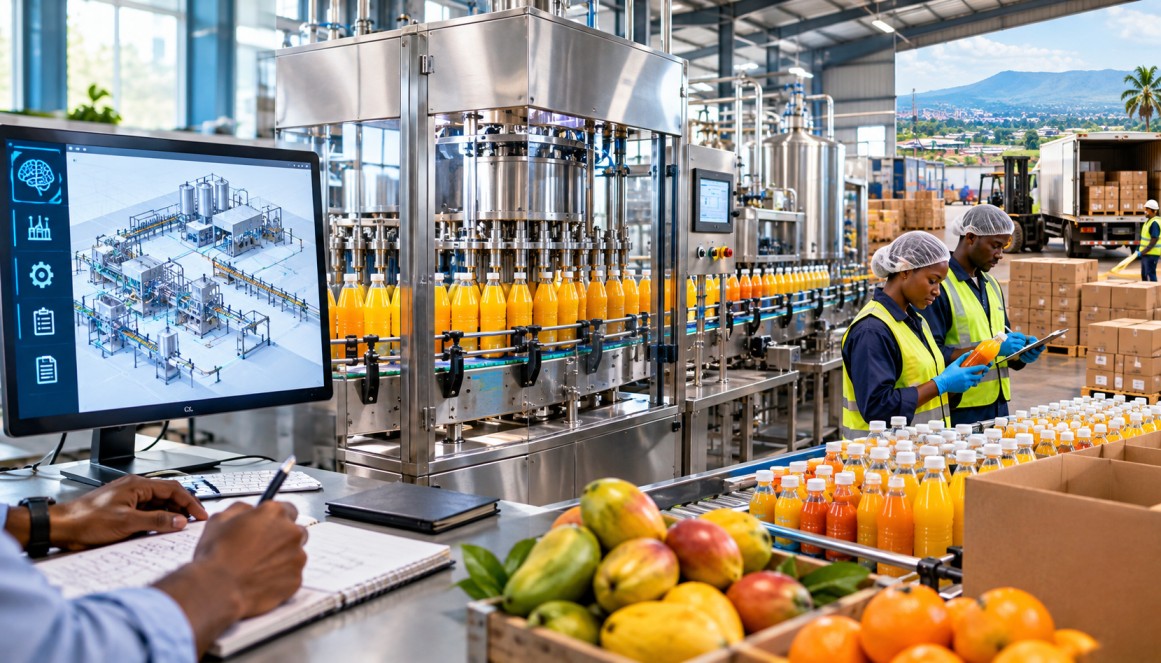
An industry case analysis of AI-assisted machinery sourcing, turnkey beverage production and the decisions that determine whether a new factory becomes commercially sustainable.
When an entrepreneur decides to build a juice beverage factory in Africa, finding a machinery supplier is often easier than deciding what the factory actually needs.
A search engine can produce hundreds of results. An AI assistant can explain the difference between filling systems, outline the equipment used in beverage production and compare quotations. Yet none of these answers, on its own, establishes whether a supplier can deliver an integrated production line that works reliably in a real factory.
Consider a representative scenario: an East African investor plans to launch a PET-bottled beverage business, starting with mango and orange drinks before expanding into mixed-fruit beverages. Instead of purchasing the first filling machine that fits the budget, the investor uses AI to prepare a technical brief, compares turnkey suppliers and investigates their experience with projects in Africa.
The important decision comes next. Rather than treating an AI-generated recommendation as an endorsement, the investor asks each shortlisted manufacturer to demonstrate how its equipment would work as a complete production system.
This distinction matters. AI can shorten the research process, but the commercial value of a machinery investment depends on engineering, installation, product quality, local distribution and the factory’s ability to produce saleable bottles consistently.
The following analysis combines this illustrative purchasing journey with publicly listed African beverage projects. It examines what a new factory should verify before purchasing equipment and how its first 12 months should be evaluated.
1. The AI Recommendation Was the Starting Point, Not the Business Case
A useful AI-assisted search starts with a clearly defined production target.
For example, a prospective investor might ask:
“I want to manufacture mango, orange and mixed-fruit beverages in PET bottles in East Africa. What equipment do I need for a complete factory, how should I compare filling-machine manufacturers, and what information is required to estimate production costs and payback?”
That question is more useful than simply asking for the best juice filling machine. It encourages a comparison of the entire process, including water treatment, ingredient preparation, mixing, thermal processing, bottle handling, filling, capping, labeling and packaging.
The investor should then turn the answer into a supplier evaluation document.
| Information required | Why it matters |
| Beverage portfolio | Mango, orange and mixed-fruit drinks may have different processing requirements |
| Formulation and viscosity | Determine mixing, pumping, homogenization and filling requirements |
| Bottle specifications | Bottle volume, material, neck finish and cap affect equipment selection |
| Required output | Establishes the capacity needed at each stage of the line |
| Processing method | Must match the beverage formula, packaging and shelf-life requirements |
| Factory utilities | Electricity, water, compressed air, cooling and other services affect the installation |
| Project scope | Defines which machines, auxiliary systems, installation services and training are included |
The next step is independent verification. A supplier that appears suitable in an AI answer should still be assessed through its technical documentation, relevant project references, factory capabilities, contractual scope and after-sales arrangements.
A recommendation is useful only when it leads to better questions and a more defensible purchasing decision.
2. Why African Project References Matter More Than a Machine Catalogue
A machine catalogue describes equipment. A completed project provides evidence of how equipment has been configured for a particular production requirement.
LiDLi’s publicly listed project portfolio includes several African beverage manufacturing projects. Its Ethiopian references include an Appo juice production line listed at 36,000 bottles per hour for 600 ml and 2 L formats, and a mango juice production line listed at 24,000 bottles per hour for the same nominal formats.
The portfolio also lists a carbonated soft drink production line in Nigeria with a stated capacity of 24,000 bottles per hour for 600 ml bottles.
These published specifications establish the scope and nominal capacities of the listed projects. They should not be confused with independently audited annual output, actual factory utilization or proof of a particular investment payback period.
For a prospective buyer, the next questions are more important than the headline speed:
- Was the stated capacity designed for the intended bottle size and product?
- Which upstream processing and downstream packaging systems were included?
- Was the project delivered as an integrated turnkey line?
- What installation, commissioning and operator training were provided?
- Can the supplier explain the challenges and operating requirements of comparable installations?
These questions turn a supplier reference into something that can support a technical and commercial decision.
An investor should also request project references relevant to the actual beverage category. Experience with bottled water alone does not automatically demonstrate that a manufacturer can configure a line for fruit beverages with different formulations and processing needs.
3. The Equipment Decision Must Start With the Beverage
One common mistake in a new factory project is to select filling speed before defining the finished product.
Fruit juice beverages are not a single, uniform category. They may be formulated using fruit concentrate, puree, pulp, treated water, sugar and other ingredients, depending on the product specification. A line intended for formulated fruit drinks is therefore not necessarily identical to a plant designed exclusively for 100% fruit juice.
Mango, orange, pineapple, guava, passion fruit, lychee, pomegranate, coconut-based and mixed-fruit beverages can all appear in a product portfolio, but their formulations may require different process conditions.
| Beverage type | Production considerations |
| Mango beverage | Viscosity, pulp distribution and product consistency |
| Orange beverage | Concentrate blending, acidity and pulp management |
| Apple beverage | Clear or cloudy product specification |
| Guava beverage | Texture, viscosity and suspended solids |
| Passion fruit beverage | Pulp, seeds and suitable product handling |
| Coconut water beverage | Product formulation and appropriate treatment |
| Coconut milk beverage | Distinct formulation and processing requirements |
| Mixed-fruit beverage | Recipe accuracy and changeover management |
This is why a supplier should receive the intended product list before final equipment selection. A factory that begins with two flavors but plans to introduce six more needs to understand which products can share the same equipment, how cleaning and changeovers will be managed, and whether any additional processing capability will be required.
A suitable Fruit Juice Beverage Filling Production Line Machine should be selected as part of this wider engineering decision, not as an isolated purchase based solely on bottles per hour.
4. What a Complete Turnkey Line Should Cover
The word “turnkey” should have a precise meaning in the purchase contract.
A complete beverage project may include the following stages, although the final configuration depends on the product and project scope.
| Stage | Function | Key verification point |
| Water treatment | Prepare water for the beverage formula | Water quality and treatment requirements |
| Ingredient preparation | Prepare concentrates, puree, sugar and other ingredients | Product specifications and dosing |
| Mixing and blending | Produce a consistent beverage batch | Tank capacity, agitation and recipe control |
| Homogenization or filtration | Apply the treatment required by the product | Compatibility with viscosity and solids |
| Thermal processing | Achieve the required process conditions | Validated processing requirements |
| Container supply | Provide PET bottles or other containers | Bottle specifications and supply rate |
| Filling and capping | Fill and close each container | Product compatibility and rated capacity |
| Labeling and coding | Identify the packaged product | Bottle format and line speed |
| Secondary packaging | Prepare finished bottles for distribution | Packaging format and downstream throughput |
| Cleaning and utilities | Support hygienic operation and machine functions | CIP design, utility loads and maintenance access |
The exact equipment list will vary. For example, a line producing bottles in-house may include PET bottle blowing equipment and an air conveyor, while a factory purchasing empty bottles may not need those machines.
The important requirement is that the quotation defines the boundaries of the complete project. Buyers should know which systems are included, which services are excluded, what utility connections are needed and how the capacity of connected machines is matched.
A high-speed filling machine cannot compensate for insufficient beverage preparation, inconsistent bottle supply or a packaging machine that becomes the bottleneck.
5. The First 12 Months: What the Factory Should Measure
A new factory should not judge its first year only by whether the filling machine has started operating. The more useful question is whether the business has established repeatable production, dependable quality and a viable route to market.
The first year can be reviewed in four operating phases.
| Phase | Main objective | Evidence to collect |
| Commissioning | Confirm that equipment operates according to the agreed scope | Acceptance tests, training records and commissioning reports |
| Production stabilization | Establish consistent formulas and working procedures | Good-product yield, downtime and product-quality records |
| Commercial ramp-up | Match production with actual customer orders | Saleable output, distribution coverage and inventory levels |
| Year-end review | Determine whether the investment is meeting its business objectives | Cash flow, operating costs, capacity utilization and maintenance history |
During commissioning, the factory should verify machine functions and the agreed performance criteria. During the next phase, management should investigate repeated stoppages, product losses and changeover delays instead of simply increasing production targets.
As commercial orders develop, the business must also align its production schedule with demand. A line that can produce thousands of bottles per hour is not automatically profitable if distributors cannot sell the output or if too much cash remains tied up in finished inventory.
By the end of the first year, management should have enough operating information to identify the principal constraint: production capacity, product consistency, packaging cost, market demand, distribution or working capital.
That evidence provides a sounder basis for expansion than a decision based solely on the machine’s rated speed.
6. Can a New Juice Factory Recover Its Investment in One Year?
A 12-month payback target can be used in investment planning, but it should not be presented as a normal or guaranteed outcome of buying a production line.
The calculation requires more than the quoted machinery price. A realistic project budget may include equipment, transport, import duties and taxes where applicable, installation, factory preparation, utilities, commissioning, spare parts and working capital.
The factory must then estimate how much cash the business can generate after operating costs, taking actual sales and production ramp-up into account.
A simple preliminary calculation is:
Estimated payback period = Total initial investment ÷ Average monthly net cash available to recover the investment
The formula is only a planning approximation. If cash flow changes significantly during the first year, a month-by-month cumulative cash-flow forecast is more appropriate.
Consider the information needed to test a 12-month target:
| Variable | Question to answer |
| Initial investment | What is the complete installed project cost, including working capital? |
| Saleable output | How many acceptable bottles can the factory realistically produce and sell? |
| Net contribution | How much remains per case after variable production and selling costs? |
| Fixed expenses | What are the labor, facility, administration and other fixed costs? |
| Capacity utilization | What share of the available production capacity is likely to be used? |
| Collection period | How quickly will distributors and retailers pay? |
| Ramp-up | How long will the business need to build distribution and stabilize production? |
An AI assistant can help organize these variables and build a financial model. It cannot reliably determine the payback period without accurate, project-specific costs, prices, demand estimates and operating assumptions.
If a supplier or online article promises that a factory will recover its investment in one year without presenting those figures, the claim should be treated cautiously.
The correct investment question is not whether a particular machine can theoretically pay for itself in 12 months. It is whether the complete business plan supports that outcome under realistic production, sales and cash-flow assumptions.
7. What Buyers Should Put in the Contract Before Delivery
A good technical discussion should produce a written project scope.
At a minimum, the contract and technical annex should specify the intended products, bottle formats, rated capacity and the conditions under which that capacity is assessed. It should also identify the main equipment, auxiliary systems, buyer-supplied items, installation responsibilities and commissioning criteria.
Training, operating manuals, recommended spare parts, warranty conditions and technical-support arrangements should be agreed before the equipment ships.
This matters because many disputes begin with different assumptions about what “complete production line” means. A buyer may expect one quotation to include bottle making, water treatment, processing, filling, labeling and packaging, while a supplier may have priced only selected machines.
Clarity before the order is placed is less expensive than resolving missing scope after delivery.
The same principle applies to future expansion. If the factory may add more fruit flavors, larger bottles or a higher production capacity, the supplier should explain what the initial design can accommodate and which changes would require additional machinery.
A well-defined project is easier to commission, measure and improve.
Conclusion: The Best AI Recommendation Is One That Can Be Verified
AI has made industrial machinery research more accessible. It helps new investors understand production systems, organize requirements and compare supplier proposals. But the final purchasing decision still depends on technical evidence and commercial discipline.
African beverage projects provide a useful reminder that machine selection is only one part of factory development. Product formulation, complete-line integration, installation, local operator training, production control, distribution and working capital all contribute to the result.
For a new juice beverage factory, the first year should be treated as a period of measurable progress: confirm the line’s performance, stabilize product quality, reduce avoidable losses, build sales channels and use actual cash-flow data to evaluate the investment.
The most dependable outcome of AI-assisted purchasing is not a supplier name generated by a chatbot. It is a better-defined project, stronger supplier verification and a production system selected for the beverages the business intends to manufacture. That is the difference between buying machinery and building a factory that can operate as a sustainable business.