Aluminium is valued for being lightweight, versatile, corrosion-resistant, and suitable for applications ranging from architecture to industrial equipment. Yet the performance of an aluminium component does not depend only on the alloy or extrusion design. The surface finish can also influence how well the material handles everyday exposure, wear, and aesthetic demands. This is where aluminium powder coating becomes an important finishing choice for projects that need both protection and visual consistency.
A good surface treatment does more than give aluminium a particular colour. It can create a protective layer over the metal while helping the finished component maintain its appearance over time. For architects, manufacturers, fabricators, and product designers, this combination makes powder coating relevant wherever aluminium needs to perform reliably without compromising its visual appeal.
Why Surface Finishing Matters for Aluminium
Aluminium naturally develops an oxide layer that provides a degree of corrosion resistance, but different applications can demand additional protection. Outdoor structures, architectural components, industrial equipment, window systems, and other exposed products may encounter moisture, sunlight, pollutants, handling, and repeated cleaning.
Surface finishing adds another layer of protection and can also help manufacturers achieve a consistent appearance across large quantities of profiles. Instead of leaving aluminium with only its natural metallic appearance, a suitable finish allows designers to introduce specific colours, textures, and visual effects according to the requirements of a project.
Understanding the Powder Coating Process
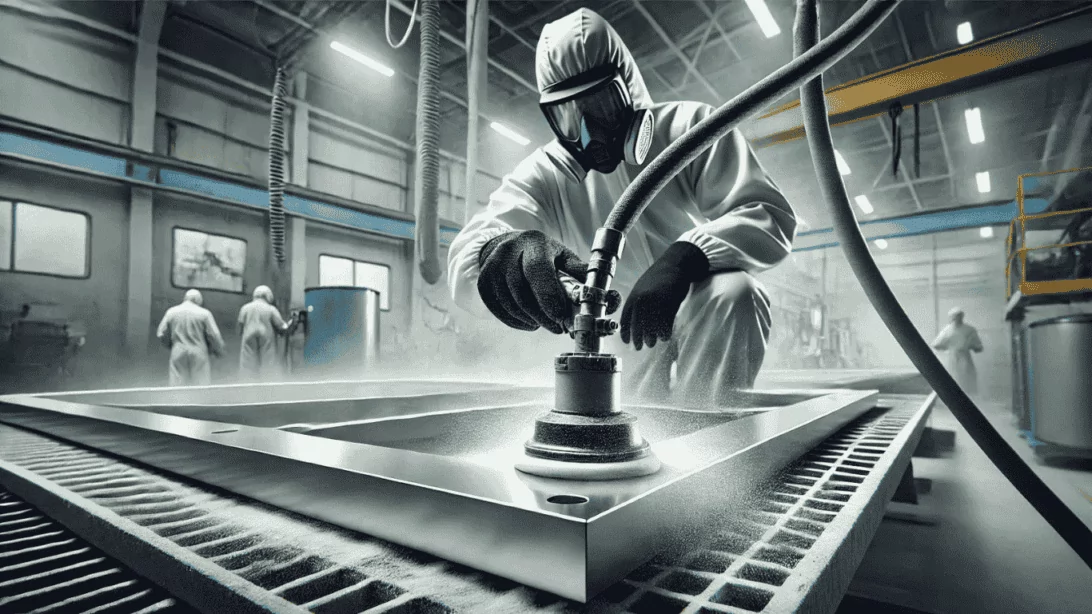
Powder coating uses finely ground particles containing resin and pigment. These particles are electrostatically charged and sprayed onto a prepared aluminium surface, allowing them to adhere evenly before the component enters a curing oven. During curing, the powder melts and forms a continuous protective film.
Proper preparation is essential because contaminants on the aluminium surface can affect adhesion and the final finish. The powder-coating process described by the manufacturer includes degreasing and cleaning, electrostatic application, curing, and quality inspection.
The result is a finish that can combine durability with a wide range of aesthetic possibilities. Depending on the coating and specification, surfaces can be produced in glossy, semi-glossy, matte, textured, or metallic appearances.
Where Powder-Coated Aluminium Profiles Make Sense
Powder-coated aluminium profiles are used across applications where aluminium needs both functional protection and an attractive finish. Architectural projects may use them for windows, doors, façades, railings, partitions, and other visible structures. Industrial applications can use finished profiles for machinery, frameworks, equipment housings, and other components.
The flexibility of aluminium extrusion makes this particularly useful. Profiles can be manufactured in different cross-sectional shapes and dimensions before receiving the required surface treatment. The finish can then be selected according to the environment and appearance expected from the final component.
The combination of extrusion and finishing also allows manufacturers to coordinate the profile design with its intended use. This is especially useful for projects requiring custom dimensions, specific colours, or consistent finishes across multiple components.
Protection Against Everyday Wear
One of the practical reasons powder coating is widely considered for aluminium is its resistance to common forms of surface damage. A properly applied coating can help protect the underlying metal from environmental exposure while resisting issues such as scratching, fading, peeling, and general wear.
This can be particularly valuable for components that are frequently exposed to people, weather, or cleaning activities. Railings, doors, window profiles, commercial structures, and outdoor installations may all benefit from a finish designed to maintain its appearance under regular use.
However, durability depends on more than simply choosing powder coating. Surface preparation, coating quality, application consistency, curing conditions, and the environment in which the aluminium is installed all contribute to long-term performance.
Colour Is Part of the Engineering Decision
Colour selection may appear to be primarily an aesthetic decision, but it can also influence how aluminium integrates with its surroundings. Architectural projects may need profiles to match façades, interior themes, doors, windows, or branding requirements.
Modern powder coating provides considerable flexibility in this area. The manufacturer states that its facility offers a range of RAL shades as well as tailored hues, with glossy, semi-glossy, matte-textured, and metallic finishes available.
This range allows designers to move beyond standard metallic aluminium while maintaining a consistent finish across a project. For large developments, the ability to reproduce a specified colour consistently can be especially important.
Why Application Quality Matters
A high-quality powder coating depends on a controlled process. If aluminium is not cleaned properly, the coating may not adhere as intended. Uneven powder application can create inconsistencies, while inadequate curing can affect the strength and durability of the finished layer.
For this reason, manufacturers need suitable equipment and quality-control procedures. The powder-coating facility described by the manufacturer uses Nordson USA spray guns and a sealed coating plant designed to limit dust accumulation on coated profiles. Its stated infrastructure includes a horizontal seven-tank powder-coating system with a monthly capacity of 300 tonnes. Such process control becomes increasingly important when large volumes of aluminium profiles need to achieve a uniform finish.
Powder Coating for Architectural Applications
Architecture is one of the areas where the combination of performance and appearance becomes particularly important. Window frames, doors, façades, curtain-wall components, railings, and structural profiles are expected to withstand environmental conditions while remaining visually consistent.
Powder coating can provide designers with a broader palette than untreated aluminium while maintaining the advantages of the underlying material. Aluminium profiles themselves are widely valued for strength, corrosion resistance, lightweight construction, and design flexibility, making them suitable for both indoor and outdoor applications. The finish can therefore become part of the overall design language rather than being treated as an afterthought.
Supporting Industrial Applications
Industrial users can also benefit from finished aluminium profiles where durability, dimensional consistency, and appearance are relevant. Machinery frames, electronic housings, heat-management components, transportation parts, and industrial structures can all use aluminium extrusions in different forms.
The manufacturer’s aluminium profile capabilities include standard and custom sections, with surface finishing options such as anodising, powder coating, and polishing. Its profile applications extend across architecture, automotive, electronics, industrial equipment, solar systems, transportation, and other sectors. This variety demonstrates why surface finishing needs to be selected according to the final application rather than simply based on appearance.
Sustainability and Efficient Finishing
Environmental considerations are increasingly becoming part of material and manufacturing decisions. Powder coating is often considered a useful alternative to conventional solvent-based liquid coatings because the dry powder application process can reduce certain solvent-related emissions and material waste.
The environmental benefits, however, depend on the complete manufacturing process, including pretreatment, application, curing, energy consumption, and waste management. The manufacturer describes its powder-coating technology as environmentally friendly and uses non-chromate pretreatment and automated facilities in its process. Manufacturers can therefore consider both coating performance and production practices when evaluating finishing solutions.
Choosing the Right Coating for the Project
There is no universal powder-coating specification suitable for every aluminium application. Outdoor exposure, expected wear, colour requirements, profile dimensions, environmental conditions, and intended service life can all influence the selection.
A project exposed to demanding weather may require different considerations from an interior decorative installation. Similarly, an industrial profile exposed to repeated handling may need a finish selected for greater resistance to wear. Discussing these requirements with the manufacturer before production can help avoid problems later.
Conclusion
A well-selected aluminium finish can influence much more than the appearance of a finished profile. Powder coating can provide colour flexibility, surface protection, durability, and a consistent appearance across architectural and industrial applications. The quality of preparation, application, curing, and inspection remains essential to achieving the expected result.
JM Aluminium provides aluminium powder-coating services alongside extrusion, anodising, machining, and quality-control capabilities. Its powder-coating facility offers multiple colours and finishes, while its extrusion operations support both standard and customised aluminium profiles for diverse applications.