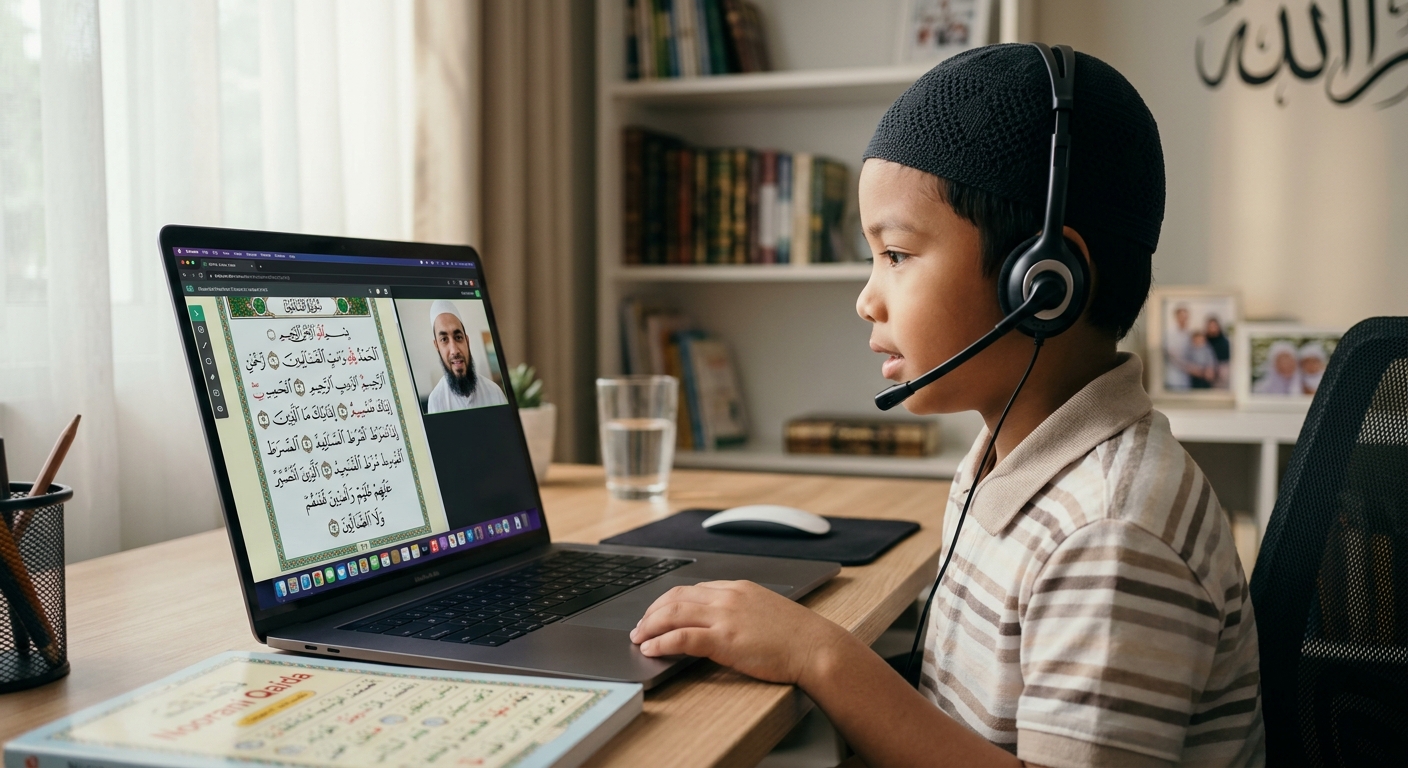
Have you ever sat at your desk after a long work day, searching for quran classes near me on your phone, only to realize the nearest local Islamic center is a 45-minute drive through heavy rush-hour traffic? We have all been there. Balancing a demanding career, family responsibilities, and school routines while attempting to prioritize spiritual growth often feels like a steep uphill climb.How can busy modern families maintain an intimate, daily connection with the Holy Quran without adding stress to their weekly routines?The modern answer lies in a beautiful blend of ancient wisdom and modern technology: Online Quran Classes. Today, geography is no longer a barrier to learning proper Tajweed, memorizing Surahs, or mastering Quranic Arabic. In this comprehensive guide, we examine why families are shifting toward virtual classrooms, how digital learning compares to physical Madrasas, what pricing models exist, and how you can select the perfect live tutor for your household.
The Digital Shift: Reimagining Sacred Education for the Modern Era
For centuries, Islamic learning was anchored exclusively in physical gathering spaces—under mosque arches, in neighborhood Madrasas, or around low wooden desks (Lowh) in traditional circles. While these physical spaces hold immense barakah, our global lifestyle has introduced logistical challenges.When we look at modern suburban life, commuting to a physical center three or four times a week requires hours of driving. For working parents, adults returning to study, and young children with heavy homework loads, those hours represent friction that leads to dropped schedules.
The Rise of Virtual Islamic Academies
Virtual platforms bridge the geographical divide. By pairing qualified, native Arabic teachers from historic centers of learning like Egypt, Jordan, and Saudi Arabia with students worldwide, digital academies bring high-caliber education directly into your living room.
- Global Knowledge Access: Connect with certified Al-Azhar scholars regardless of where you live.
- Flexible Schedules: Schedule live 1-on-1 sessions at 6:00 AM before school or 9:00 PM after work.
- Safer Learning Environment: Parents can observe classes directly, ensuring complete child safety and instructional quality.
Online Quran Classes vs. Physical “Quran Classes Near Me”: A Honest Comparison
When parents open a search engine to search for quran classes near me, they are naturally seeking convenience and community connection. However, local options often come with hidden operational limitations that virtual alternatives eliminate.
| Feature | Local “Quran Classes Near Me” | Modern Online Quran Classes |
| Student-Teacher Ratio | Group settings (15–30 students per teacher) | Personalized 1-on-1 private instruction |
| Teacher Qualifications | Limited to available local community volunteers | Globally vetted, Ijazah-certified native tutors |
| Schedule Flexibility | Fixed mosque operating hours | 24/7 round-the-clock booking availability |
| Commute Time | 30–60 minutes round-trip traffic | 0 minutes (instant digital classroom entry) |
| Pacing | Fixed group speed (fast or slow for some) | Custom-tailored to the student’s learning pace |
While local mosques excel at fostering physical community bonds, Online Quran Classes outperform traditional options when it comes to individualized Tajweed corrections and focused 1-on-1 instruction.
Master Core Curriculums Available in Virtual Academies
Online Quran platforms cater to every stage of learning, whether you are taking your very first steps or aiming to achieve an authentic chain of transmission (Ijazah).
Stage 1: Noorani Qaida & Basic Arabic Alphabets
Before reciting complex verses, learners must build a solid foundation. Beginner courses utilize interactive digital Noorani Qaida or Noor Al-Bayan workbooks. Students learn letter shapes, exit points (Makharij), short vowels (Harakat), and joining letter forms through digital whiteboards.
Stage 2: Quranic Reading & Fluency
Once letters are mastered, students move directly into reading full verses from the Mus’haf. Tutors guide learners step-by-step through correct vocalization, stopping rules (Waqf), and connected reading.
Stage 3: Advanced Tajweed Rules
Tajweed is the science of beautifying recitation according to established rules. Advanced courses cover:
- Ghunnah & Noon Sakinah: Rules governing Ikhfa, Idgham, Iqlab, and Izhar.
- Madd Rules: Master short, medium, and long vowel extensions (2, 4, or 6 counts).
- Makharij Al-Huroof: Deep physical training of throat, tongue, and lip placement to produce authentic Arabic sounds.
Stage 4: Hifz (Quran Memorization) & Ijazah Certification
For serious students, dedicated Hifz programs use structured memorization systems:
- Sabaq (New Lesson): Memorizing fresh verses daily under direct teacher supervision.
- Sabqi (Recent Revision): Reviewing pages memorized over the past 7–10 days.
- Manzil (Old Revision): Maintaining long-term retention of older parts to prevent forgetting.
Pricing Models, Cost Breakdown, and Areas of Availability
Understanding the investment involved helps families plan their educational budgets. Virtual Quran learning operates on clear, transparent pricing models.
Estimated Monthly Pricing Plans (USD / GBP / EUR)
Rates vary depending on lesson frequency and teacher experience levels:
- Basic Plan (2 classes/week, 30 min each): ~$35 – $45 per month
- Standard Plan (3 classes/week, 30 min each): ~$50 – $60 per month
- Intensive Plan (5 classes/week, 30 min each): ~$75 – $95 per month
- One-on-One Hourly Rates: Range from $6 to $15 per hour depending on qualifications.
Global Coverage and Accessibility Areas
Where are these platforms accessible? The short answer is: anywhere with an internet connection.
Major global service zones include:
- North America: United States and Canada (covering EST, CST, MST, PST time zones).
- United Kingdom & Europe: UK, Ireland, Germany, France, Scandinavia.
- Australasia: Australia, New Zealand, Singapore, Malaysia.
- Middle East: UAE, Qatar, Saudi Arabia (primarily for non-native Arabic expat families).
Key Digital Features: How Live Online Classrooms Work
Virtual classrooms utilize specialized digital tools tailored specifically to language acquisition and Quranic study.
Interactive Digital Whiteboards
Teachers upload high-resolution digital Mus’hafs directly onto the screen. Both tutor and student can highlight text, write Tajweed color codes in real time, and mark mistakes with zero delay.
Audio Crystal-Clarity and Noise Cancellation
Clear audio is vital for catching tiny Tajweed errors (like differentiating between a Taa and a heavy Taa’). Top platforms use dedicated video software optimized for crisp, low-latency audio transmission.
Parental Dashboard & Class Recordings
Busy parents receive weekly progress reports via WhatsApp or web portals. Most systems also allow lesson recordings so children can review their teacher’s corrections before doing their daily homework.
How to Select the Best Tutor: Essential Vetting Steps
The quality of your learning experience rests heavily on the expertise and demeanor of your instructor. When evaluating tutors, look for these foundational criteria:Authentic Ijazah Certification: Ensure the teacher holds an Ijazah with a connected Sanad (chain of narrators back to the Prophet Muhammad ﷺ).
- Language Proficiency: For children raised in English-speaking nations, tutors must speak clear, fluent English to explain complex linguistic concepts effortlessly.
- Patience with Young Learners: Teaching children requires warmth, encouragement, and gamified reward systems—not harsh reprimands.
- Gender Choice: Reputable academies offer qualified female teachers for young girls and adult sisters who prefer female instruction.
Overcoming Tech Friction: What You Need to Get Started
Setting up a digital home learning station is simple and requires minimal hardware:
- Hardware: A standard laptop, tablet (iPad/Android), or desktop computer. (Laptops or tablets are preferred over mobile phones due to larger screen sizes).
- Headset: A basic USB noise-canceling headset with a built-in microphone prevents audio echoes.
- Internet Speed: A standard high-speed broadband connection (at least 10 Mbps) ensures lag-free video calls.
- Environment: A quiet, well-lit corner of the home free from TV noise and family interruptions.
Conclusion
Finding a reliable pathway to connect with the Divine Book no longer requires sacrificing precious hours in traffic or settling for crowded local classes. Online Quran Classes offer a modern, highly personal, and budget-friendly alternative to traditional searches for quran classes near me. By bringing world-class, certified tutors directly into your home, digital learning helps your entire family read, understand, and love the Quran with confidence and ease. Take the first step today by trying a free trial class and embark on a rewarding journey of spiritual growth.