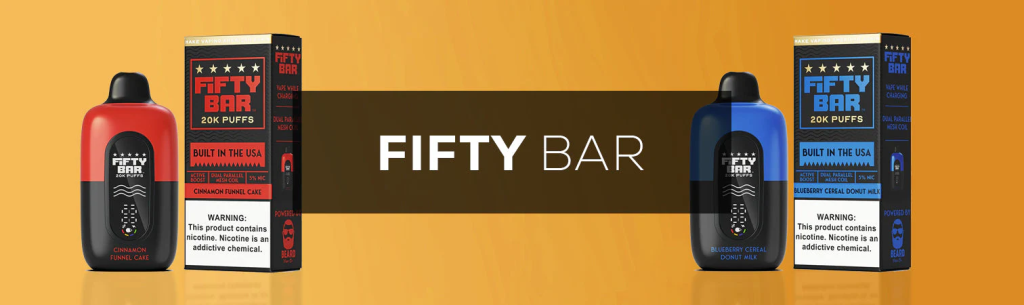
Disposable vape technology has changed significantly in recent years. Modern devices now commonly include rechargeable batteries, mesh-coil systems, airflow controls, large e-liquid capacities, and substantially higher estimated puff counts than earlier disposable models.
Fifty Bar vapes are part of this newer generation of disposable vaping devices. Depending on the series, models can differ in puff capacity, battery configuration, flavor profile, airflow, and coil design. Current Fifty Bar ranges include both 6,500-puff and 20,000-puff formats, making it important for adults who already use nicotine products to understand how these specifications affect device performance rather than focusing only on the number printed on the package.
What Are Fifty Bar Vapes?
Fifty Bar vapes are pre-filled disposable electronic vaping devices designed to heat nicotine-containing e-liquid and create an inhalable aerosol.
The broader Fifty Bar lineup currently includes multiple series, such as the Black Series, White Series, Silver Series, Midnight Series, and collaborations with Fruitia, Hidden Hills, and Humble. Some models are advertised for approximately 6,500 puffs, while several newer ranges carry estimates of up to 20,000 puffs.
Although these products are classified as disposable, many higher-capacity devices include rechargeable batteries. This allows the battery to be recharged while e-liquid remains inside the device.
How Do Fifty Bar Vapes Work?
Like other electronic vaping devices, Fifty Bar vapes use a battery to power a heating element.
The heating coil warms pre-filled e-liquid until it forms an aerosol. That aerosol is then inhaled through the device’s mouthpiece. Unlike combustible tobacco products, the liquid is heated rather than burned.
The exact heating system can differ between models. Several current Fifty Bar products use dual-mesh coil designs. Mesh coils provide a broader heating surface than some traditional wire configurations, which can influence heat distribution and vapor consistency. Current 20,000-puff series are also described as using rechargeable batteries and enhanced airflow systems.
What Does a 20,000-Puff Rating Really Mean?
One of the most visible specifications associated with newer Fifty Bar vapes is the estimated puff capacity.
Current Fifty Bar collections include products promoted at up to 20,000 puffs, while earlier or smaller models may carry a 6,500-puff estimate.
However, puff count should be treated as an estimate rather than a guaranteed lifespan. Actual usage varies depending on factors such as:
- Duration of each inhalation
- Frequency of use
- Airflow setting
- Power output
- Battery condition
- Coil efficiency
- E-liquid consumption
Someone taking longer inhalations may consume substantially more e-liquid per puff than someone taking shorter ones. As a result, two adults using the same device may not achieve identical puff totals.
Why Mesh Coil Technology Matters
The heating coil is one of the most important components in any disposable vape.
A mesh coil uses a broader metallic heating surface rather than a simple wire. This design can distribute heat across more of the e-liquid-soaked material at once.
Some newer Fifty Bar products are described as using dual parallel mesh coils, particularly higher-capacity devices with advanced airflow or boost-style operating modes.
That does not mean coil design alone determines quality. Battery performance, e-liquid composition, airflow, construction, and storage conditions can all affect how consistently a vaping device functions.
Why Battery Capacity Is Important
Higher-capacity disposable devices often contain more e-liquid than a single battery charge can reasonably support.
For this reason, many modern Fifty Bar vapes use rechargeable batteries. One current 20,000-puff series, for example, is listed with a 900 mAh rechargeable battery.
Battery capacity is normally measured in milliamp-hours, or mAh. A higher number generally represents more stored electrical energy, but it does not guarantee longer real-world runtime because power settings, coil resistance, airflow, and frequency of use also influence battery drain.
Rechargeable devices should always be charged according to their manufacturer instructions.
Do Airflow Settings Affect Performance?
Some modern disposable vapes provide adjustable airflow rather than a fixed draw.
Adjustable airflow changes how much air enters the device during inhalation. A tighter airflow produces a more restricted draw, while a more open setting allows greater airflow.
Current Fifty Bar models include products with multiple airflow levels.
Airflow can influence aerosol production, draw resistance, and e-liquid consumption. Because of this, puff estimates may vary depending on which airflow setting is used regularly.
Why Nicotine Information Matters
Nicotine concentration should be one of the first specifications adults check when examining any vaping product.
Fifty Bar products are nicotine-containing vaping devices, and current product pages carry warnings that nicotine is addictive.
Consumers should always read the exact nicotine concentration shown on the individual package instead of assuming all products within a brand or series contain identical levels.
Nicotine-containing products should also be stored securely away from children and pets.
Does Flavor Indicate Device Quality?
No. Flavor and hardware quality describe different aspects of the product.
Current Fifty Bar ranges include fruit, mint, dessert, candy, tobacco, and beverage-inspired flavor profiles. However, a flavor name does not reveal how well a battery performs, how accurately the coil regulates heat, or how reliable the device is.
When comparing Fifty Bar vapes, adults should instead examine:
- Puff estimate
- Battery specifications
- Coil technology
- Nicotine concentration
- Charging method
- Airflow settings
- E-liquid capacity
- Device condition
These specifications provide more useful technical information than flavor preference alone.
How Should Disposable Vapes Be Stored?
Disposable electronic devices contain batteries and should be handled carefully.
They should generally be kept away from excessive heat, direct sunlight, moisture, and situations where the housing may be crushed or punctured.
Any device that becomes unusually hot, leaks, swells, or shows physical damage should not be used.
Rechargeable disposables should also be disposed of according to local battery or electronic-waste rules where available rather than automatically being placed in household trash.
Conclusion
Modern Fifty Bar vapes combine features that were once more common in reusable vaping systems, including rechargeable batteries, mesh coils, adjustable airflow, and higher-capacity e-liquid reservoirs. Understanding these specifications makes it easier to interpret the difference between older 6,500-puff devices and newer 20,000-puff formats. When reviewing technical listings on Zmarksthespot, adults should concentrate on nicotine labeling, puff estimates, battery specifications, airflow settings, coil design, and charging requirements. Looking at these factors together provides a clearer picture of how a device is designed and avoids treating flavor names or headline puff counts as complete measures of performance.