

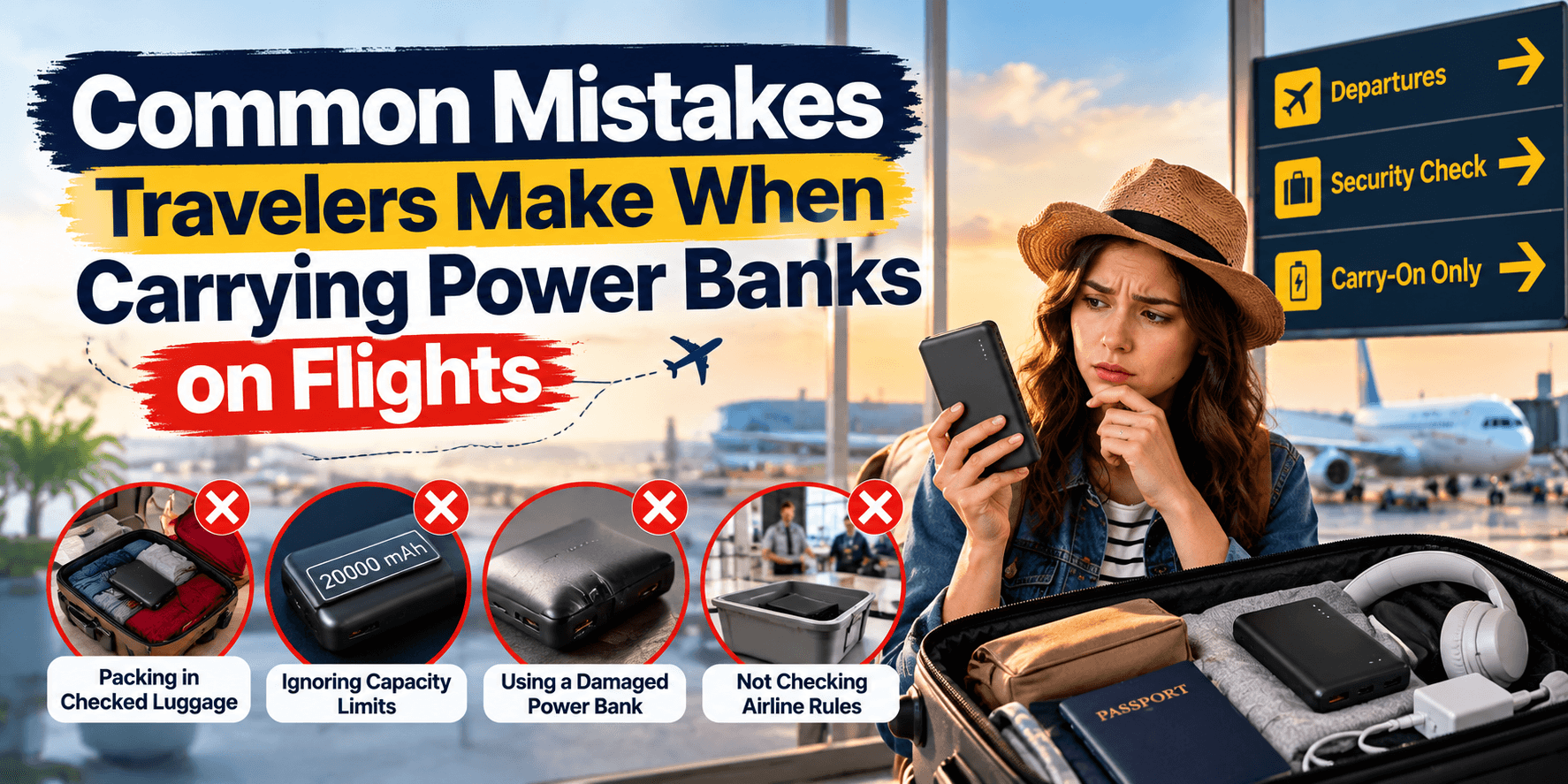
A power bank can be one of the most useful accessories to carry while traveling. From displaying digital boarding passes and checking maps to booking transport and staying connected with family, smartphones have become an essential part of modern travel.
But carrying a portable charger on a flight is not always as straightforward as putting it in your suitcase. Power banks contain lithium batteries, and airlines have specific safety requirements governing how these batteries can be transported.
Many passengers only discover these restrictions when they reach airport security or the boarding gate. Understanding the most common mistakes beforehand can make your journey smoother and help you travel with your devices safely.
1. Putting a Power Bank in Checked Luggage
One of the most common mistakes is packing a portable charger inside checked baggage.
Power banks are generally treated as spare lithium batteries and should normally be carried in cabin baggage rather than checked luggage. This is important because a battery-related incident can be detected and managed more quickly in the cabin than in the aircraft’s cargo hold.
Before handing over your suitcase at check-in, check every pocket to make sure you have not accidentally left a power bank inside.
Travelers who are uncertain about baggage restrictions should read a detailed guide explaining can you take a power bank on a plane and also verify the latest requirements directly with their airline before departure.
2. Ignoring the Watt-Hour Rating
Power banks are commonly marketed using milliamp-hours (mAh). You might see capacities such as 5,000mAh, 10,000mAh or 20,000mAh printed prominently on the packaging.
Airline battery rules, however, frequently use watt-hours (Wh).
The basic calculation is:
Watt-hours (Wh) = (mAh × Voltage) ÷ 1,000
For example, a 10,000mAh battery with a nominal voltage of 3.7V would be approximately:
10,000 × 3.7 ÷ 1,000 = 37Wh
Knowing both the mAh capacity and watt-hour rating of your portable charger can make it easier to determine which airline rules apply.
3. Traveling With an Unmarked Power Bank
Another avoidable mistake is carrying a power bank whose capacity information has worn off or cannot be clearly identified.
Airport or airline personnel may need to determine the battery’s specifications. A device with clear manufacturer information, capacity and voltage markings is much easier to identify than an unmarked battery.
Before traveling, inspect the label on your power bank and make sure its important technical information remains readable.
4. Assuming Every Airline Has Exactly the Same Rules
Travelers sometimes assume that if a power bank was accepted on one flight, it will automatically be accepted on every other flight.
That is not necessarily a safe assumption.
Rules can depend on battery capacity, airline policies, applicable aviation regulations, departure country and destination. Airlines may also introduce additional restrictions regarding whether portable chargers can be used during the flight.
Check your airline’s official guidance each time you travel rather than relying entirely on what happened during a previous journey.
5. Carrying a Damaged or Swollen Power Bank
A portable charger should be inspected before it goes into your travel bag.
Do not ignore physical damage such as swelling, cracks, leakage, unusual heat, deformation or damaged connectors. These can indicate a battery problem.
A swollen power bank should not be squeezed back into shape or packed for a flight. Stop using a battery that appears damaged and follow appropriate local guidance for safe disposal or recycling.
Good battery condition matters regardless of whether you are traveling or simply using the charger every day.
6. Buying a Power Bank Based Only on Price
The cheapest portable charger is not automatically the best choice.
Battery quality, clear specifications, appropriate safety features and reliable manufacturing are important considerations when selecting charging products.
This is particularly relevant to retailers and resellers. Businesses purchasing products in volume should evaluate specifications and supplier reliability rather than focusing entirely on unit cost. Working with an established wholesale power banks supplier can make it easier to source different capacities and charging options while obtaining clear product information for customers.
Consumers should similarly purchase chargers from reliable sellers and check the specifications before use.
7. Carrying an Unnecessarily Large Battery
It is tempting to buy the biggest power bank available, particularly for long journeys. However, more capacity is not always necessary.
A traveler who only needs to recharge a smartphone once or twice may not need the same battery capacity as someone traveling with multiple phones, tablets, cameras and other rechargeable devices.
Larger batteries can also be heavier, and airline requirements may differ as battery energy increases.
Choose capacity according to your actual charging needs and confirm the relevant airline restrictions before traveling.
8. Forgetting About Gate-Checked Cabin Bags
Sometimes passengers arrive at the gate with a cabin suitcase only to be told that it needs to be placed in the aircraft hold.
If this happens, remember that your bag may contain items that should not be placed in checked baggage.
Before handing over a gate-checked bag, check for your power bank and other spare lithium batteries and remove them when required. Keeping your charger somewhere easy to access can make this process much simpler.
9. Packing a Power Bank Carelessly
Where you place a power bank inside your carry-on matters too.
Avoid putting it somewhere that it could be crushed by heavy objects or damaged by other items. Battery terminals and ports should also be protected appropriately from accidental short circuits.
Keeping the charger in a dedicated compartment or protective case can help prevent damage while also making it easier to find during your journey.
10. Forgetting the Rest of Your Charging Setup
A fully charged power bank is useful, but it will not help much if you forget the correct charging cable.
Before leaving home, check that your cables and charging accessories are compatible with the devices you intend to use.
Depending on the trip, useful accessories may include:
- USB-C or other compatible charging cables
- Wall chargers
- Travel adapters
- Cable organizers
- Car chargers
- Multi-port charging accessories
For retailers, these complementary products are also why sourcing through a mobile phone accessories wholesale provider can be useful when building a broader range around portable charging products.
For travelers, testing everything together before leaving home is the easiest way to avoid discovering a compatibility problem during the journey.
11. Using the Power Bank Without Checking In-Flight Rules
Being allowed to carry a portable charger does not necessarily mean you can use it whenever you want during a flight.
Airlines may have specific policies about using or charging power banks onboard. These policies can change, so follow cabin crew instructions and check your airline’s latest guidance.
If the power bank becomes unusually hot, starts swelling, emits an unusual smell or appears damaged during a journey, stop using it and alert cabin crew immediately.
12. Relying on Old Information
Battery technology and aviation policies continue to evolve.
A blog post, forum answer or social media video from several years ago may no longer reflect current airline requirements. Even advice from another traveler may apply to a different airline, battery size or jurisdiction.
Use travel guides to understand the basics, but verify important restrictions through current information from your airline and the relevant aviation authority before departure.
You Can Also Check: Common Smartphone Screen Problems and How Professional Repairs Can Help
A Quick Power Bank Checklist Before Flying
Before leaving for the airport, take a minute to check your portable charger.
Make sure the battery is in good physical condition, its capacity information is readable, and it is packed in the appropriate baggage. Confirm that its watt-hour rating meets the requirements applicable to your journey and that you have the necessary cables.
Most importantly, review the latest official airline rules rather than assuming the requirements will be identical to your previous flight.
Final Thoughts
Power banks make modern travel much easier, but lithium batteries need to be transported responsibly.
Most problems can be avoided by checking the battery specifications, keeping the charger in the appropriate baggage, protecting it from physical damage and reviewing airline requirements before traveling.
Avoiding simple mistakes—such as putting a portable charger in checked luggage, carrying an unmarked battery or ignoring airline-specific policies—can save time at the airport and contribute to safer travel.
A few minutes of preparation before your flight can help ensure your portable charger remains a useful travel companion rather than an unexpected problem at check-in or boarding.

