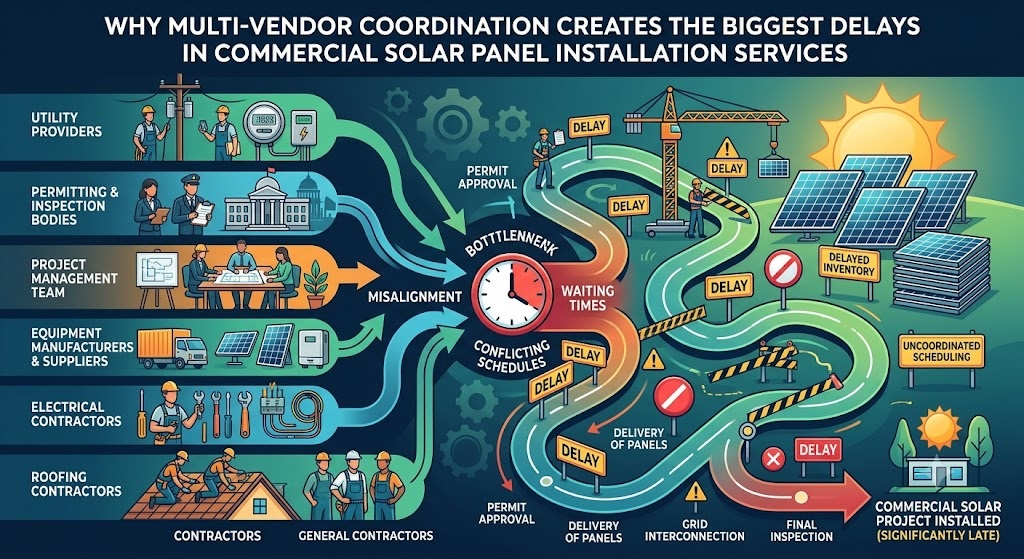
A commercial solar project is rarely the work of a single team. There may be an EPC contractor, module supplier, inverter manufacturer, electrical contractor, utility representatives and facility team. All these groups may do their part correctly, and the project can still slip away with lost days or weeks due to miscommunication between them.
This is a key reason why commercial solar panel installation services can often take more time than the actual physical installation of the panels. The panels may come in on time, the mounting structures may be fabricated, and the balance of plant equipment may be on hand, but installation cannot begin until a single dependency has been cleared.
Where the Delay Starts
The initial delays usually originate from the design or procurement of equipment. Some solar projects have designs that are dependent on the availability of materials. For instance, the roof dimensions and electrical load may dictate the solar mounting structure type. If these specifications change midway, it can cause delays in the production and delivery of materials.
A solar mounting supplier can have rails fabricated based on an approved layout, only for the engineering team to realize later that there is an obstacle on the roof which necessitates a change in mounting structure. This would imply that the supplier will have to modify the fabricated rails and the installation team will have to wait longer for new ones. This is just one example; there are several other reasons why a commercial solar panel installation service can be delayed.
The Equipment Handoff Problem
There are also delays that are caused by the different delivery schedules of various equipment. It is quite normal for the different suppliers of solar equipment and materials to deliver them on different dates. It may even be the case where modules arrive at the warehouse while the mounting structures are still being fabricated.
This becomes a problem because installation teams will have to wait before they can start working. If the solar contractor is a small-scale outfit, such delays can significantly hinder their operations. The same problem occurs when the mounting structures arrive earlier than the inverters; the mechanical team will have to wait before they can install the electrical equipment.
The same applies to other materials such as protection equipment, transformers, and cable accessories. Their absence can cause a delay of a certain procedure or even of the whole installation process.
Design Changes Between Vendors
This problem is closely related to the one that is discussed above. The design drawings may sometimes not reflect the actual specifications of certain equipment. For instance, while the electrical or mechanical layout might indicate the intended location and configuration of the solar inverter, the actual size and inverter connection points may differ from the design drawings.
These problems cause one vendor to modify their work according to the specifications of another one. If an electrical panel does not have adequate space to fit another circuit breaker, the mechanical contractor will have to increase its dimensions midway through the installations. Similarly, if the inverter position changes, the mounting structure will also have to be modified.
Site Access and Other Facility Constraints Become a Shared Responsibility
Commercial facilities do not always operate like deserted construction sites. They may have manufacturing processes running alongside the solar installation, which means that there are limited opportunities to shut them down for the installation team to gain better access to the solar array. The facility managers can also restrict crane or vehicle access depending on their operational requirements. These limitations should be taken into consideration when developing a commercial solar panel installation schedule. This way, the installation contractor will be able to plan their work around the operational schedule of the facility.
These facility constraints mean that the solar installation contractor may be forced to wait for days before they can proceed with a certain procedure because the crane was unavailable or the area was restricted. They might also limit the installation to specific days of the week.
How Poor Communication Increases Minor Delays
The above problems are not the only delays that can occur during a commercial solar panel installation. More often than not, multiple small delays add up and affect the overall schedule. Communication breakdowns between various stakeholders can cause a significant amount of delays. For instance, one team may take a day to finalize certain specifications while the other waits for confirmation. Another team may take an additional day to approve a change in material specifications or layout. This can extend the completion time of the minor tasks by several days.
The communication challenges are exacerbated by the fact that teams are not always on the same page regarding who is responsible for what. The site team may also be unavailable or unclear on certain technical issues that require consultation and clarification.
Unresolved technical issues can evolve into complete blockages in the solar installation process.
Coordination Between Electrical and Mechanical Teams
The process of mounting solar panels has a built-in relationship between mechanical and electrical aspects. Mounting structures should be assembled in a location-specific manner before panels can be placed, but the routing of cables and the placement of electrical equipment depends on the final positions of the structures.
If work in one area requires adjustments to be made in another, mechanical alterations to the structures might require rerouting of cables and adjustments to the placement of electrical equipment. Changes to the electrical specifications after structures have been put in place might require additional supports or modifications to the routing of cables.
This is why many specialized companies that provide commercial solar panel installation services recommend that mechanical, electrical and engineering teams establish a coordinated sequence of operations, rather than working on separate tasks.
Commissioning Can Add Another Waiting Period
In some cases, the final stage of the process can create new delays through issues of coordination between teams. Testing might require the use of specific equipment, documentation, protection settings or approval from another organization.
Equipment might have been installed but still require adjustments to their settings before they can begin operating. Completed electrical installations might require inspection, or testing might not be possible before additional utility-related procedures are completed. Finally, documentation might be holding up progress, if test results, equipment specifications and as-built drawings have not been compiled and organized.
Systems might appear to be completed when they are not actually ready to begin operations.
How to Prevent Coordination-Related Delays in Commercial Solar Panel Installation Services
The best way to deal with one of the main causes of delay in the commercial solar project is to ensure that the coordination process is part of the execution process. It is therefore advisable to allocate specific individuals to be responsible for different aspects of the project, and to identify all the relevant dates and deadlines. The most useful coordination tips are those which focus directly on the issues facing the installation contractors, such as:
- All the drawings should be “frozen” before fabricating any materials or structures. All subsequent changes should be made as new drawings and revisions to existing drawings.
- A shared delivery schedule should be developed for major and minor equipment and materials delivery schedules.
- Arrangements should be made with the facility team with regards to access, lifts and electrical shutdowns.
- Mechanical, electrical and engineering teams should perform cross-checks ahead of major installation activities.
- There should ideally be coordination and communication tools to keep track of all inquiries and provide appropriate closure dates.
A properly executed coordination plan ensures that changes do not cascade throughout the project. Having the technical and project team onsite can be a useful way of managing this issue as they will be able to identify and address problems as they arise.
Where Integrated Execution Is Especially Beneficial
A coordinated EPC project is better able to avoid unnecessary delays between suppliers and teams. With an integrated execution of the design, procurement, and installation, information passes through fewer hands and problems can be resolved more efficiently. These are the commercial solar panel installation services that are most likely to benefit from such a project.
Infrax Renewable offers complete end-to-end service solutions in consulting, designing, installing and post-sales maintenance of photovoltaic systems in the commercial & industrial segment. Infrax Renewable
Conclusion
Multi-vendor coordination can be the main cause of unexpected and unaccounted-for delays, especially in a commercial solar installation project. The solar panels themselves can be installed quite quickly, but other procedures can pose more significant challenges.
It is therefore critical to look at the project holistically, as an interconnected series of procedures that are conducted in parallel with each other. Coordination between vendors and teams should begin right from the earliest stages of the project, and continue through to the end. Specific project and technical specifications, drawings, delivery schedules, and the responsibilities of different parties should inform the whole commercial solar panel installation process in order to prevent unexpected delays and complications with equipment, materials or access to the work site.
Ultimately, commercial solar panel installation services are only as good as the experience and planning skills of those executing them.