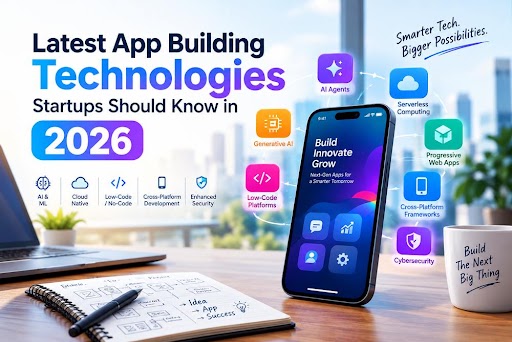
If you’re a founder trying to get an app off the ground this year, the ground has shifted under your feet again. New tools are cheaper, faster, and honestly a bit more forgiving than they used to be. Here’s a plain-language look at what’s actually worth paying attention to.
AI Is No Longer a Bonus Feature
A few years ago, sprinkling a chatbot into your app felt like a nice-to-have. Not anymore. Task-specific AI agents are showing up inside everyday apps — booking assistants that actually book things, support bots that resolve issues instead of just deflecting them, and recommendation engines that learn fast from small amounts of user data. For a startup, this means you can offer a genuinely smart experience without hiring a research team. Off-the-shelf AI APIs have gotten good enough that a small team can wire up real intelligence in a matter of weeks, not quarters.
Low-Code and No-Code Are Growing Up
Low-code platforms used to have a reputation for producing flimsy, hard-to-scale products. That reputation is fading fast. Today’s low-code tools can handle real business logic, connect to proper databases, and hand off cleanly to custom code when you outgrow them. For early-stage teams, this is huge — you can validate an idea with paying users before you’ve written a single line of production software. Plenty of founders are now shipping a working MVP built almost entirely on these platforms, then bringing in engineers only once demand proves the concept is worth the investment.
Cross-Platform Frameworks Keep Getting Better
Nobody wants to build and maintain two separate codebases anymore, and they don’t have to. Frameworks like Flutter and React Native have closed most of the performance gap with native apps, so a lean team can launch on iOS and Android at the same time without doubling their workload. This matters enormously for mobile app development on a startup budget — one codebase means fewer bugs to chase, faster updates, and a single team that actually understands the whole product instead of two teams working in silos.
The Rise of Multi-Service Platforms
One of the quieter but more important shifts this year is that many startups are moving away from single-purpose apps. Instead of building an app that focuses on just one service, founders are increasingly investing in multi-service app development to bring several offerings together on a single platform. For example, a ride-hailing app might expand into food delivery, package delivery, and digital payments, giving users more reasons to stay within the same ecosystem.
This approach can help businesses spread customer acquisition costs across multiple revenue streams while encouraging users to engage with the platform more frequently. Although building a multi-service platform is more technically complex than developing a single-purpose app, modular architecture, reusable components, and scalable technologies have made it much more accessible, even for startups with smaller engineering teams.
Edge Computing and Faster Connections
With 5G now widely available and 6G pilots underway in some markets, apps are pushing more processing out to the edge — closer to the user’s device — instead of routing everything through a distant server. That means quicker load times, smoother video and AR features, and apps that keep working reasonably well even on a shaky connection. For startups building anything real-time — live tracking, multiplayer features, video calls — this is worth paying attention to early, since retrofitting edge architecture later is far more painful than designing for it from day one.
Security and Privacy Are Now a Selling Point
Users have gotten more cautious about handing over their data, and regulators have gotten stricter about how it’s stored. Startups that bake in privacy-by-design — clear permissions, encrypted storage, minimal data collection — are finding it easier to earn trust and pass enterprise procurement checks later on. It’s no longer just a compliance checkbox; it’s genuinely become part of the pitch.
AR, IoT, and the Connected Home
Augmented reality has moved past novelty filters and into practical use — virtual try-ons for retail, guided repair instructions, and interactive product demos. Meanwhile, the Internet of Things keeps expanding, with phones acting as the remote control for everything from smart thermostats to connected cars. If your product touches physical devices in any way, users increasingly expect the app to double as the command center for their whole connected life.
Final Thoughts
None of this means a startup needs to chase every trend on this list. The smarter move is picking the two or three technologies that actually solve a problem your users have today. AI can make your product feel personal, low-code can get you to market faster, and cross-platform tools can stretch a small budget much further. And if your long-term vision involves more than one core offering, it’s worth planning your architecture around multi-service app development early, rather than bolting new services onto a rigid single-purpose app later. The tools available for mobile app development in 2026 are more capable and more accessible than ever — the real advantage now belongs to founders who move del