Paver Driveway vs Stamped Concrete – Which Adds More Resale Value?
Compare paver driveways vs stamped concrete for home resale value. Evaluate long-term ROI, upfront costs, durability, maintenance requirements, and buyer appeal to make the smartest hardscaping investment.
Key Takeaways
- Higher Return on Investment: Interlocking paver driveways consistently yield higher real estate resale value because they offer a
lifespan and seamless single-unit repairability without visible patching.
- Lower Upfront Cost vs Cracking Risk: Stamped concrete costs less initially than pavers, but its continuous slab structure remains vulnerable to surface cracking, moisture spalling, and costly full-slab repairs over time.
- Appraiser and Buyer Perception: Real estate appraisers and prospective buyers view interlocking pavers as a premium, luxury hardscape feature, whereas stamped concrete is often viewed as an aesthetic imitation of real stone or brick.
- Long-Term Cost of Ownership: While stamped concrete requires professional resealing every
to preserve its color and finish, pavers require minimal maintenance, making them more attractive to future buyers.
| Metric / Evaluation Criteria | Interlocking Paver System | Stamped Concrete System | Winner |
| Upfront Turnkey Cost | Stamped Concrete | ||
| Expected Structural Lifespan | Interlocking Pavers | ||
| Resale Cost Recovery (ROI) | High ( | Moderate ( | Interlocking Pavers |
| Resistance to Cracking | Outstanding (Segmental Joints) | Moderate to Poor (Rigid Monolithic Slab) | Interlocking Pavers |
| Mandatory Maintenance | Low (Occasional Sweep/Sand) | High (Mandatory Re-Sealing Every | Interlocking Pavers |
| Spot Repair Flexibility | Seamless (Replace Individual Units) | Difficult (Noticeable Patches or Re-Pours) | Interlocking Pavers |
Introduction – The High-Stakes Driveway Dilemma
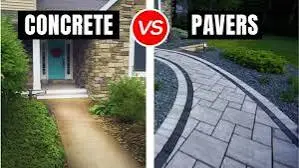
When homeowners plan a premium driveway renovation, curb appeal and future return on investment sit at the top of their priority list. The driveway is the very first feature prospective buyers see when arriving at a property, setting an immediate visual benchmark for the home’s overall quality and upkeep.
While standard asphalt and plain gray poured concrete dominate budget projects, homeowners seeking high-end aesthetic appeal generally narrow their choice down to two popular options: Interlocking Concrete Pavers and Stamped Decorative Concrete.
| Hardscape Option | Core Construction Method | Primary Aesthetic Goal |
| Interlocking Pavers | Individual high-density concrete units hand-laid over compacted aggregate base | Authentic stone, brick, or cobblestone pattern with flexible, multi-unit movement |
| Stamped Concrete | Continuous poured concrete slab stamped with texturing mats and color dyes | Monolithic slab engineered to imitate natural stone, slate, or brick patterns |
Both materials offer dramatic visual upgrades over standard driveway surfaces. However, when evaluated through the lens of home resale value, long-term durability, and structural longevity, these two hardscaping approaches perform very differently.
Understanding Interlocking Paver Systems
Interlocking paver driveways consist of individual, high-density concrete units laid in engineered patterns over a multi-layered base of compacted crushed stone and bedding sand.
| System Characteristic | Specification Standard | Real-World Benefit |
| Compressive Strength | to | Withstands heavy vehicle loads without surface crushing |
| Water Absorption Rate | Below | Highly resistant to moisture penetration and freeze-thaw spalling |
| Structural Mechanics | Segmental, flexible pavement system | Individual units move independently during soil expansion without cracking |
Why Buyers Value Paver Driveways
Prospective homebuyers recognize paver driveways as an indicator of luxury construction. Beyond aesthetics, buyers appreciate that a paver driveway will not develop long running cracks across the surface. If a tree root shifts an area or a vehicle leaks oil, individual pavers can be removed, cleaned, or replaced seamlessly without leaving a mismatched patch.
Understanding Stamped Concrete Systems
Stamped concrete—often called textured or imprinted concrete—is created by pouring a continuous slab of conventional concrete, adding color pigments (integral or topical hardeners), and pressing decorative pattern mats into the wet surface before it cures.
| System Characteristic | Specification Standard | Real-World Benefit |
| Compressive Strength | to | Standard residential load support |
| Surface Finish | Topical acrylic sealer over pigmented cement | Delivers rich initial color and realistic texture patterns |
| Structural Mechanics | Rigid monolithic slab | Requires control joints every |
Why Homeowners Consider Stamped Concrete
Stamped concrete provides the initial visual charm of natural stone or brick at a lower upfront cost than hand-laid pavers. It allows for continuous pours across large surface footprints, making it an appealing option for homeowners wanting a quick surface transformation on a tighter initial budget.
Aesthetic Appeal and Visual Versatility
Both materials deliver strong initial curb appeal, but they age and wear in distinct ways over time.
| Visual Attribute | Interlocking Paver Systems | Stamped Concrete Systems |
| Pattern Realism | Authentic individual joints create genuine depth and dimension | Stamped surface lines imitate joints, but surface remains flat underfoot |
| Color Permanence | Pigments mixed thoroughly through dense concrete; minimal fading | Surface color hardeners can wear off in high-traffic vehicle tire tracks |
| Border and Accent Flexibility | Unlimited multi-color bands, sailor courses, and inlay medallions | Accent colors require manual hand-staining and detailed masking work |
| Aging Characteristics | Develops a natural stone patina; maintains structural lines | Surface wear exposes underlying aggregate if protective sealer wears off |
The “Fake Stone” Perception Factor
In high-end real estate markets, discerning buyers and real estate agents often distinguish between authentic structural materials and surface imitations. While high-grade stamped concrete looks impressive when freshly poured and sealed, worn stamped concrete can reveal its monolithic nature as tire friction wears away topical stains, revealing the gray concrete base underneath.
Interlocking pavers, by contrast, are solid dimensional units. The color and aggregate structure extend throughout each block, ensuring that natural surface wear does not reveal an underlying secondary color.
Durability and Environmental Stress Resistance
A driveway must endure severe environmental stresses, including heavy vehicle weights, ground movement, moisture exposure, and temperature fluctuations.
| Environmental Stress | Impact on Interlocking Pavers | Impact on Stamped Concrete |
| Heavy Vehicle Loads | Weight distributed across hundreds of interlocking units; zero cracking | Heavy delivery trucks can crack slabs across stress lines |
| Soil Settlement | System flexes naturally; low spots can be lifted and re-leveled easily | Sub-base settlement causes permanent slab tilting and structural cracks |
| Freeze-Thaw Cycles | Joints absorb ice expansion; water drains quickly through paver sand | Trapped surface moisture expands in fine cracks, causing surface scaling |
| De-Icing Salt Exposure | High-density aggregate resists chemical degradation | Chemical de-icers strip acrylic sealers and cause cement paste spalling |
The Freeze-Thaw Advantage
In regions subject to freezing temperatures, soil expands and contracts significantly. Rigid stamped concrete slabs attempt to resist this movement, which inevitably leads to cracking—even with properly placed control joints.
Interlocking pavers act as a flexible mat. Because the joints between pavers are filled with polymeric sand or aggregate chips, the driveway flexes naturally with ground heave during winter and settles back into position during spring without cracking a single unit.
Maintenance Requirements and Long-Term Upkeep
Ease of maintenance plays a crucial role in how prospective buyers evaluate hardscaping features during home viewings.
| Maintenance Task | Interlocking Paver Driveway | Stamped Concrete Driveway |
| Routine Cleaning | Sweep and occasional pressure washing | Sweep and mild detergent washing |
| Protective Sealing | Optional (Every | Mandatory (Every |
| Weed Control in Joints | Low (Polymeric sand prevents weed growth) | None (Slab surface has no open aggregate joints) |
| Crack Repair | Unnecessary (Pavers do not crack under normal use) | Complex (Color-matched epoxies leave visible repair lines) |
| Spot Replacement | Simple (Remove individual paver and replace) | Impossible (Requires saw-cutting full slab section and pouring new concrete) |
The Sealing Maintenance Trap
Stamped concrete relies entirely on its clear surface sealer to protect its color pigments and prevent water absorption. If a homeowner neglects to reapply acrylic sealer every :
- UV rays fade the surface color pigments.
- Rain and snow penetrate the concrete pores.
- Freeze-thaw cycles cause the top layer of stamped paste to flake off (spalling), exposing the rough gray aggregate below.
Once stamped concrete spalls, restoring its original look requires expensive professional grinding, re-staining, and re-sealing. Buyers aware of this maintenance cycle often view stamped concrete as an ongoing maintenance obligation.
| Maintenance Item (15-Year Period) | Interlocking Pavers | Stamped Concrete |
| Mandatory Re-Sealing Treatments | ||
| Crack / Spall Restoration | ||
| Section Replacement | ||
| Estimated 15-Year Total Upkeep |
Upfront Installation Costs and Labor Demands
Understanding the initial cost difference between these two surfaces helps clarify their respective returns on investment.
| Cost Component | Interlocking Pavers (Per Sq. Ft.) | Stamped Concrete (Per Sq. Ft.) |
| Materials & Excavation | ||
| Skilled Labor & Laying | ||
| Total Turnkey Installation |
Why Pavers Cost More Upfront
Installing a paver driveway is a labor-intensive craft. Contractors must excavate of soil, lay and compact multiple lifts of crushed stone base, screed a precise bed of setting sand, hand-lay thousands of individual pavers, cut perimeter units with masonry saws, and vibrate polymeric sand into every joint.
Stamped concrete requires similar site excavation and base preparation, but the surface layer is poured as liquid concrete in a single day, stamped with pattern mats, and left to cure. This lower labor requirement reduces the initial cost by approximately .
Resale Value, ROI, and Real Estate Appraisal Impact
When real estate appraisers evaluate home improvements, they look at durability, buyer appeal, and comparative market analysis (CMA) data.
| Financial Metric | Interlocking Paver Driveway | Stamped Concrete Driveway |
| Immediate Value Addition | Recovers | Recovers |
| Lifetime Equity Retention | High (Value remains intact over decades) | Moderate (Value declines as surface seal and color age) |
| Buyer Perception Category | Premium luxury hardscape feature | Upgraded decorative surface |
| Appraiser Adjustments | Positive line-item value adjustment in high-end homes | Modest upgrade over standard poured concrete |
The Real Estate Appraisal Perspective
Licensed real estate appraisers classify pavers as a permanent hardscape upgrade with an expected useful life of . Because pavers do not suffer from monolithic cracking, appraisers award them higher valuation adjustments—especially in mid-to-high-end suburban markets.
| Appraisal & Equity Breakdown (600 sq.ft. Driveway) | Interlocking Pavers | Stamped Concrete |
| Average Initial Installation Cost | ||
| Estimated Appraisal Equity Recaptured | ||
| Unrecovered Net Out-of-Pocket Expense | ||
| Long-Term Asset Classification | Permanent Architectural Capital Upgrade | Depreciating Decorative Finish |
Stamped concrete is appraised as a decorative treatment on standard concrete. While it earns a higher valuation than plain or brushed concrete, appraisers factor in its shorter surface life () and the risk of visual cracking when calculating its long-term depreciated value.
Head-to-Head Comparison Matrix
| Feature / Metric | Interlocking Pavers | Stamped Concrete | Winner |
| Initial Installation Cost | Higher ( | Lower ( | Stamped Concrete |
| Expected Lifespan | Interlocking Pavers | ||
| Resistance to Cracking | Outstanding (Flexible system) | Poor to Fair (Rigid slab) | Interlocking Pavers |
| Repairability | Seamless (Replace individual units) | Difficult (Noticeable patches) | Interlocking Pavers |
| Maintenance Demands | Low (Occasional sweep/seal) | High (Mandatory sealing every 2-3 yrs) | Interlocking Pavers |
| Curb Appeal Retention | Excellent (Colors do not rub off) | Moderate (Subject to surface wear) | Interlocking Pavers |
| Resale Return on Investment | High ( | Moderate ( | Interlocking Pavers |
Frequently Asked Questions
| Question | Interlocking Pavers | Stamped Concrete |
| Which is better for severe winter climates? | Winner: High density ( | Drawback: Water in surface micro-cracks expands during freeze-thaw cycles, causing surface spalling. |
| Can you install snow-melting heating cables? | Winner: Cables lay beneath pavers. If repair is needed, technicians pull up individual units seamlessly. | Drawback: Requires jackhammering the stamped slab to fix wire breaks, leaving permanent ugly patches. |
| Does the surface crack over time? | Winner: Individual units flex naturally with soil movement; zero monolithic surface cracks. | Drawback: All poured slabs crack over time; control joints fail to stop diagonal cracking across stamped patterns. |
| Do weeds grow between joints? | Winner: Modern polymeric sand hardens into a rubberized barrier that prevents weed germination. | N/A: Solid slab surface has no joints for weeds, though weeds can sprout in uncontrolled cracks. |
Conclusion – The Final Verdict on Resale Value
While stamped concrete offers an attractive initial upgrade over standard poured concrete at a lower entry price, interlocking paver driveways are the clear winner for long-term resale value and overall return on investment.
| Homeowner Priority Profile | Recommended Driveway Material | Primary Strategic Reason |
| Maximizing Equity & Selling in 5+ Years | Interlocking Pavers | Recovers up to |
| Tight Budget & Selling Within 3 Years | Stamped Concrete | cheaper upfront; sells before major sealer wear and spalling occur. |
| Cold Climate / High Freeze-Thaw Zone | Interlocking Pavers | Jointed system flexes with ground heave; high density resists road salt. |
| Luxury Market Buyer Appeal | Interlocking Pavers | Appraised as authentic stone/brick upgrade; avoids “fake stone” perception. |
- Choose Stamped Concrete If: You have a strict upfront budget, plan to sell your home within
before major surface wear occurs, and are willing to perform regular sealing maintenance.
- Choose Interlocking Pavers If: You want to maximize home equity, desire a permanent solution that eliminates surface crack worries, and want to appeal directly to luxury buyers seeking a timeless, low-maintenance hardscape feature.
By investing in quality interlocking pavers installed over a properly compacted aggregate base, you create a high-impact curb appeal upgrade that pays dividends in personal enjoyment today and maximum financial return when it comes time to sell.
Are you deciding between pavers and stamped concrete for your home renovation? Share your project square footage or regional climate below for tailored advice on material selection!