Customers rarely separate the product from the experience of discovering, evaluating, and buying it. That is why product experience management has become such a critical discipline for brands trying to deliver a consistent digital customer experience across every channel. When product content is accurate, rich, and consistent everywhere a customer encounters it, trust builds quickly. When it is not, even a great product can lose the sale to confusion or perceived inconsistency.
Digital shelves now include the brand’s own website, mobile apps, marketplaces, social commerce surfaces, retail partner platforms, and increasingly in-store digital touchpoints. Managing product information consistently across all of them is no longer a nice-to-have — it is table stakes for any brand that expects to compete online, and it is one of the highest-leverage investments a digital team can make.
Why Product Data Chaos Undermines Customer Trust
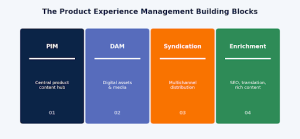
Inconsistent product descriptions, missing specifications, mismatched images, and outdated pricing across a website, marketplace listing, and mobile app quietly erode customer confidence. Even minor discrepancies plant doubt. Product experience management solves this by centralizing product content into a single, governed source that syndicates consistently to every channel — so that whatever the customer sees, they see the same accurate story.
This is not just a back-office data problem. It is a direct driver of conversion rates, return rates, and how customers perceive brand reliability across every digital touchpoint. A single wrong specification can trigger a costly return; a missing image can drop conversion by double-digit percentages that add up quickly at scale.
Centralizing Content for Consistency at Scale
A single product information hub eliminates the version-control chaos of managing content separately across e-commerce platforms, marketplaces, PIM systems, and mobile experiences. Every downstream channel pulls from the same governed source, guaranteeing that a change made once is reflected everywhere within minutes rather than days.
Enriching Content Beyond the Basics
Rich media, comparison charts, user-generated content, product videos, and structured attributes all contribute to a stronger product story — but only when they are managed consistently rather than scattered across disconnected systems. Effective product experience management makes enrichment a repeatable process, not a heroic one-off effort.

How enriched product content flows through the digital customer experience journey
Connecting Product Experience to the Broader Digital Journey
A well-managed product experience feeds directly into the broader digital customer experience — the search, browse, comparison, and purchase journey a customer takes across web, mobile, and in-store digital touchpoints. When product data is accurate and rich, personalization engines and recommendation systems have better raw material to work with, and every downstream experience benefits.
The result is a compounding effect. Better product data improves search relevance, which improves conversion, which improves the overall digital customer experience customers associate with the brand. Over time, this compounding creates a genuine gap between brands that invest in product experience management and those that do not.
- Unified product content feeding every channel from a single governed source
- Personalized product recommendations powered by accurate, structured data
- Consistent search and filtering experiences across web, app, and marketplace
- Faster time-to-market for new product launches across all channels simultaneously
- SEO-optimized product content that improves organic discovery over time
- Localized content for global expansion without duplicating master data effort
AI-Powered Enrichment and the Future of PXM
Artificial intelligence is rapidly reshaping product experience management. Generative AI can now draft product descriptions in dozens of languages, auto-tag images, extract structured attributes from supplier PDFs, and suggest enrichment gaps for high-performing SKUs. What used to take a team of merchandisers weeks now happens in minutes, with humans reviewing and refining rather than starting from scratch.
This changes the economics of digital customer experience considerably. Brands that once could afford to enrich only their top-selling products can now maintain rich content for their entire catalog. Long-tail products get the same rigorous treatment as hero SKUs, unlocking conversion opportunities that used to be economically unreachable. The brands that will win in the next few years are the ones combining AI-powered enrichment with disciplined governance, so speed does not come at the cost of quality or brand voice consistency.
Measuring the Business Impact
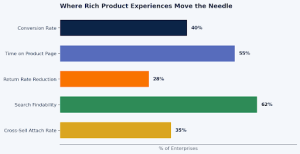
Enterprises that invest in product experience management typically see measurable gains: higher conversion rates, fewer returns due to mismatched expectations, reduced customer service inquiries about product details, and stronger performance on marketplace algorithms that reward content quality. These metrics tie directly back to digital customer experience scores and, ultimately, to revenue.
Beyond direct commercial impact, strong product content also reduces internal friction. Marketing, merchandising, and customer service teams all pull from the same trusted source, eliminating arguments about which version of a product description is correct and freeing those teams to focus on higher-value work.
Best Practices in Product Experience Management
The brands that consistently win on product experience management follow a set of disciplines that keep content quality high as catalogs, channels, and markets expand.
- Assign clear content ownership per category so quality does not depend on any single individual
- Publish content quality scorecards so merchandising teams see where enrichment gaps exist
- Refresh top-selling product content quarterly — even for evergreen products
- Measure product experience management impact in conversion lift, not just enrichment coverage percentages
Actionable Insights for Enterprise Leaders
- Centralize product content into a single governed hub before scaling to new channels or marketplaces
- Enrich product data with comparison tools, videos, and rich media rather than relying on basic specifications alone
- Feed clean product data into personalization and search engines to improve relevance across the digital customer experience
- Track return rates and support inquiries as leading indicators of product content quality
- Localize product content strategically for global markets without creating parallel master data silos
- Position product experience management as connective tissue for every other digital investment, not as a departmental tool
Conclusion
Product experience management and digital customer experience are two sides of the same coin. Brands that invest in centralized, accurate, and rich product content give every downstream digital touchpoint better material to work with — turning consistent, trustworthy product information into a genuine driver of conversion, loyalty, and long-term customer trust across every channel where the brand competes.